
Cadence unveils AI virtual engineer, cuts chip validation from weeks to hours
Serge Bulaev
Cadence Design Systems has introduced an AI-powered virtual engineer that may perform chip verification and design tasks usually done by humans. This new system, built with NVIDIA technology, reportedly reduces chip validation from several weeks to less than a day. Early demonstrations suggest the agent can run tests, find errors, and fix problems by itself. Analysts believe this might let engineers spend more time supervising and less time on routine tasks, but some experts say that real productivity gains are uncertain until tested in real-world chip production.

Cadence Design Systems has unveiled a groundbreaking AI virtual engineer, a move set to slash chip validation times from weeks to mere hours. Announced at Computex 2026, this fully autonomous agent, developed with NVIDIA technology, promises to revolutionize chip design by automating complex verification tasks. The announcement, detailed in a Business Wire press release, introduces what Cadence calls a Level-5 agentic AI capability within its ChipStack AI Super Agent portfolio.
The new system dramatically accelerates the design process, compressing a standard five-week register-transfer-level (RTL) validation cycle into less than one day. This massive speedup is achieved by integrating Cadence's verification engines with NVIDIA's Nemotron models and OpenShell runtime. NVIDIA is presented as a partner and early adopter of the Cadence verification agent, but the exact figures about thousands of engineers and billions of compute hours are not verified here.
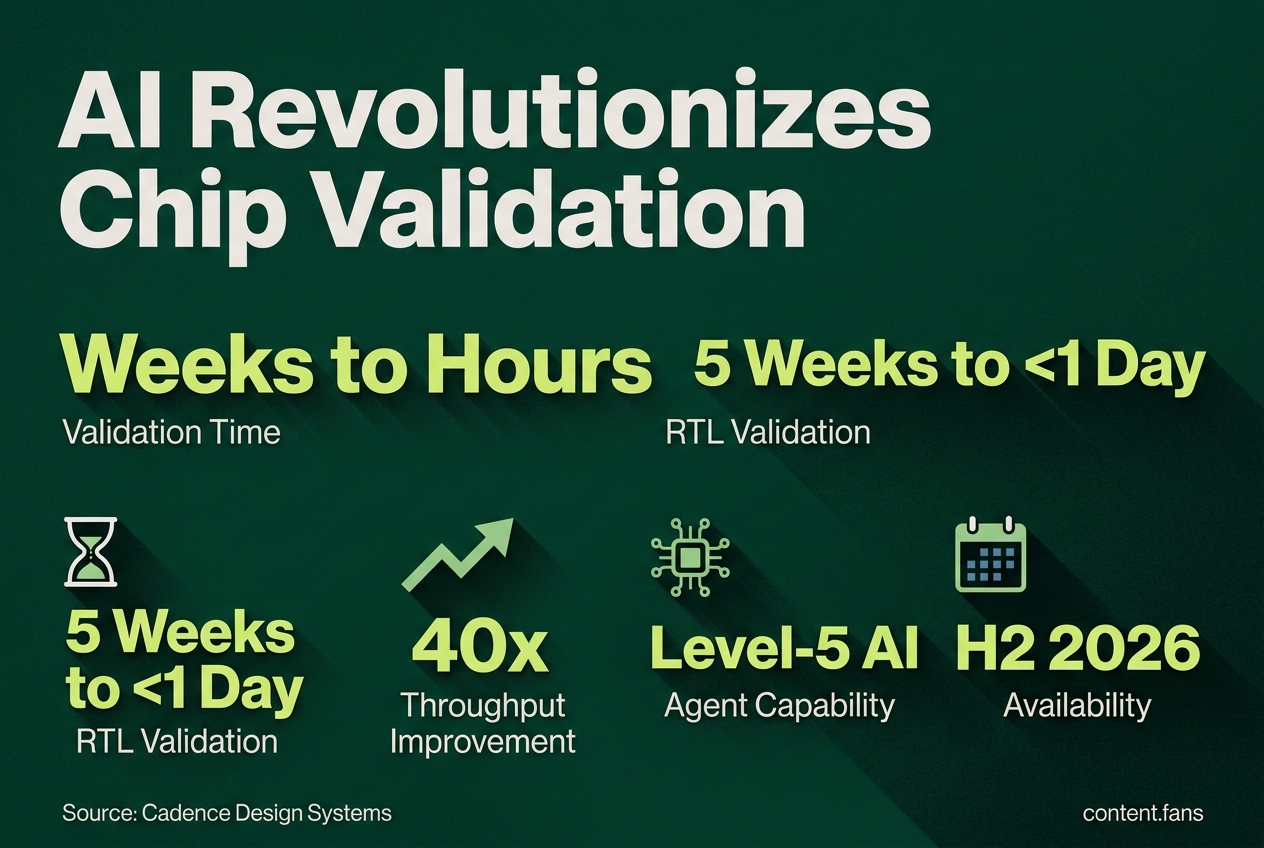
Core Capabilities of the AI Virtual Engineer
This AI agent operates autonomously across the verification workflow. Its tasks include planning tests, generating testbenches, and launching simulations with tools like Xcelium Logic Simulation and Jasper Formal Verification. The system independently monitors for failures, analyzes root causes, and iterates on solutions without human intervention until all coverage goals are satisfied.
The Cadence AI virtual engineer is a fully autonomous system designed for electronic design automation (EDA). Powered by NVIDIA AI technology, it automates the entire chip verification process, from planning and simulation to debugging, significantly reducing the time required for register-transfer-level (RTL) validation.
Industry Impact and Market Outlook
The introduction of a 40x improvement in validation throughput promises a significant shift in the semiconductor industry. Analysts predict engineering roles will evolve from hands-on execution to supervising autonomous workflows. This leap in efficiency could allow for more frequent iterations on AI accelerator designs and mitigate schedule risks for projects using advanced nodes. In response, competing EDA vendors are likely to fast-track their own agentic AI developments. The technology will be available to early-access customers in the second half of 2026, giving chip designers a first look.
Challenges and Adoption Hurdles
Despite the promising claims, industry experts urge caution, noting that true productivity gains must be validated in real-world production environments. Several key questions remain: How will the AI agent handle complex corner cases? Can it integrate seamlessly with existing sign-off criteria? And what are the computational costs of achieving this level of autonomy? Feedback from the early-access program will be crucial in shaping the future roadmap for Cadence's RTL, digital, and analog design agents.
What exactly is Cadence's new autonomous virtual engineer?
Cadence calls it the industry's first fully autonomous virtual engineer, a Level-5 autonomous agent powered by NVIDIA Nemotron models and secured by NVIDIA OpenShell. The system is designed as a "super-agent" that can open EDA tools, run dynamic simulations such as Xcelium Logic Simulation, execute Jasper Formal Verification, and iterate on its own without human interaction. In early tests it has replaced traditional manual verification loops that ran five weeks with fully automated cycles that finish in less than a day.
How much faster can RTL validation become?
According to Cadence's Computex 2026 disclosure, the agentic workflow delivers over 40× faster RTL validation cycles. A typical front-end verification loop that once consumed about five weeks is compressed to under 24 hours on leading-edge designs. The improvement comes from GPU-accelerated compute on NVIDIA Blackwell/GB300-class hardware plus agentic orchestration that can keep simulations running overnight while engineers sleep.
When will customers be able to use it?
Cadence expects Level-5 autonomous capabilities to reach early-access customers in the second half of 2026. The company's broader roadmap shows three companion agents rolling out in parallel:
ChipStack for RTL and verification
InnoStack for back-end digital implementation
ViraStack* for analog design and migration
These agents are being co-optimized with NVIDIA's upcoming Vera Rubin platform and will ship as part of the existing Cadence AI-driven EDA portfolio.
What is NVIDIA's role beyond supplying GPUs?
NVIDIA is presented as both technology partner and early adopter, though specific usage figures are not verified. Beyond hardware, NVIDIA provides the Nemotron foundation models for reasoning, the OpenShell runtime for security, and the CUDA-X plus Omniverse stack for simulation and digital-twin workflows.
How does this compare with competitors?
Siemens announced Fuse EDA AI Agent in March 2026 as a domain-scoped autonomous AI agent for end-to-end EDA workflows across design, verification, and manufacturing sign-off. Synopsys is embedding generative and agentic AI deeper across its platform. The provided sources do not verify the Cadence 'Level-5 autonomy' or 'weeks to hours' claim. Industry observers suggest the competitive landscape is evolving rapidly as vendors develop end-to-end workflow orchestration capabilities.