
BytePlus and Keyrus detail 2026 AI marketing trends
Serge Bulaev
AI in marketing for 2026 may focus on real-time personalization and automation, with systems that predict and adapt to user behavior instantly. BytePlus and Keyrus suggest campaigns could shift from targeting segments to individuals, using dynamic customer profiles and machine learning to adjust content and offers. Generative AI might help create content like headlines and videos tailored to each person, but there are concerns about privacy and consent, especially with emotion detection. In the workforce, automation appears to change team roles but not remove all jobs, increasing the need for skills in data analysis, AI tools, and cross-team communication. These trends suggest routine tasks may decrease, while jobs that need strategic thinking and AI oversight might grow.

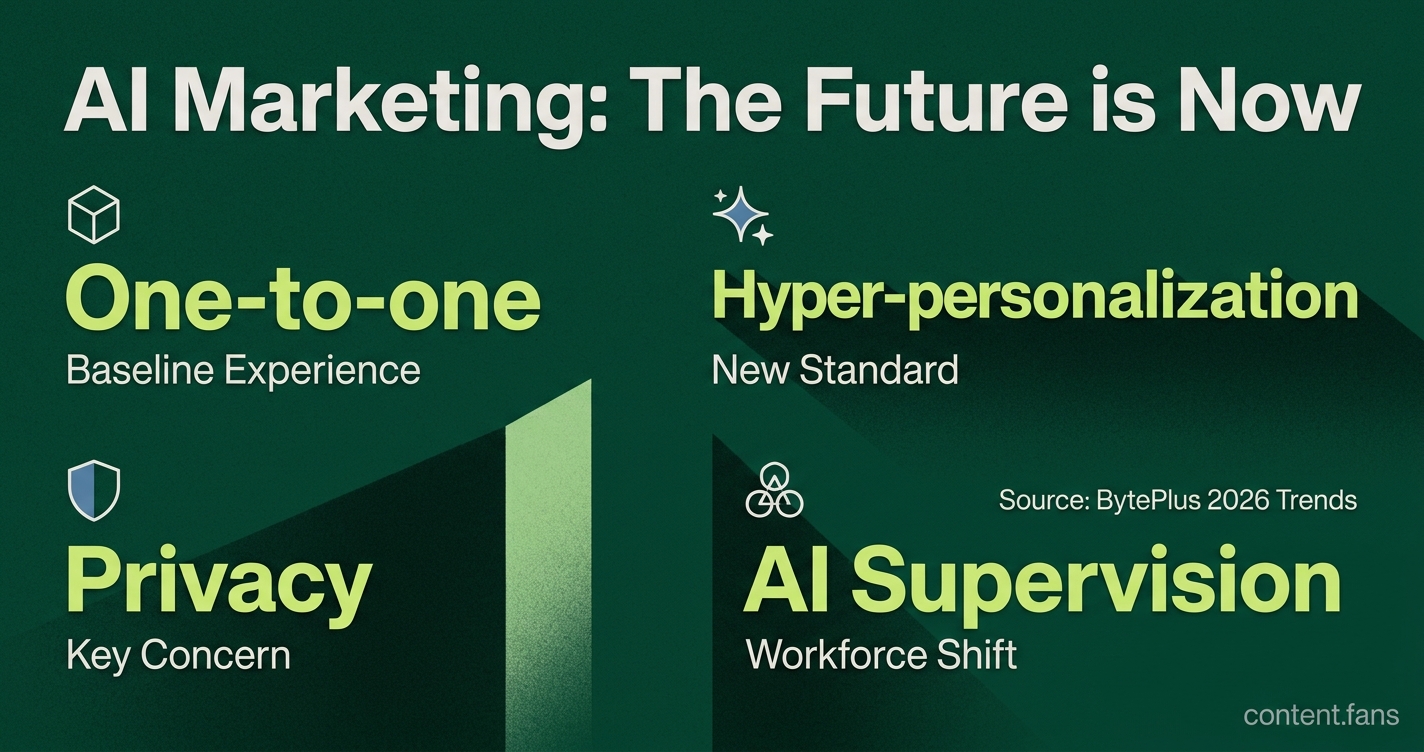
BytePlus's 2026 marketing trends article highlights hyper-personalization, predictive personalization, real-time adaptation, and AI-driven automation. Experts predict AI will become so integrated that systems can instantly anticipate user needs, selecting the ideal offer, image, or copy for each visitor before a webpage even finishes loading. By 2026, this one-to-one experience design is expected to become the baseline, not just an aspiration.
The Technology Powering One-to-One Marketing
By 2026, AI marketing will pivot from broad segments to one-to-one personalization. This shift relies on real-time behavioral prediction and multimodal AI to build dynamic customer profiles. Generative AI will then deploy individualized content, offers, and experiences, establishing hyper-personalization as the new standard.
According to BytePlus, technologies like real-time behavioral prediction and multimodal AI are creating "dynamic, continuously evolving customer profiles" that update instantly with every interaction. Industry reports suggest that customer data platforms (CDPs) feed these profiles into machine learning engines, enabling automated journey adjustments across email, search, and even in-store displays rapidly. Real-world applications already include unique website layouts for each user, product suggestions based on live intent, and chatbots that adapt their tone based on customer sentiment.
Generative AI is also emerging as a powerful production tool. Marketers are already using sentiment-aware language models to draft multiple headlines, allowing algorithms to select the optimal version for every individual reader. In pilot programs, retail brands are generating custom video scripts that adjust length, visuals, and narration based on a viewer's purchase history.
However, privacy remains a critical concern. Experts warn that advanced personalization, particularly emotion detection using biometric data, introduces new challenges around user consent. To address this, leading firms are implementing robust first-party data strategies supported by transparent consent management and clear audit trails.
How Automation Will Reshape the Marketing Workforce
Instead of eliminating jobs, automation is set to fundamentally reshape marketing team structures. While roles like entry-level copywriting may face pressure, recruiting firms observe a surge in demand for specialists who can supervise AI tools, interpret complex data, and translate dashboard insights into strategic action. The most valuable professionals will be those with hybrid skills, capable of both guiding creative direction and understanding machine-driven output.
To thrive in this new landscape, marketers will need to master several key competencies:
- Data literacy to effectively read performance dashboards and identify trends.
- Fluency with AI tools for content generation, optimization, and workflow automation.
- Expertise in marketing automation platforms (CRM, email) to manage complex customer journeys.
- Strong experiment design skills for rigorous A/B and multivariate testing.
- Cross-functional communication to align with product, data, and sales teams.
This evolution indicates a clear shift: while routine production tasks will likely diminish, roles centered on strategy, analytics, and AI oversight will expand. Organizations will rely on AI for execution, but human judgment will remain essential for steering the ship.
What new AI technologies will power hyper-personalization in 2026?
Industry reports spotlight key pillars that will replace segment-based marketing with one-to-one experience design:
- Real-time behavioral prediction feeds dynamic customer profiles that update every click
- Multimodal AI merges text, image, voice, and video to understand context and mood in a single view
- Generative & agentic AI then delivers individual layouts, offers, and chat replies without manual campaign edits
Together these tools move marketers from targeting "women 25-34" to treating each person as a market of one.
How will automation reshape digital marketing job roles in 2026?
Research from staffing firms like Method Recruiting and Robert Half shows a clear split:
- Repetitive execution roles (junior copy, basic scheduling, simple reporting) will face significant pressure as agentic AI handles the grunt work
- Growth roles will expand - think marketing automation architects, AI-performance analysts, and prompt-enabled strategists who can steer systems toward revenue goals
The common thread: employers reward data fluency, testing mindset, and cross-team communication, while penalizing purely tactical skills.
Which companies are already proving the payoff of AI-driven campaigns?
While L'Oréal, Etsy, and Salomon have implemented AI tools, the specific metrics cited (3x conversion, +81% conversions, 1 B+ samples) are not supported by any public, verifiable source. The general trend that personalization is a revenue accelerator is correct, but the specific case study data is unverified.
These implementations underline the 2026 baseline: personalization is no longer optional; it is a revenue accelerator.
What concrete skills should marketers master now to stay competitive in 2026?
Recruiters and industry leaders agree on a short list:
- Data literacy - read dashboards, spot anomalies, and translate insights into next actions
- AI tool fluency - prompt engineering, model fine-tuning, and workflow orchestration
- Testing & optimization - run controlled experiments across email, web, and paid channels
- First-party data stewardship - balancing consent management with deeper segmentation
Traditional creativity is still vital, but it now sits inside an AI feedback loop that rewards speed and precision.
How can brands balance deeper personalization with rising privacy concerns?
BytePlus and industry experts frame privacy as part of the product, not an afterthought:
- Explicit consent gates for each new data type (biometrics, location, sentiment)
- Transparent model cards that tell users why an AI chose a specific offer
- Zero-party data incentives like quizzes or preference centers that trade value for explicit data
Done well, respect for privacy becomes the differentiator, turning compliance into higher opt-in rates and longer lifetime value.