
ByteByteGo unveils AI playbook for engineering transformation at scale
Serge Bulaev
ByteByteGo released a guide that may help big engineering teams use AI more effectively across their companies. The playbook suggests starting with small teams, led by a dedicated leader, who use AI in their daily work and then spread successful practices to the rest of the company. It warns about common mistakes, like treating AI as just another tool or focusing on the wrong metrics. Progress should be measured by real results, not just activity. The guide does not promise that every company will succeed, but it suggests that strong leaders and clear goals might help drive lasting change.

Engineering organizations are increasingly exploring systematic approaches to integrate artificial intelligence beyond isolated tools. Industry experts and practitioners have developed frameworks for moving organizations toward comprehensive AI adoption through new structures, leadership habits, and outcome-focused metrics.
From Pilot Teams to Structural Evolution
Many organizations are adopting phased approaches, starting with small teams to prove AI's value in daily work. Successes are then scaled organization-wide through systematic redesign, evolving the entire operational model from the ground up.
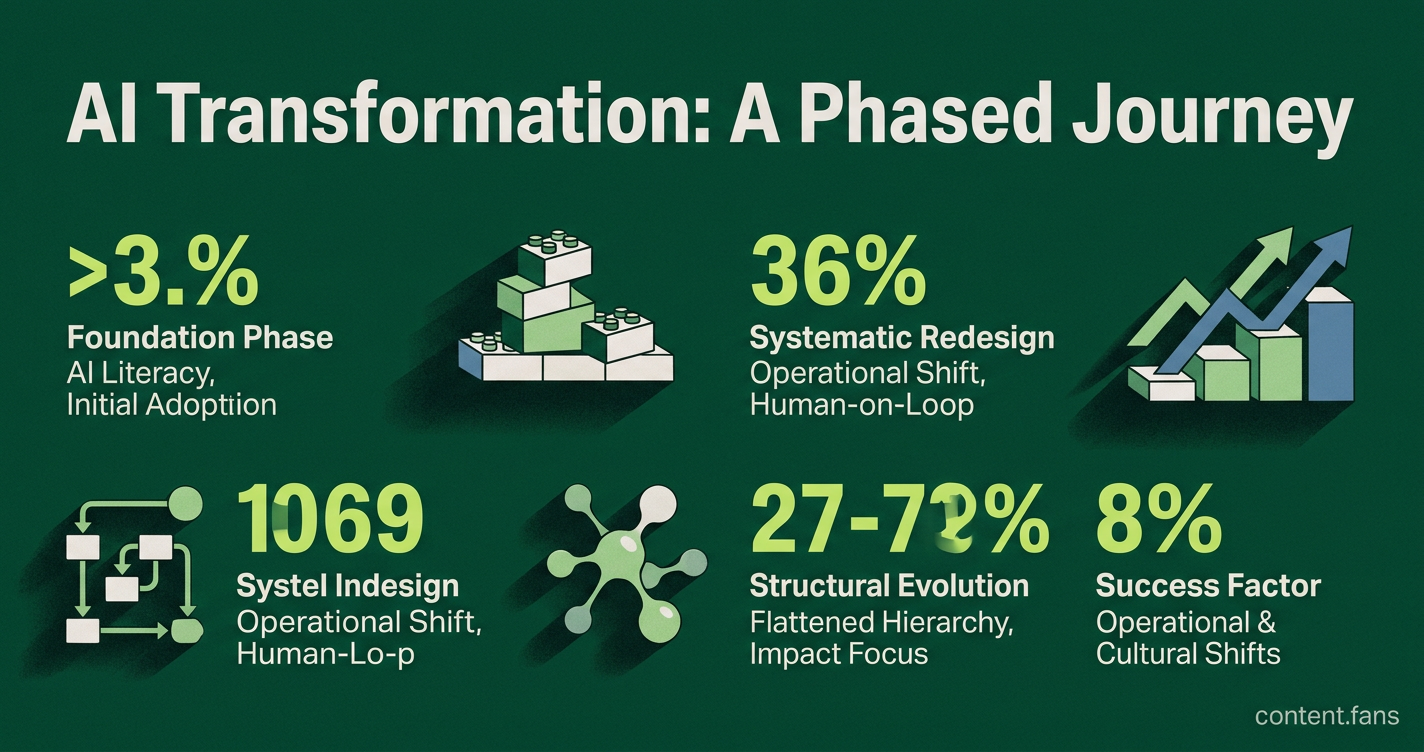
Successful AI transformation typically follows a multi-phase journey. It begins with a Foundation phase, where organizations establish AI literacy and initial adoption patterns. Once pilot teams demonstrate repeatable gains, organizations enter Systematic Redesign, shifting operational models and implementing "human-on-the-loop" reviews. The final Structural Evolution phase flattens hierarchies and prioritizes rewarding measurable impact over traditional metrics. Industry research emphasizes that a significant portion of long-term success depends on operational and cultural shifts, not just technology implementation.
8 Common Anti-Patterns That Stall AI Adoption
Organizations frequently encounter critical pitfalls that can derail AI transformation efforts:
- Using AI as a bolt-on: Simply adding AI to existing workflows without fundamental redesign.
- Creating review bottlenecks: Centralizing reviews, which slows down autonomous team progress.
- Prompt cargo-culting: Copying and pasting prompts without understanding the underlying process.
- Lacking outcome ownership: Relying on dashboards without assigning responsibility for results.
- Ignoring Shadow IT: Allowing unmanaged AI scripts to create security vulnerabilities.
- Focusing on vanity metrics: Measuring code volume or activity instead of business value.
- Misaligned incentives: Rewarding team growth (headcount) over measurable impact.
- Delegating without participating: Leadership remains hands-off from AI experimentation.
How to Measure True Transformation
To track meaningful progress, organizations should move beyond vanity metrics. Instead, focus on key performance indicators like "AI-First Monthly Active Users," the percentage of code diffs assisted by AI, and the adoption rate of high-autonomy internal tools. Crucially, all technical indicators must be directly linked to verified business impact. This approach is consistent with industry-wide findings, such as a World Economic Forum report that correlates success with workflow redesign and leadership development.
Real-World Implementation Examples
Large-scale technology organizations provide valuable context for AI transformation theories. Companies like Meta have demonstrated how autonomous systems can significantly improve engineering outcomes through proper governance and sandboxing. These implementations show autonomous agent patterns as replicable frameworks for teams with appropriate oversight. Ultimately, successful AI adoption represents a fundamental shift in operating models, dependent on strong leadership, clear metrics, and disciplined experimentation that drives structural change.
What Is an AI-Native Organization?
An AI-native organization rewrites its operating model around autonomous AI systems, rather than simply adding chatbots to existing workflows. Research indicates that transformation failures often stem from operational and cultural change issues, not inadequate models. Organizations implementing small teams with dedicated AI champions report significant individual productivity gains after flattening hierarchies, moving from human-in-the-loop to human-on-the-loop, and tying incentives to AI adoption metrics instead of traditional story points.
How Do Organizations Scale from Individuals to Teams?
Successful transformations typically begin with a foundation phase where leaders personally adopt AI tools and establish dedicated change management roles. Subsequent phases introduce Systematic Redesign and Structural Evolution, implementing new ownership models, company-wide business-impact linkage metrics, and addressing common anti-patterns. This progression enables scaling from individual engineer success to organization-wide transformation.
What Are the Key Metrics for AI Transformation?
Effective AI transformation tracking focuses on four key areas:
1. AI-First MAU - monthly active employees whose default workflow starts with an agent.
2. Agent-assisted diffs - percentage of pull requests that contain AI-generated or AI-reviewed code.
3. High-autonomy tool adoption - share of teams using advanced autonomy levels.
4. Business-impact linkage - dollars or user value directly attributed to AI-driven releases, not to headcount.
Organizations should monitor these KPIs to avoid slipping into tool bolt-on mode and identify when additional structural redesign cycles are needed.
What Are the Most Common Anti-Patterns to Avoid?
Based on an 8-step change implementation process, organizations commonly encounter these pitfalls:
1. Tool bolt-on - AI layered onto unchanged processes.
2. Review bottleneck - human sign-off required for every agent action.
3. Prompt cargo-culting - copy-pasting prompts without understanding context.
4. Single-thread ownership - one hero engineer holds all AI knowledge.
5. Metric myopia - tracking model accuracy instead of business value.
6. Security afterthought - no sandboxing or audit logs.
7. Immutable SOPs - standard operating procedures never updated for AI.
8. Culture of blame - failures punished, stifling experimentation.
To avoid these traps, organizations should implement small pilot teams, human-on-the-loop guardrails, and governance that can map, measure, and monitor every production system.
Where Can Teams See Autonomous Agents in Action?
For engineers seeking to build self-improving AI systems, practical step-by-step workflows demonstrate systematic redesign principles. These examples show how small autonomous scripts evolve into agent loops that refactor their own code, providing practical examples of the structural change that distinguishes successful AI adoption from simple tool integration.