
Bynder: 52% of consumers reduce engagement with AI-written content by 2026
Serge Bulaev
A 2026 Bynder study suggests that 52 percent of people may engage less with content if they think it was written by AI. Reports indicate that as AI-generated writing becomes more common, readers appear to trust it less and often move on quickly, especially on social media. Some evidence points to AI content leading to less sharing and weaker emotional connection. Detection tools for AI writing are improving but might still miss mixed or edited texts. Experts recommend that human writers focus on unique voice and real experiences to stand out and keep readers interested.

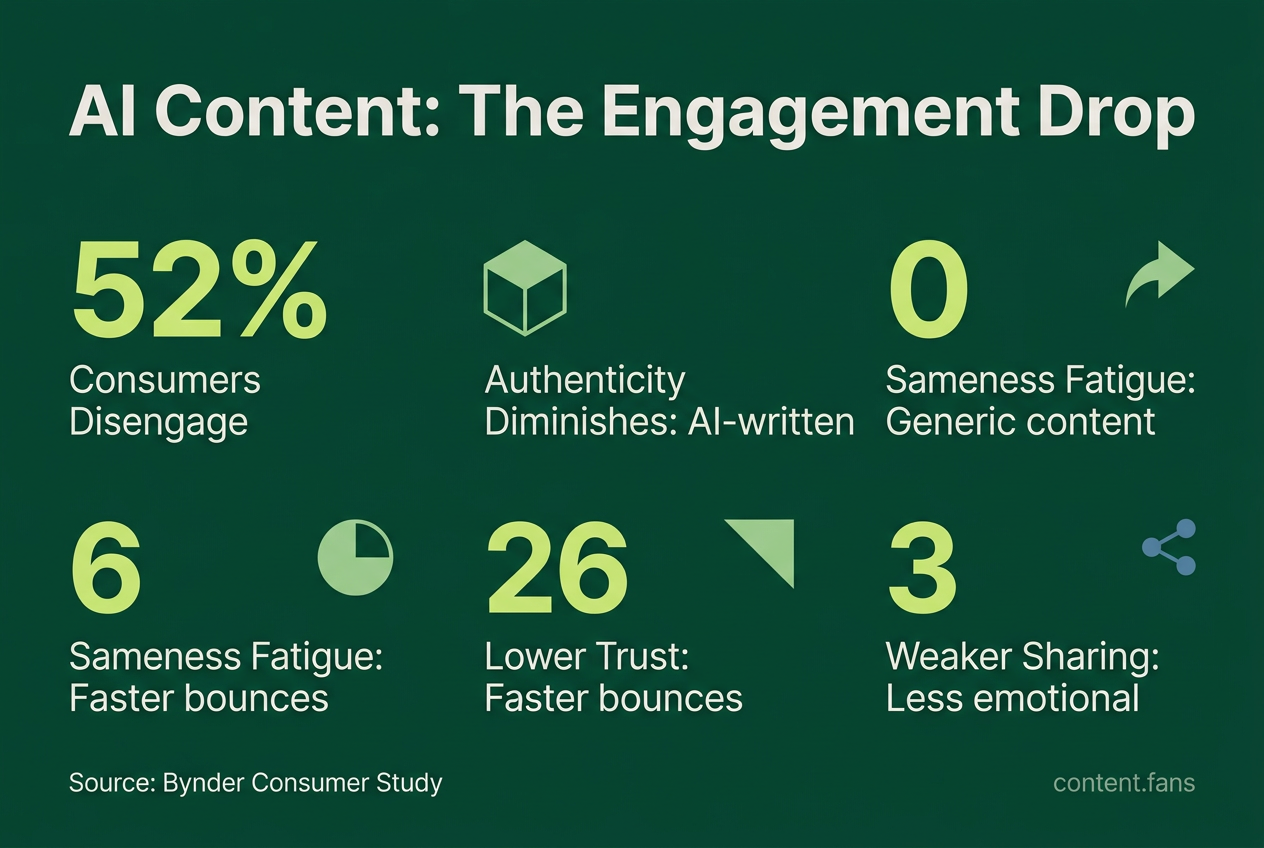
New research shows consumers reduce engagement with AI-written content, with a 2026 Bynder consumer study finding 52% of people would disengage if they suspected a text was machine-authored. This trend, driven by the rise of high-quality AI, has led to a content surplus where readers quickly lose interest in writing that feels interchangeable, especially on crowded social media channels.
This effect is particularly pronounced on social media. A study in Scientific Reports found that while AI increases post volume, it diminishes perceived authenticity and harms conversation quality (Scientific Reports experiment). Industry reports suggest reader attention is collapsing, with shorter engaged time on articles and declining organic click-through rates when AI Overviews appear in search results.
Evidence of Attention Dilution
Readers are experiencing 'sameness fatigue' from AI content that feels fluent but generic. This leads to lower trust, faster bounce rates, and weaker social sharing. Even well-written automated text often lacks the personal cues and emotional resonance that hold human attention, turning deep readers into headline skimmers.
Analysts describe a feedback loop where increased AI output leads to more homogeneity, eroding trust and causing faster bounces. This homogenous language is also linked to weaker social sharing, suggesting a drop in emotional resonance when personal cues are absent. While AI detection technology is improving, its reliability remains a concern. Commercial detectors show varying performance in independent tests, and their effectiveness drops significantly on heavily edited or mixed human-AI text.
How Writers Can Respond
To stand out, experts advise human authors to compete on unique voice, deep insight, and transparency, rather than trying to match the scale of AI output. Key strategies include:
- Insert proprietary data or lived examples that large models cannot replicate.
- Keep sentences tight, add sign-posted subheads, and design for fast scanning without sacrificing nuance.
- Display author credentials and sourcing to rebuild trust.
This approach is often called the "human-in-the-loop" model, where AI assists with research and drafting, but a human provides the narrative, voice, and final judgment. By focusing on a distinctive tone and real stories, writers signal authenticity to both readers and algorithms. The path forward is not chasing infinite AI output, but creating sharper, expertise-driven content that only a human can.
How big is the drop in consumer engagement when text is suspected to be AI-written?
A 2026 study commissioned by Bynder asked more than 1,000 U.S. consumers how they would react if they believed an article had been written by AI. 52% said they would reduce their engagement - fewer page views, shorter reading time, and less social sharing. The same survey showed the effect is strongest for long-form opinion pieces and brand voice content, where perceived authenticity is critical.
Read the full Bynder report
Why does high-quality AI text still trigger reader disengagement?
Industry analysts point to sameness fatigue: even when the grammar is flawless, readers begin to recognise formulaic sentence patterns, stylised sub-headings, and repetitive examples. A peer-reviewed Scientific Reports experiment found that perceived authenticity scores fell significantly when identical information was presented in an AI-voice versus a human-voice style. The result is not lower traffic, but far shallower interaction: average engaged time on AI-heavy pages has dropped substantially according to industry reports.
What practical tactics help human writers stand out in 2026?
Surveys of top-performing blogs show four repeatable moves:
1. Insert proprietary data - original survey results, first-party case studies, or exclusive quotes.
2. Open with a human story - anecdotes, customer quotes, or personal experience significantly outperform generic definitions in average scroll depth.
3. Signal authorship clearly - named bios, head-shots, and links to social profiles raise trust scores according to industry research.
4. Keep an audible voice - writers who vary sentence length and include natural pauses retain readers substantially longer according to scroll-tracking tools.
These tactics align with the "human-in-the-loop" model described in several 2026 playbooks: use AI for research and structure, but reserve final edits, voice, and judgment for the human creator.
How accurate are AI-content detectors like Pangram that the article references?
Vendor materials claim 99.98% accuracy and a 1-in-10,000 false-positive rate on clean AI text, but independent reviews suggest real-world performance varies significantly when text is lightly edited or humanised. Still, Pangram is among the strongest commercial detectors currently adopted by universities and media houses. The safest practice is to treat any detector as directional evidence, not courtroom proof.
Should writers and brands disclose when they use AI assistance?
Transparency boosts trust. Bynder's survey found that readers who see a clear "co-created with AI" label are more forgiving of suspected AI tone than when no disclosure is given. Editorial teams are moving toward "editorial provenance notes" that spell out what was AI-drafted, human-verified, or fully written by a named author - a small footnote that protects credibility without distracting casual readers.