
Brier's AI Framework Integrates Humans, Agents for Better Alignment
Serge Bulaev
Noah Brier's essay suggests that the main challenge in building with AI tools is team coordination, not just code generation. He proposes a framework with five layers - standards, architecture, specs, plans, and code - to help align humans and AI agents toward the same goals. Brier warns that without clear artifacts and strong standards, AI-generated code may increase technical debt and cause quality issues. Early reports suggest that using AI can speed up routine tasks, but may also introduce security and maintainability risks. Brier's approach aims to keep both humans and AI agents working together smoothly by making rules and processes clear to everyone involved.

Noah Brier's AI framework for human-agent alignment addresses a critical challenge in modern software development: team coordination, not just code generation. In his influential essay, Brier argues that without a new cultural approach, the speed of AI tools will create chaos, not value. He rejects the "software factory" metaphor, proposing instead a layered cultural stack to keep human and AI agent efforts aligned with a unified product vision The Culture of AI Engineering - Every.
His model maps standards, architecture, specs, plans, and code to different paces of change, echoing Stewart Brand's systems thinking while offering a concrete strategy for managing AI-driven engineering. Teams, in his view, need explicit artifacts to prevent misalignment as autonomous tools accelerate output. He recommends an ARCHITECTURE.md file in each repository to capture key decisions - like data flow and error handling - so any contributor, human or agent, can quickly absorb the system's mental models. Specs then define acceptance criteria and "out-of-scope" clauses, mitigating the risk of an agent inventing unintended features.
The Culture of AI Engineering - Noah Brier's Framework for Human-Agent Alignment
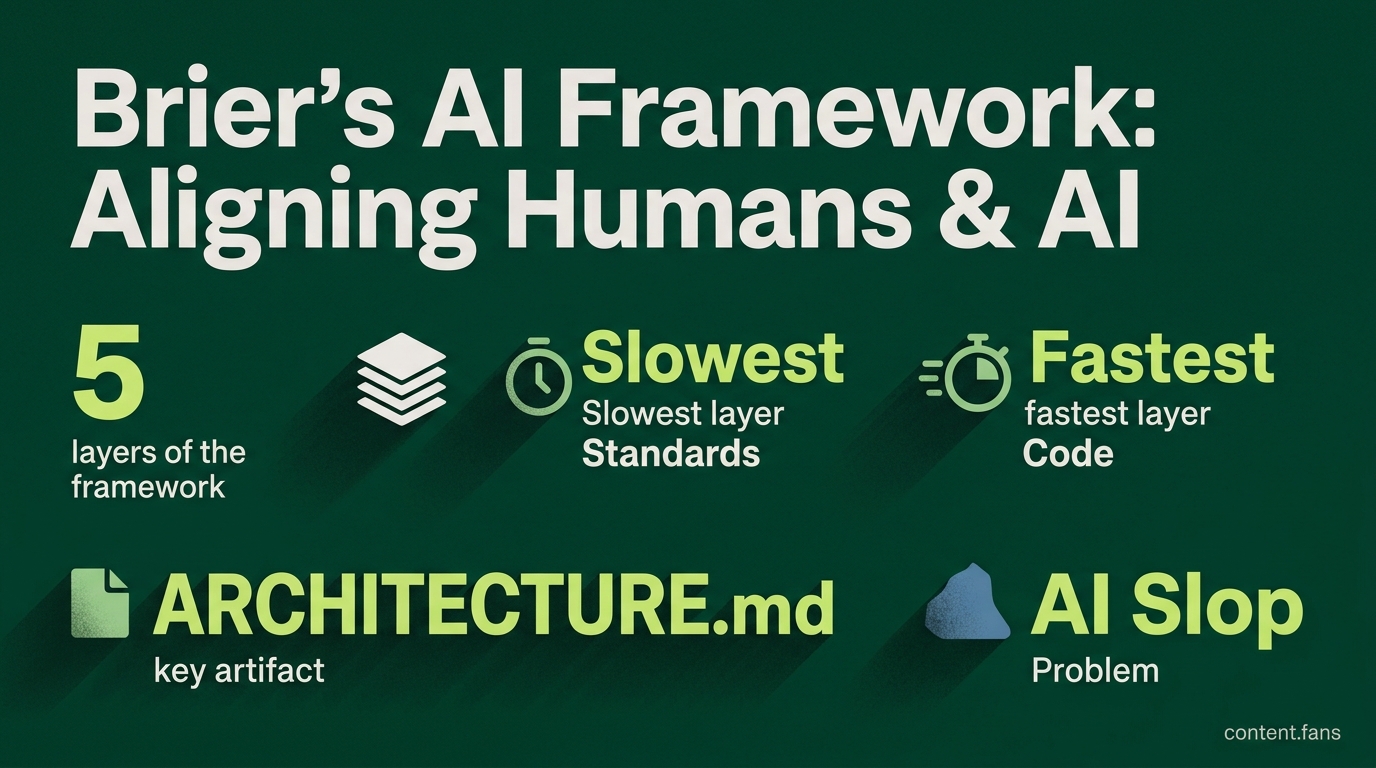
Brier's framework organizes engineering culture into five layers, from slowest to fastest: standards, architecture, specs, plans, and code. This structure, inspired by pace layering, ensures that slow-changing principles like security standards govern fast-moving, AI-generated code, preventing misalignment and maintaining quality as development accelerates.
Brier's framework is organized into this five-layer cultural stack:
- Standards: Naming, testing, and security rules that change slowly.
- Architecture: High-level structure, maintained in a single markdown file.
- Specs: Detailed feature documents with success metrics and exclusions.
- Plans: Short-lived tasks and tickets.
- Code: The fastest layer, where agents often operate.
Drawing inspiration from Stewart Brand's pace layers, this model dictates that slower, foundational layers should constrain the faster ones, while innovations from faster layers can inform the stack's evolution. This managed friction is crucial, as unmanaged boundaries can lead to destructive outcomes when AI agents operate without proper constraints.
Alignment problems seen in the wild
The need for such a framework is evident in real-world scenarios, where the rise of "AI slop" is a growing concern for open-source maintainers. Industry reports suggest that AI-generated pull requests can increase code complexity and reduce maintainability in many cases. Similarly, project leads on GitHub report being strained by a high volume of low-context AI contributions, with many users not disclosing AI assistance. These issues confirm Brier's central warning: without guardrails, AI-driven speed can rapidly accelerate technical debt.
Practices that encode culture into tooling
Brier's framework translates cultural norms into specific, enforceable practices. These align with industry best practices like context engineering, which also advocate for gradual, standardized updates to prevent system fragmentation. By insisting that teams update context files incrementally, they avoid destructive outcomes.
- Lint and static-analysis rules tied to the standards layer.
- Test harnesses that fail when agents breach architectural boundaries.
- Onboarding modules that quiz both junior developers and agent prompts on repository norms.
- Continuous evaluation datasets that measure feature drift against the original spec.
What early adopters report
Early adopters, including Brier's own consultancy Alephic, report significant efficiency gains. By using AI as a 'second brain,' practitioners have reduced time on routine tasks substantially. However, these gains are paired with persistent quality risks. Industry analyses suggest that a significant portion of AI-generated code snippets contain security vulnerabilities, highlighting the urgent need for automated governance across every layer of the engineering stack.
Ultimately, Brier's cultural framework does not reject AI agents but integrates them into the established social systems of human collaboration. By explicitly defining and encoding standards, architecture, and specifications, teams can effectively harness the velocity of AI agents while mitigating the risk of chaos and technical debt.
Why does Brier reject the "software factory" metaphor for AI engineering?
He argues that code is culture, not assembly-line output. Treating agents as mindless machines ignores the real problem: keeping carbon and silicon teams aligned on the same product vision. Brier reframes the challenge as designing rituals, documents and tooling so humans and agents iterate together instead of pulling the codebase in separate directions.
What is the "pace layers" cultural stack Brier proposes?
A five-level hierarchy that moves from slow-changing to fast-changing artifacts:
1. Standards (lint rules, security policies)
2. Architecture (mental models captured in an ARCHITECTURE.md file)
3. Specs (user stories with acceptance criteria and explicit out-of-scope statements)
4. Plans (task break-downs)
5. Code (the fastest layer)
Each layer moderates the layer above while being nudged by the one below, preventing destructive shearing when agents ship at high speed.
How do you onboard an AI agent like a human teammate?
Brier gives agents the same starter kit: an onboarding module that contains the ARCHITECTURE.md, style guide, test conventions and links to canonical examples. He also encodes "skills" - reusable prompts stored in version control - so every agent clones the repo with context instead of guessing patterns from stale code.
What concrete artifacts keep agents from drifting off vision?
- ARCHITECTURE.md - a living doc that explains why the system is shaped the way it is
- Specs with "out-of-scope" bullets - agents know what not to build
- Linting rules and static checks - cultural norms turned into executable gates
- Acceptance-test stubs - failing tests that spell "done"
These artifacts translate slow cultural intent into fast mechanical feedback, catching misalignment before it compounds.
Where has the framework already been tested?
Brier piloted it inside his AI consultancy Alephic and in open-source experiments. Early reports show significant reductions in review rounds when agent pull-requests arrive pre-aligned to ARCHITECTURE.md and encoded skills. He also keeps a public Claude Code "second brain" repo that demonstrates the stack in action, inviting the community to fork and stress-test the boundaries.