
Brands Face "Trust Penalty" for Undisclosed AI Content, Study Finds
Serge Bulaev
A recent study suggests that brands may face a trust penalty if they do not clearly disclose when AI is used to create content. Research finds that people trust AI-generated ads less than human-made ones, and labeling content as AI-made can lower purchase intent. Simple disclosures and visible proof of AI involvement might help ease some concerns, but brands should also use human review and follow clear rules. Full transparency appears to be important, as many consumers worry about misinformation in AI content.
Brands face a significant 'trust penalty' for using undisclosed AI content, a consequence that erodes consumer confidence and lowers purchase intent. As recent studies and emerging regulations from the IAB and EU show, transparent disclosure is no longer optional - it's a critical component of any modern content marketing strategy.
Why transparency matters for engagement
The 'trust penalty' refers to the measurable drop in consumer trust, perceived authenticity, and purchase intent that occurs when brands use AI content. This penalty applies whether the AI use is disclosed (triggering skepticism) or undisclosed and later discovered (creating a sense of deception).
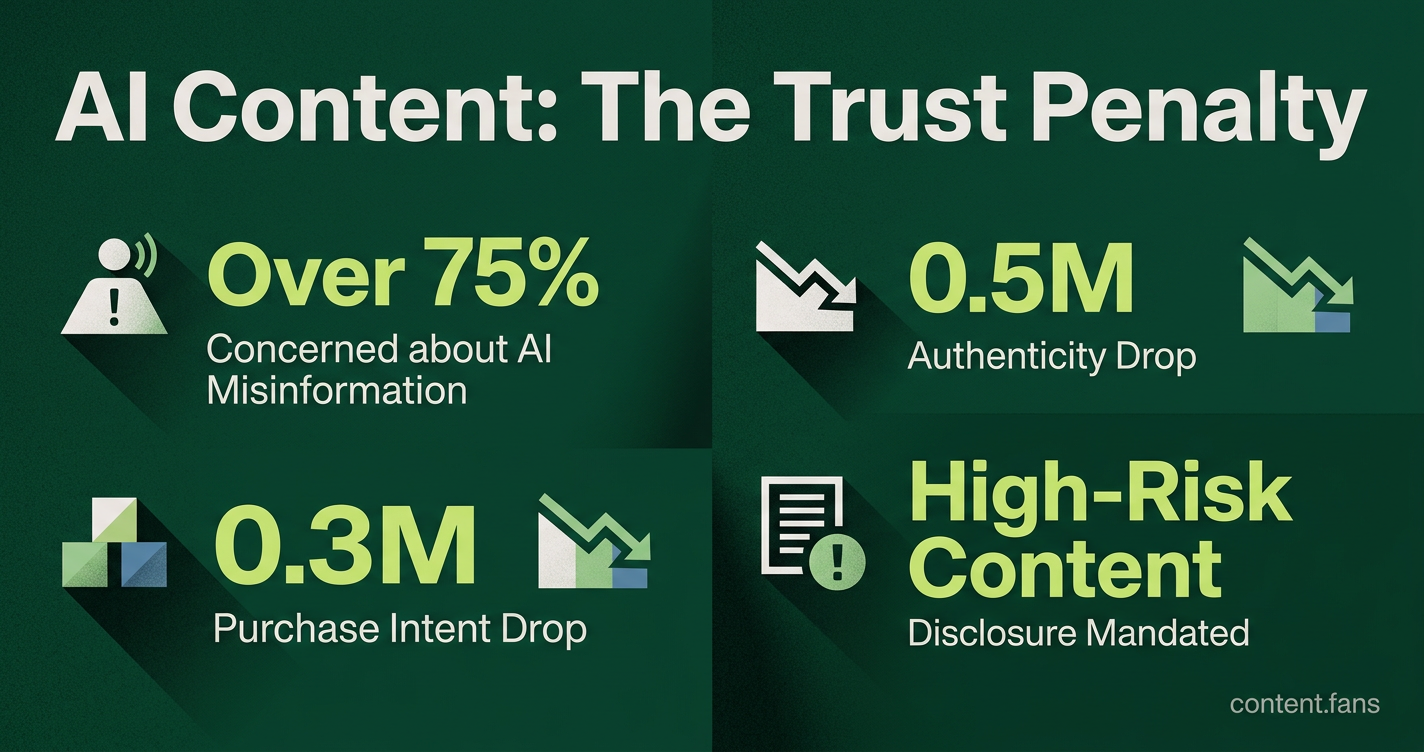
Consumer skepticism is high, with over 75% concerned about AI-driven misinformation according to a Forbes Advisor survey. This concern is reflected in regulations like the EU AI Act and frameworks from the IAB, which mandate disclosure for high-risk content like synthetic media. Studies show audiences use AI labels as a heuristic for credibility, often rating disclosed AI ads as less authentic.
Practical disclosure checklist
To align with FTC and EU expectations, brands should implement a clear disclosure process:
- Place a short, plain-language label such as "AI-generated image" early in the asset.
- Specify the role of AI: "AI-assisted scriptwriting" or "AI-generated voice".
- Embed C2PA or similar metadata so provenance tools can verify the file.
- Keep an internal audit trail that records which tools were used and whether disclosure was applied.
Maintaining quality and consistency
Effective governance extends beyond simple labels. Leading brands adopt a Human-in-the-Loop (HITL) workflow where human strategists guide AI generation, and expert editors verify facts and refine tone. This model includes tiered review systems - rigorous expert checks for high-risk content like health or financial advice, and lighter reviews for low-risk posts. To ensure brand consistency, teams should build a shared prompt library and continuously monitor both quantitative metrics (traffic, conversions) and qualitative feedback on content authenticity.
Balancing automation with authenticity
Ultimately, audiences reward authenticity, which requires visible proof of human involvement. The most effective strategy combines clear AI disclosure with rigorous human oversight and machine-readable provenance (like C2PA metadata). This approach demonstrates respect for the audience, mitigates the trust penalty, and ensures compliance with a complex global regulatory landscape, allowing brands to leverage AI's efficiency without sacrificing credibility.
What is the "trust penalty" brands face for failing to disclose AI-generated content?
Industry research indicates that simply labeling an ad as AI-generated can drop perceived authenticity and purchase intent, even when the creative itself was identical to the human-made version. According to industry reports, disclosing AI use consistently activates "persuasion knowledge" and erodes trust, with perceived authenticity acting as the key mediating factor. In practical terms, a significant portion of online users now trust AI content less than human content. For brands, the takeaway is blunt: undisclosed AI feels deceptive once discovered, and disclosed AI automatically carries a trust handicap.
Which AI-driven assets absolutely require visible disclosure?
Current industry consensus suggests several key triggers that mandate upfront labels:
- AI-generated images or videos created from text prompts
- AI-generated voices of deceased people making new statements
- AI-generated voices of living people saying things they never said
- Photorealistic synthetic humans shown in primary roles
- Digital twins of people shown in events that never happened
- AI chatbots or avatars simulating human interaction
Routine post-production touch-ups (color correction, cropping, etc.) do not require public disclosure, but teams are advised to keep internal logs for brand-safety audits.
Where should the disclosure appear so consumers actually see it?
Best-practice guidance from both the FTC-style playbook and the EU AI Act converges on prominent, early placement:
- Text: include "AI-assisted article" or "AI-generated image" at the top or first scroll, not in footnotes or hashtags.
- Images/Videos: embed on-screen text or watermarks from the first frame; pair with audible disclosures for video or podcast ads.
- Audio: add a short spoken line - "This voice is AI-generated" - within the first five seconds.
Buried or "fine-print" labels quickly lose consumer notice and fail to offset the trust penalty, according to industry reports.
How can marketers maintain quality if they admit the content is AI-made?
Teams that avoid the trust penalty pair disclosure with visible human oversight. Current best practices include:
- Human-in-the-Loop workflow: strategist brief → AI draft → subject-matter expert review → editor polish.
- Tiered quality gates: high-risk assets (medical, financial claims) get full expert review; low-risk social captions get spot checks.
- Prompt libraries: standardized, brand-vetted prompts that keep tone and facts consistent across writers.
- Performance feedback loop: weekly dashboards track not only clicks but qualitative brand-alignment scores, letting teams iterate fast.
These steps shift the narrative from "AI did it" to "real experts guided and verified every AI step", which industry reports note can partially restore trust.
Are consumers completely rejecting AI content, or is there a path forward?
The data is nuanced. While a small percentage of shoppers say visible AI content makes them trust a brand more, industry studies show transparency plus authentic human framing can recover a significant portion of lost purchase intent. Key behaviors:
- The vast majority of consumers want to know whether an image is AI-generated.
- Many reduce engagement when they merely suspect AI involvement, but drop-off decreases significantly when the brand pairs disclosure with a clear "expert verified" badge.
The path forward is radical transparency paired with proven human expertise - audiences are not anti-AI, they are anti-deception.