
BMS Adopts Anthropic Claude AI for Drug Development Workflows
Serge Bulaev
Bristol Myers Squibb is partnering with Anthropic to use Claude AI in drug development workflows, which may give over 30,000 employees advanced AI tools. The agreement aims to speed up research by helping connect and use data across discovery, development, manufacturing, and business teams. Claude may help with things like writing documents, analyzing data, and monitoring quality, but exact productivity gains have not been shared. The deal suggests a move toward using AI for more automated tasks in the company, though some results are still uncertain.
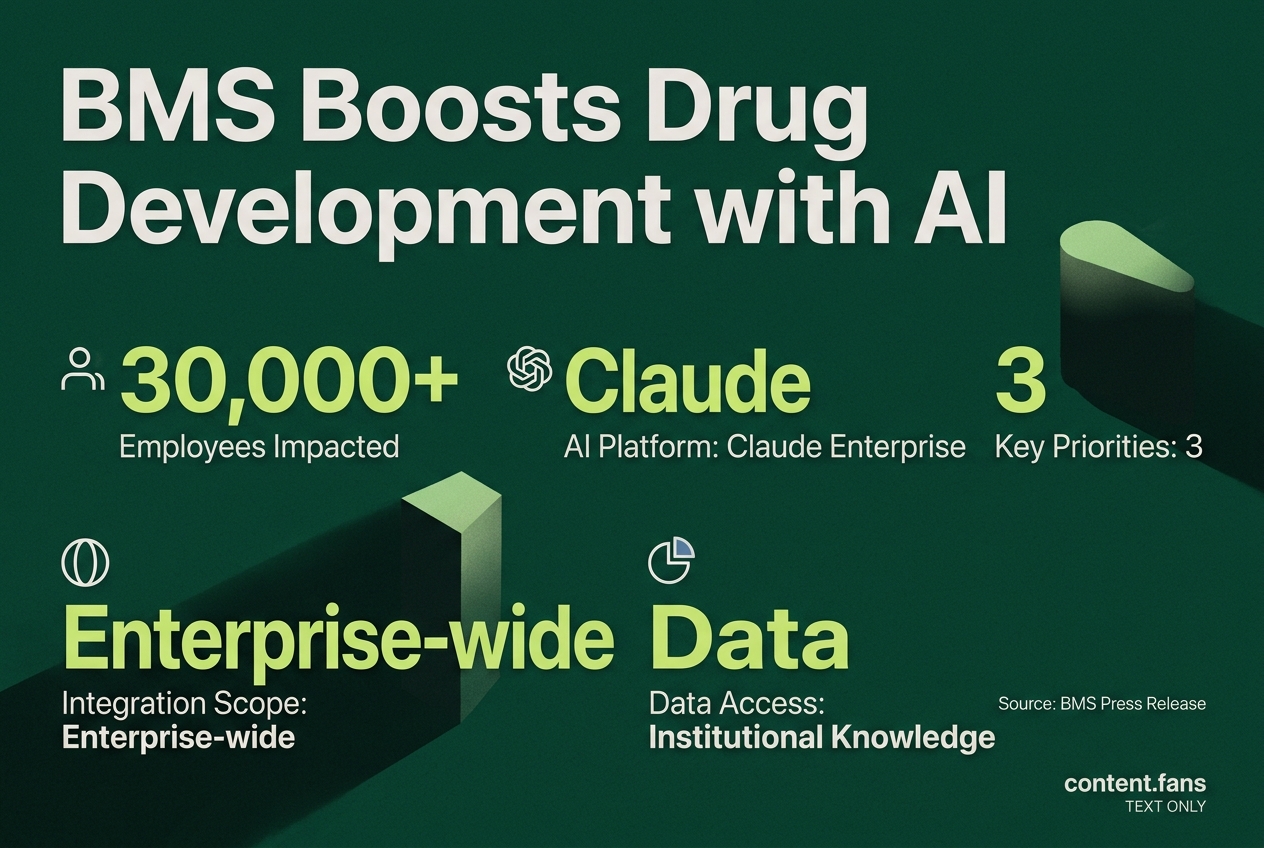
In a major move for AI in pharmaceuticals, Bristol Myers Squibb (BMS) is adopting Anthropic's Claude AI for its drug development workflows. The strategic agreement, announced on May 20, 2026, will deploy Claude Enterprise as a shared intelligence platform to over 30,000 employees, marking one of the largest enterprise AI rollouts in the life sciences sector to date (BMS press release).
The partnership's primary goal is to boost research productivity by integrating generative AI across the entire drug lifecycle, from discovery and development to manufacturing and business operations. According to BMS Chief Digital and Technology Officer Greg Meyers, the key objective is to use Claude as an agentic layer to unlock critical insights from decades of siloed scientific and clinical data (BioPharma Dive).
Claude Deploys Across All Core BMS Functions
The enterprise-wide rollout will integrate Claude into research, clinical development, manufacturing, commercial, and corporate functions. This initiative provides more than 30,000 employees - including scientists, engineers, and business staff - with advanced AI tools for handling regulated documents and complex experimental data, marking a significant AI adoption milestone in the life sciences industry.
Bristol Myers Squibb is integrating Anthropic's Claude AI across its operations to accelerate drug development. The platform will serve over 30,000 employees, helping them analyze scientific data, streamline documentation, and unlock insights from internal knowledge bases to bring new therapies to market faster.
BMS Defines Three Key Priorities for Claude Integration
BMS has outlined three immediate priorities for the Claude platform:
- Accelerate Engineering: BMS says engineering and data science teams will leverage Claude Code to speed software and AI development.
- Enhance R&D with Agentic AI: Claude will function as an agentic research assistant, synthesizing proprietary molecular and clinical data to aid in target identification and optimization across key therapeutic areas like oncology, hematology, neuroscience, and immunology.
- Unlock Institutional Knowledge: The AI will connect to internal data repositories, allowing employees to access scientific, regulatory, and commercial expertise on-demand, all within a governed and auditable framework.
Potential Day-to-Day Impacts on Drug Research
The integration is expected to transform daily research activities by enabling:
- Accelerated Data Synthesis: Faster analysis of scientific literature and internal company reports.
- Automated Document Drafting: Generation of clinical study documents while adhering to strict compliance guardrails.
- Advanced Predictive Analysis: Use of multimodal datasets for more accurate target validation in early research.
- Enhanced Quality Control: Automated monitoring of manufacturing lines to detect quality signals.
- Improved Communications: Streamlined creation of engagement materials for healthcare professionals.
Industry analysts view the agreement as a pivotal shift from small-scale AI pilots to large, automation-focused enterprise deployments. According to industry reports, a significant portion of enterprise AI usage involves full task delegation, suggesting companies are increasingly using AI as an autonomous worker, not just a chatbot. At BMS, this could empower scientists to delegate repetitive data-gathering tasks and concentrate on high-value experimental design and strategic decision-making.
Furthermore, BMS is exploring Claude for critical regulatory support, including drafting patient safety narratives and clinical study reports. Success in this area could dramatically reduce documentation timelines that frequently delay drug programs. Although specific productivity gains have not been announced, the company's stated goal is to streamline the entire R&D pipeline while maintaining stringent governance and audit standards.
What exactly did BMS and Anthropic announce on May 20 2026?
Bristol Myers Squibb revealed a "shared intelligence platform" pact to install Claude Enterprise across research, clinical development, manufacturing, commercial and corporate functions, immediately reaching more than 30 000 employees worldwide. The deal makes Claude a single, company-wide reasoning layer rather than a pilot chatbot.
Which drug-discovery tasks will Claude handle first inside BMS?
The press release lists three near-term priorities:
- Claude Code accelerates internal engineering and data-science teams
- Agentic workflows embed Claude into research to synthesize decades of proprietary molecular, clinical and scientific data for target identification and optimization in oncology, hematology, neuroscience and immunology
- Enterprise knowledge activation connects Claude to scientific, regulatory, clinical and commercial repositories, surfacing insights "where and when they are most needed" under full governance and audit controls
How does this compare with other pharma deployments of Claude?
Confirmed from the primary BMS release: BMS announced Claude Enterprise deployment across global operations for 30,000+ employees. This represents one of the largest enterprise AI rollouts in the life sciences sector to date.
What measurable impact is Claude already showing in pharma?
According to industry reports, many companies are using AI for full task delegation rather than just conversation augmentation, signaling true workflow acceleration. At BMS, this could enable scientists to focus on higher-value experimental design and strategic decision-making while delegating routine data-gathering tasks.
What safeguards come with this scale of AI use?
All BMS Claude workloads run under full enterprise governance and audit controls and connect only to vetted internal data repositories. The goal is to unlock "decades of data trapped in disconnected systems" without exposing proprietary molecules or patient-level information.