
BCG: Agentic AI Forces Enterprise Redesign, Not Just New Models
Serge Bulaev
BCG's research suggests that just adding smart AI models does not usually change how a company works. Instead, companies may need to rethink how people and AI share tasks, set rules, and handle decision-making. Early reports show that agentic AI, which can plan and learn, may require changes to job roles, team structures, and investment strategies. Evidence from firms like Lenovo appears to show the real challenge is changing management and governance, not just adding new technology. The value from agentic AI might only appear if organizations redesign workflows and learn to manage these new AI agents as active team members.

According to BCG, the rise of agentic AI forces enterprise redesign because these systems require more than a simple tech upgrade. On a recent podcast, BCG's Erik Lenhard warned that smart models alone rarely change a company. The real transformation involves rethinking org charts, governance, and the daily handoffs between people and software. Lenhard states that enterprises are now in an "agentic" era where AI plans, acts, and learns across workflows. Unlocking value requires leaders to overhaul roles, guardrails, and investment logic, not just buy better GPUs.
Why Agentic AI Is a Core Management Challenge
Agentic AI is a management problem because it acts more like a quasi-employee than a simple tool. These systems can plan, act, and learn, forcing leaders to redefine roles, decision rights, and governance structures. Success hinges on redesigning the organization, not just deploying new technology.
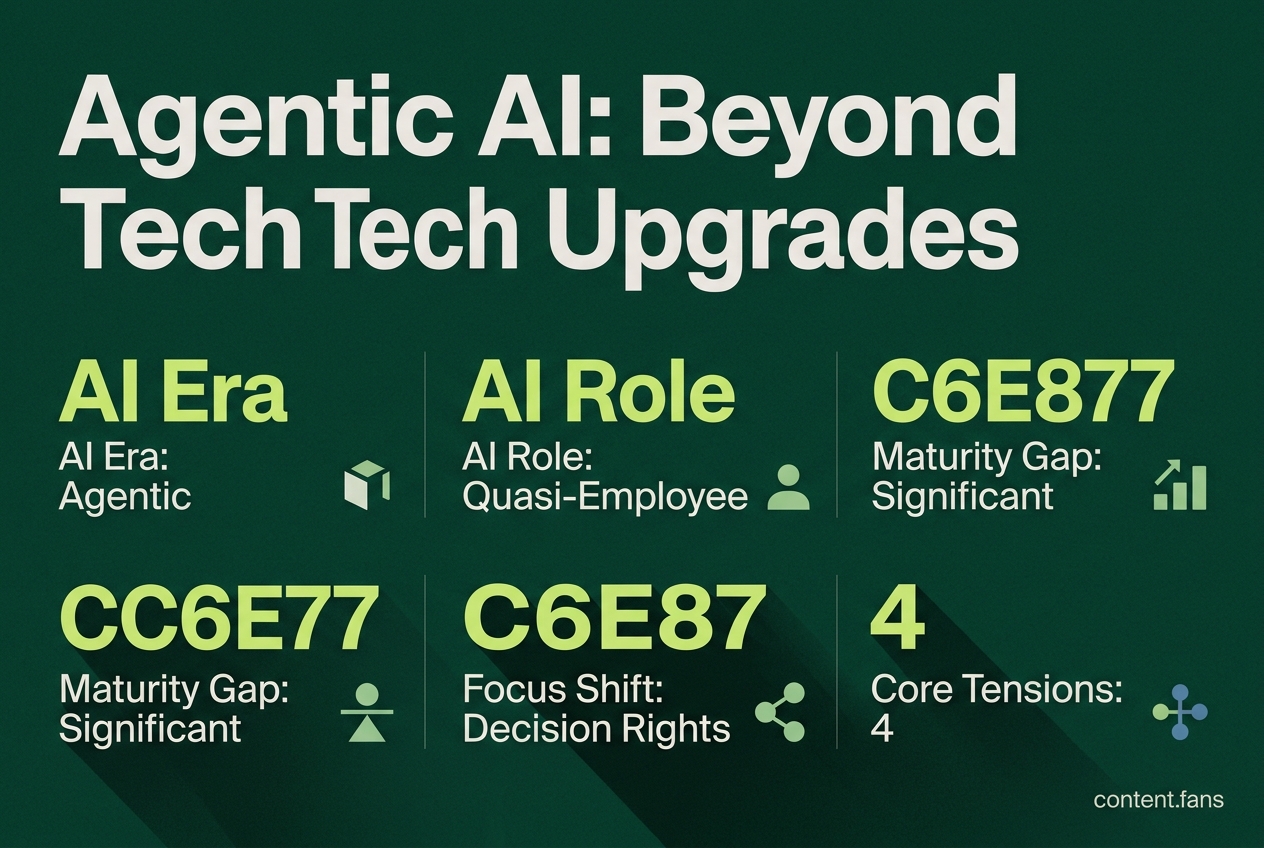
A 2025 study from BCG and the MIT Sloan Management Review describes agentic AI as technology with both tool-like and human-like capabilities. This duality creates four core management tensions: balancing scalability with adaptability, investment with employment, supervision with autonomy, and retrofitting processes versus reimagining them. Because these agents constantly adapt, static deployment models fail. In response, firms are creating agile, cross-functional teams to iterate on AI policies and data integrations.
Redefining Governance and Operating Models
Lenhard's commentary reinforces this, emphasizing that decision rights, escalation paths, and audit trails must be redesigned before an agent is deployed. According to industry reports, a significant maturity gap exists: many large firms lack mature governance models for autonomous agents. This explains why many AI pilots stall - companies approve the technology but delay the difficult work of rewriting their operating model.
Based on BCG's research, successful adoption focuses on five key actions:
- Map a Core Workflow: Define a clear human-agent boundary for one high-friction process.
- Build Guardrails: Establish rules for data access, security, and compliance before launch.
- Create Learning Loops: Implement continuous feedback systems for both the AI and human teams.
- Adopt Flexible Funding: Shift from fixed budgets to rolling ROI models as agent value evolves.
- Empower Small Teams: Staff autonomous teams to monitor, retrain, and scale the agentic system.
Evidence from Early Adopters
Early adopter case studies provide compelling evidence. Lenovo's supply chain agent, iChain, autonomously monitors demand signals and reroutes freight. To achieve this, Lenovo redesigned planning processes and approval thresholds, shifting human oversight to high-impact exceptions. This case validates that the primary challenge is reallocating decision rights, not just technical integration. While industry reports note growing board-level focus on AI agents, many firms still treat them as simple add-ons, limiting their transformative potential.
Rethinking the Investment Model
Investing in agentic AI requires a new financial mindset. Traditional ROI and NPV formulas fall short because value emerges over time through learning curves and faster cycle times. Industry reports highlight a shift toward rolling funding models tied to performance milestones instead of fixed budgets. This confirms that organizational change, not technology spend, is the true driver of long-term value. Ultimately, the critical question for leaders shifts from "Can the AI model work?" to "How do we manage a digital colleague that continuously learns and evolves?"
What makes agentic AI fundamentally different from earlier automation?
Agentic systems behave like quasi-workers, not just smarter tools. Boston Consulting Group's 2025 field study with MIT Sloan shows they "combine capabilities typical of tools with others characteristic of people." This dual nature means an agent can plan, act, learn, and hand off work inside the same workflow. In practice, Lenovo's iChain agent now monitors global supply-chain signals 24/7 and can reroute freight without a human clicking "approve" every time, cutting exception-resolution time by 38 % in pilot lanes.
Where should companies start when redesigning workflows?
Pick one high-friction end-to-end process and redesign it agent-first instead of bolting an agent onto an old SOP. According to industry reports, projects starting with a blank-sheet workflow map reach repeatable scale significantly faster than retrofit pilots. The most common starter domains are supply-chain replenishment, customer onboarding, and policy servicing - areas where a single agent can own the full "plan-act-learn" loop while human reviewers focus on exceptions.
How are decision rights changing between humans and agents?
Authority is being re-cast into four buckets:
- Fully human (strategy, high-stakes legal, final accountability)
- Human-approved agent (finance postings, security patches)
- Autonomous within guardrails (triage, scheduling, low-risk routing)
- Exception escalation (confidence < threshold triggers human review)
Industry reports stress that the real work is writing the "escalation logic and audit trail" before the first agent goes live; firms that skipped this step saw significantly higher incident escalation volume once agents moved from pilot to production.
What does governance look like in an agentic operating model?
Governance is now architectural, not policy-only. Leading firms create an orchestration layer that sits between enterprise systems and agent runtimes. This layer records every tool call, data request, and human handoff, producing a tamper-evident audit chain. According to industry case studies, organizations have achieved substantial reductions in compliance review time after implementing such layers because regulators can replay any agent action in minutes.
How long does the transformation actually take?
Industry roadmap data points to a four-phase journey:
- 2023-2024: ad-hoc pilots
- 2024-2025: opportunistic production within a single workflow
- 2026-2027: repeatable implementation across similar processes
- 2028-2029: managed transformation where entire operating models are reinvented around agents
The bottleneck in every phase is organizational redesign, not model performance. Firms that budgeted significant program spend for change management, reskilling, and governance were substantially more likely to reach phase 3 on schedule.