
B2B Tech Brands See 8x Engagement From Employee Advocacy
Serge Bulaev
Employee advocacy may be a strong way for B2B tech brands to grow, with evidence suggesting it can give about 8 times more engagement than traditional brand channels. Sharing posts from employees, like engineers and specialists, appears to build more trust and credibility with buyers, who may see the advice as more reliable. Data suggests leads from employee-shared content might convert at higher rates, and many B2B buyers now check social posts before choosing vendors. Experts recommend starting with a small group, clear goals, and ongoing support to measure and improve the impact. Programs should focus on educational content, use simple rules for compliance, and reward participation with recognition instead of gifts.

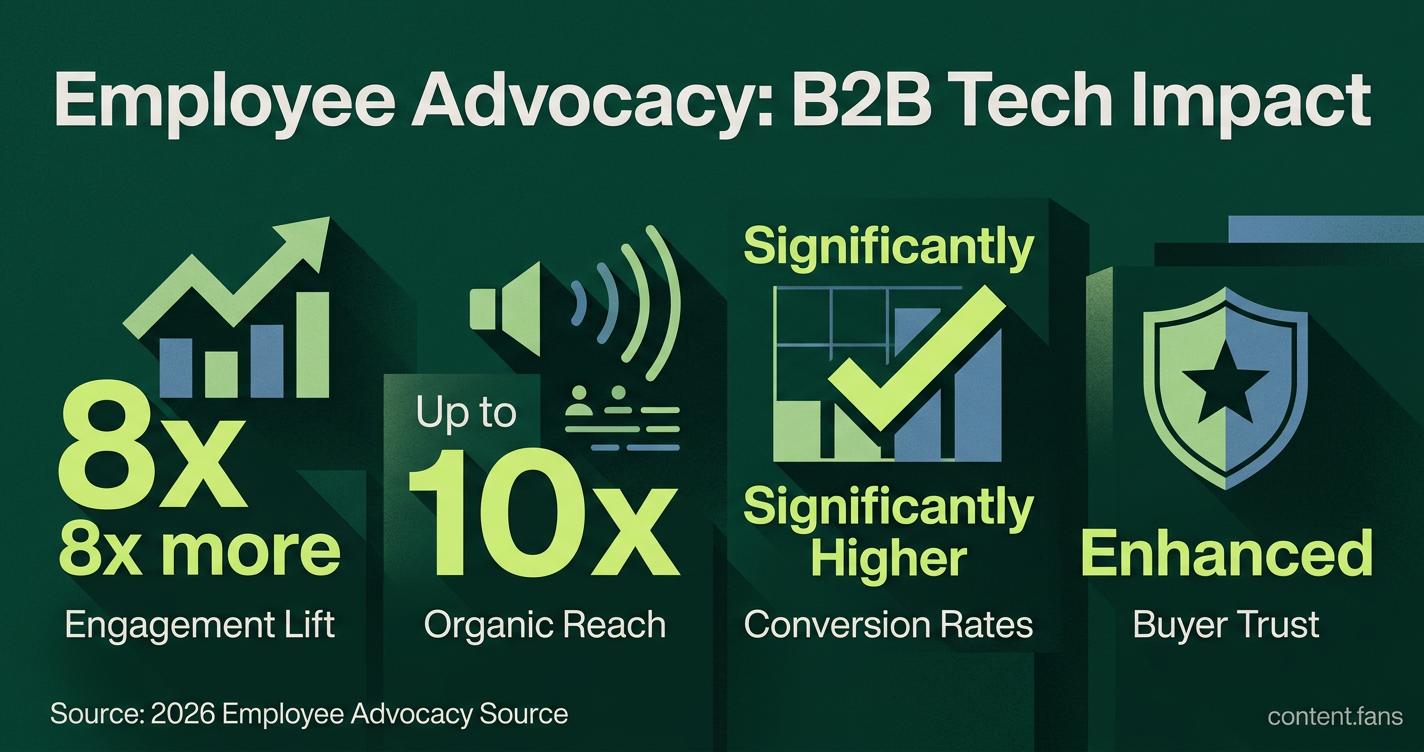
A 2026 employee advocacy source reports that employee-shared content receives about 8x more engagement than content shared through official brand channels. For B2B tech brands, employee advocacy is a primary growth engine, with industry reports calling it a top-tier growth opportunity for 2025. When technical experts like engineers and product specialists share content, their credibility directly enhances buyer trust in the brand.
This guide analyzes recent data on how employee voices boost demand generation and provides a framework for building a program that demonstrates measurable pipeline impact.
Why employee advocacy matters in complex technical buying
Employee advocacy matters because it leverages the high trust buyers place in technical practitioners. Posts from engineers and specialists generate significantly higher engagement and conversion rates than corporate marketing, directly influencing complex buying decisions by providing credible, peer-to-peer insight into a product's value and implementation.
Complex B2B sales cycles are long, involve multiple stakeholders, and are defined by risk aversion. Benchmark studies consistently show that employee-shared content generates approximately 8x more engagement than posts from corporate channels, extending organic reach by up to 10x. Industry reports indicate that a significant portion of advocacy programs prioritize lead generation or sales as a primary goal. When technical staff share insights on architecture or integrations, prospects find the advice more authentic and reliable than polished marketing content.
Recent data points suggest additional upside:
- Industry reports show significantly higher conversion rates for leads originating from employee social shares.
- Recent surveys indicate that a majority of B2B buyers use social media content to research and shortlist vendors.
How Employee Advocacy Impacts the Sales Funnel
Benchmarks from multiple sources converge on three funnel effects:
| Funnel stage | Observed lift (approximate) | Key driver |
|---|---|---|
| Awareness | 8x engagement | Expanded networks |
| Consideration | Higher trust signals | Practitioner insight |
| Lead creation | Higher conversion | Social referrals |
This suggests that well-run programs can influence both top- and mid-funnel metrics, then accelerate late-stage conversations by warming prospects in advance.
Building a pilot that proves impact
Experts advising B2B tech companies advocate a phased roll-out:
- Recruit a pilot group: Start with 10 - 20 socially active volunteers and secure at least one executive sponsor.
- Define content pillars: Focus on 2-3 key themes that address customer pain points, like AI adoption or integration challenges.
- Provide content: Offer a weekly set of customizable posts in a central content hub to simplify sharing.
- Offer coaching: Train participants on LinkedIn profile optimization, maintaining a personal tone, and understanding compliance rules.
- Track key metrics: From day one, measure participation, reach, engagement, and referral traffic to demonstrate value.
What to measure after launch
A small, focused KPI set keeps the program aligned with revenue goals.
- Participation Rate: Percentage of employees sharing at least once per month.
- Reach & Engagement: Compare per-post metrics against corporate channel averages.
- Click-Through Rate (CTR): Track clicks to key conversion points like gated assets or demo requests.
- Sourced Leads: Attribute Marketing-Qualified Leads (MQLs) originating from unique employee URLs.
- Sales Cycle Impact: Measure the sales-cycle length for opportunities influenced by employee advocacy.
Industry reports suggest that public recognition ranks higher than gift cards in sustaining activity. Leaderboards showcased during all-hands meetings encourage friendly competition without forcing scripted posts.
Guardrails and risk controls
Governance is critical in technical industries with strict compliance or security needs. To maintain control, implement safeguards like pre-approved content templates, simple do-and-don't guidelines, and quarterly post audits for accuracy. Modern advocacy tools can archive all social activity to satisfy audit trails while empowering employees to maintain an authentic voice.
Content that resonates with technical buyers
Practitioner guides emphasize educational, insight-driven content over promotional messages. For technical buyers, high-performing formats include brief implementation stories, architecture diagrams, benchmark data, and concise video demos. When employees add personal commentary, social media algorithms often boost visibility, and buyers gain confidence from seeing that real-world practitioners endorse the product.
If engagement wanes, analyze which topics, formats, or posting times have lower performance. Use this data to continuously refine the content strategy, ensuring the program remains credible and aligned with market needs.