
B2B Marketers Scale Content with Custom LLMs, Human-in-the-Loop AI
Serge Bulaev
B2B marketers are using custom AI tools and keeping humans in the loop to make content that stands out and keeps a strong brand voice. Instead of sounding boring and the same as everyone else, they train AI with their own stories and check results to keep messages sharp. AI can quickly adapt messages for different platforms like LinkedIn and TikTok without losing the company's style. Marketers also use new ways to measure if their stories actually help sales, not just count clicks. Finally, they set rules to be fair and honest, making sure AI helps tell real stories that connect with buyers.

To combat falling engagement rates, B2B marketers are scaling content with custom LLMs and human-in-the-loop AI. This strategy is a direct response to buyers complaining that generic, AI-generated assets make all vendors sound the same, which lengthens sales cycles. The new mandate is clear: scale efficiently without losing the unique brand voice that wins deals.
Reclaiming the Power of Story with Data and AI
High-performing teams scale content by combining custom large language models (LLMs) with human-in-the-loop oversight. They train AI on their own proprietary messaging to maintain narrative consistency and use editorial boards to review and refine outputs, ensuring every asset aligns with their distinct brand voice and quality standards.
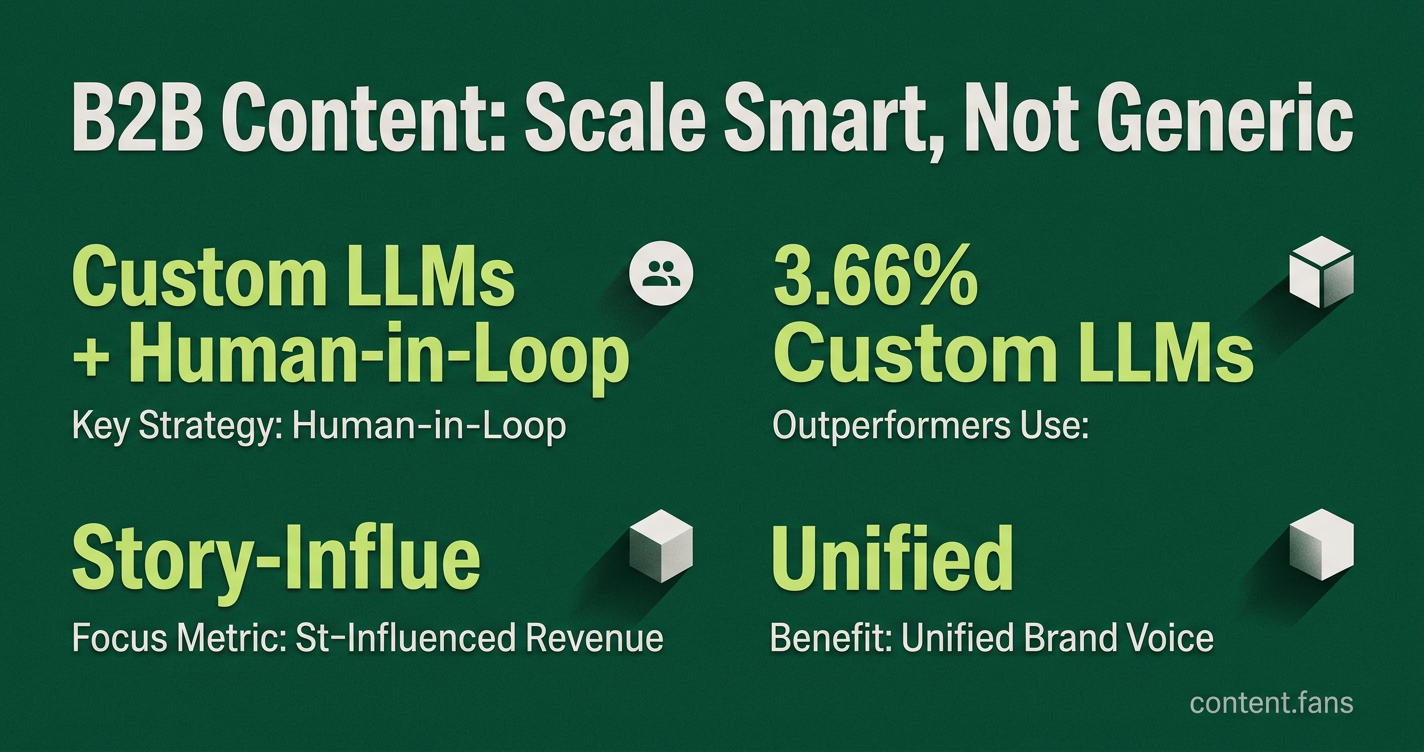
Three key shifts separate high-performing marketers from the content blur:
- Human-in-the-loop workflows maintain brand tone while scaling volume. Editorial boards review AI drafts and teach the models what to improve, a practice Robotic Marketer credits with creating sharper messaging.
- Custom LLMs trained on proprietary messaging eliminate generic "AI slop." According to CMSWire, teams that deploy custom LLMs outperform those using off-the-shelf tools because every asset inherits the same narrative spine.
- Story-first measurement replaces vanity metrics. Instead of just tracking page views, leaders now measure which narratives influence closed-won revenue, a benchmark noted by Allego for 2026.
From Channel Chaos to Cohesive Choreography
AI now enables marketers to adapt a single core story for multiple platforms without fragmenting the brand voice. By setting rule-based templates, LinkedIn posts can remain analytical while TikTok clips stay conversational and blogs provide deep dives. Finelight Media reported this platform-specific tailoring lifted conversion rates significantly in 2025.
Top techniques for this approach include:
- Training models on call transcripts and sales decks to capture authentic phrasing.
- Using intent data from platforms like 6sense to trigger narrative variants as accounts move through the sales funnel.
- Pairing video generators like Synthesia with human-recorded introductions and conclusions to enhance credibility.
Metrics That Truly Matter
| KPI | Why It Replaces Legacy Metrics |
|---|---|
| Story-Influenced Revenue | Directly aligns content performance with pipeline and sales impact. |
| Voice Consistency Score | Flags off-brand language across all channels to ensure a unified narrative. |
| Human Edit Time Per Asset | Measures efficiency gains from AI without sacrificing the quality control of full automation. |
According to a McKinsey report cited in Itransition's AI trend roundup, brands applying these metrics report higher ROI on personalized case studies and improved mid-funnel conversions.
Guardrails for Ethical Scaling
To prevent AI from flooding feeds with low-quality or off-brand content, leaders are instituting three critical guardrails:
- Conducting bias audits before deploying any model.
- Providing clear disclosure when content is machine-generated.
- Calibrating for tone continuously using internal employee feedback loops.
While the playbook is still evolving, one principle remains firm: technology should amplify the human voice, not erase it. When data and AI serve the storyteller, B2B brands regain the clarity and authenticity that buyers demand.
How can B2B teams prevent brand-voice dilution when they need thousands of assets per month?
The fix is a three-layer stack:
1. Custom LLMs that are fine-tuned only on your proprietary messaging, tone and buyer insights (CMSWire, 2026).
2. Human-in-the-loop editorial boards that review, edit and approve every AI draft before it leaves the building (Robotic Marketer, 2026).
3. Rule-based channel automation so the same core asset can be reshaped for LinkedIn, TikTok, or email without sounding like it came from three different companies.
Early adopters are already proving the model: teams using this triple-layer approach report higher efficiency and improved conversions than those relying on off-the-shelf models.
What does "AI as a creative partner" look like in daily workflows?
Think of AI as the research intern and humans as the creative director.
- AI handles the grunt work: data crunching, first-draft copy, headline A/B tests.
- Humans inject story, structure and emotion - elements AI still struggles to fake.
For example, a campaign brief still starts with a strategist outlining the narrative arc, but the AI instantly generates ten story angles, three landing-page outlines and a set of ad variants. The strategist picks the best, rewrites for tone, and pushes live. The result: approximately 81-87% of marketers now use AI for content tasks, but the output that wins deals still carries the human fingerprint.
Which KPIs prove that human-in-the-loop is worth the extra time?
Forget vanity metrics. Track closed-won revenue attached to each asset, not just views or clicks. Dashboards from Allego and others now surface which whitepaper, case study or podcast actually moved the deal to signature. Teams that tie assets to pipeline see higher conversion rates from signal-based prospecting (Allego, 2026).
How do we keep every channel on-brand without creating a bottleneck?
Set channel-specific guardrails inside the AI tool itself:
- Maximum character counts for Twitter threads.
- Tone sliders for LinkedIn (professional) vs. TikTok (conversational).
- Visual rules that instruct Canva AI or Midjourney to use exact brand colors and fonts (Intent Amplify, 2026).
The AI learns from engagement feedback in real time, tightening the voice rules automatically. Humans only step in when an outlier post triggers an alert.
What will experts be debating at the May 6 event on automation versus creativity?
Expect three hot topics:
1. "Story over specs" - why narrative differentiation trumps product feature lists in an AI-saturated feed (CMSWire, 2026).
2. "Human-first gated content" - newsletters, podcasts and communities where real voices outperform AI noise, driving both trust and revenue (HubSpot State of Marketing, 2026).
3. "Ethical AI charters" - guidelines that keep automation from sliding into generic "slop" that erodes brand equity, focusing on trust, transparency, fairness, and accountability, with some noting positive impacts on brand equity via responsible practices.