
AWS Unveils Continuum, Context for Multi-Agent AI Orchestration
Serge Bulaev
AWS has launched Continuum and Context to help AI agents work together across big organizations. Continuum is a security service that may handle tasks like scanning for code problems and running security tests, starting with human supervision and possibly moving to automated fixes. Context builds a map of company data from many sources so AI agents can search and understand information easily. Both tools are only available to some customers for now, and pricing is not published. Experts suggest that whether these tools succeed may depend on how AWS balances automation with keeping customers in control.

At AWS Summit New York 2026, AWS announced AWS Continuum for security/vulnerability management and AWS Context for data/context retrieval and governance. The services provide the essential control planes for autonomous agents to securely share memory, data, and operational guardrails within large organizations. This announcement signals a strategic shift from isolated model interactions toward governed, system-wide AI execution.
What Continuum delivers
Continuum and Context provide a comprehensive framework for governing autonomous AI. Continuum acts as an AI-native security service for the entire vulnerability lifecycle, while Context creates a shared knowledge graph, enabling agents to understand and query complex organizational data from disparate sources like Slack and SharePoint.
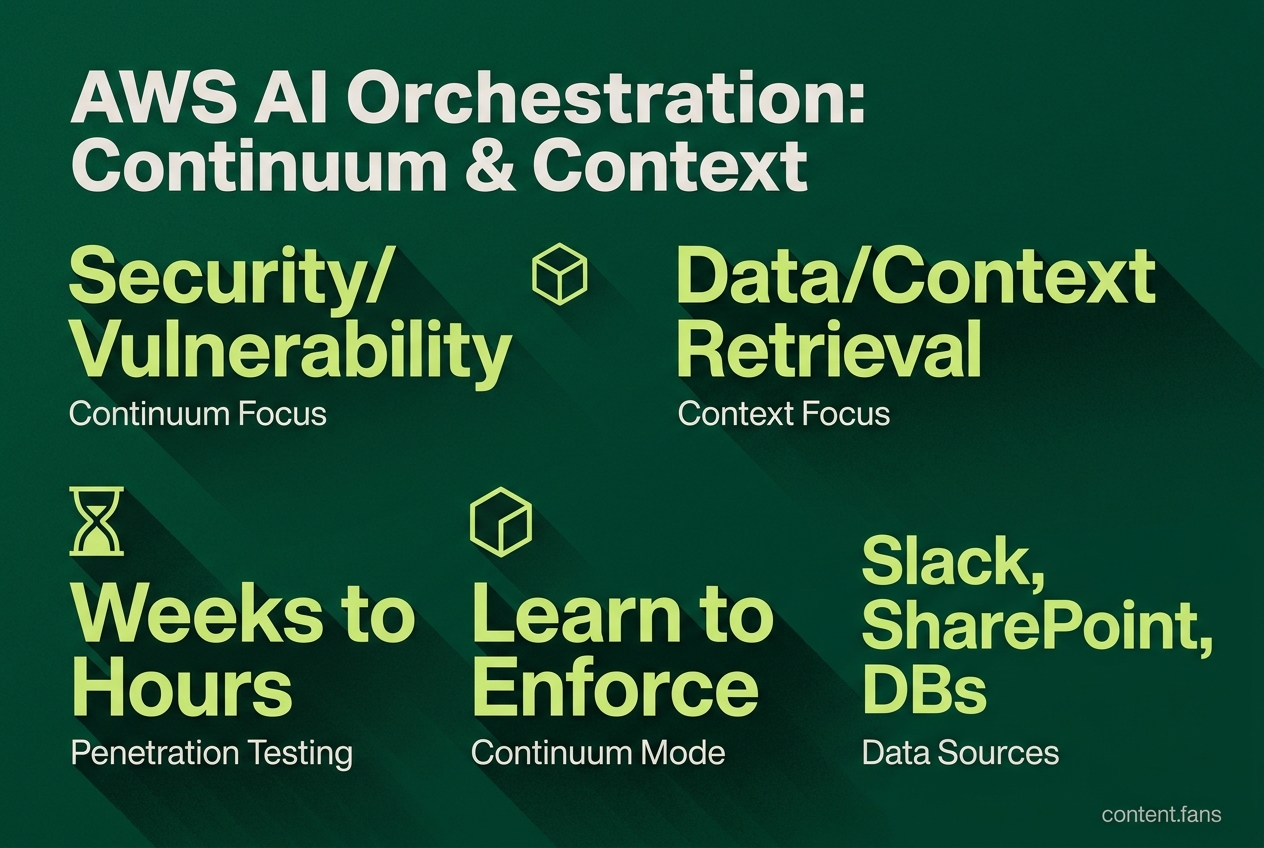
Continuum is an AI-native security service designed to manage the entire vulnerability lifecycle at machine speed, as detailed in the official AWS Continuum announcement. Access is through a gated preview integrating four key modules:
- Code Vulnerabilities: A full lifecycle workflow for detection and remediation (preview).
- Penetration Testing: On-demand security tests that reduce engagement times from weeks to hours (preview).
- Code Scanning: Deep static and compliance analysis (preview).
- Threat Modeling: Automated STRIDE diagram generation from design documents or source code (preview).
The service operates initially in a supervised "Learn Mode" and can be promoted to an automated "Enforce Mode" for applying patches once trust is established. Pricing for the preview modules has not been published.
Context and the knowledge graph layer
Context, also in a gated preview, constructs a unified knowledge graph from diverse enterprise data sources, including structured Iceberg tables and unstructured content in Slack or SharePoint. This creates a persistent, searchable data layer that all internal AI agents can query for enhanced situational awareness. Summit demonstrations showed Context ingesting data from "your databases, your documents, your Slack history" to infer relationships across them AWS Summit highlights.
Context provides connectors for various enterprise data sources. Initial access is limited to approved customers in the finance, automotive, and technology sectors, with pricing undisclosed.
Early market positioning
AWS appears focused on providing the critical infrastructure for orchestration and governance rather than simply launching more model endpoints. An analysis from Mission Cloud notes that Context "is essentially the data layer that makes all the other systems work at enterprise scale" Mission Cloud analysis, reinforcing its foundational role.
This strategy aligns with industry reports suggesting that a significant portion of enterprise applications will embed task-specific agents in the coming years. As the market matures, buyers will likely compare Continuum and Context against emerging control-plane solutions from other hyperscalers and integration platforms, with differentiation shifting toward proven performance, policy enforcement, and integration depth.
Current access and limits (June 2026)
As of the provided sources, AWS Context was coming soon/in preview and AWS Continuum was in preview/closed or gated preview. Both services require application review for access, with no publicly announced general availability dates or unit-based pricing for the preview services. Enterprises interested in agent-based security or knowledge graph search must currently apply for pilot programs with specific use-case details.
What to watch
Market adoption will likely hinge on how effectively AWS balances powerful automation with robust customer control. The inclusion of an "Enforce Mode" in Continuum suggests a future where agents autonomously apply fixes to production code. However, by starting with human-in-the-loop supervision, AWS aims to build enterprise trust. This cautious, phased approach may set the standard for how other vendors introduce autonomous systems in the coming year.
What exactly are AWS Continuum and Context, and how do they differ from one another?
AWS Continuum is a security-first service that manages the full vulnerability lifecycle at machine speed inside customer-defined guardrails. It scans, prioritizes, validates, and can even autonomously fix code vulnerabilities using a supervised Learn Mode before moving to Enforce Mode. Penetration Testing, Code Scanning, and Threat Modeling are included as sub-modules, all currently in preview.
AWS Context, on the other hand, is a knowledge-graph layer that connects every AI agent in an enterprise to structured and unstructured data sources such as S3, SharePoint, Confluence, and Slack. Context builds an always-updated map of relationships so agents can reason over business rules, domain knowledge, and identity permissions in real time.
Think of Continuum as what keeps agents secure and Context as what makes agents smart.
When can customers start using these services, and what is the approval process?
As of mid-2026, both offerings are in Gated Preview for selected customers:
- AWS Continuum (core Code Vulnerabilities workflow): requires an application review; currently piloted in finance, automotive, and technology sectors.
- AWS Context: listed as "Coming Soon"; also requires an application review.
There is no publicly released per-unit pricing yet. Customers interested in early access should apply through the official AWS Continuum page.
How do the new services change the competitive landscape for agentic AI orchestration?
Industry reports suggest that enterprise AI will fail to scale without agentic orchestration platforms, with many enterprise applications expected to embed task-specific AI agents in the coming years. The deciding factor is no longer model quality alone but the ability to coordinate, govern, and verify multi-agent workflows at scale.
AWS is positioning Continuum + Context as an integrated control plane that spans:
- Security (Continuum)
- Federated data access (Context)
- Policy enforcement and cost observability (both)
This combination directly challenges point-solution vendors who might excel at agent authoring or monitoring but lack native orchestration depth.
What cybersecurity threats do AI agents introduce, and how does Continuum address them?
Agentic AI has shifted the supply chain from a visibility era to a governance era. Autonomous agents are increasingly writing, testing, and deploying enterprise code, accelerating the spread of vulnerabilities. Key threats include:
- Malicious agent skills (a significant portion of audited skills contain credential-theft payloads).
- Vulnerable MCP servers (the new connective tissue between agents and external tools).
- "Vibe coding" (rapid, unvetted development).
Continuum counters these risks by collapsing the Mean Time to Remediate (MTTR) from weeks to minutes. An agent detects a CVE, proves exploitability in a sandbox, identifies a safe patch, creates a pull request, and even submits the fix through existing deployment pipelines. Human oversight remains via Learn/Enforce modes until the customer opts into full autonomy.
Can Context support cross-platform interoperability, or is it locked to AWS-only agents?
Context is designed for enterprise heterogeneity more than for an AWS-only stack. While the service runs on AWS, it ingests data from various enterprise repositories including cloud storage, collaboration platforms, and document management systems. Its knowledge graph is exposed through a documented agentic search API, which means agents built on any runtime that can call HTTPS endpoints can query Context. This approach aligns with the emerging Model Context Protocol (MCP) and other cross-platform initiatives, giving customers a single source of truth across cloud boundaries rather than a new silo.