
AWS unveils Continuum, Context for agentic AI security, memory
Serge Bulaev
AWS introduced two new AI tools, Continuum and Context, to help teams with security and memory for agentic AI. Continuum may help find and fix code problems quickly, but starts in a learning mode before making changes on its own. Context gives AI agents a way to remember and share information, which might reduce errors when agents work together. Both tools are only available to selected users, and details about where they work and how much they cost are not yet shared. Experts suggest that the biggest challenges for using these tools are linking them to old systems and making sure decisions and data are tracked carefully.

With the launch of AWS Continuum and Context, Amazon Web Services provides new enterprise tools for agentic AI security and memory. These services, which debuted at AWS Summit New York in June 2026, aim to coordinate multi-agent systems but are currently available only in a gated preview with pricing details unreleased.
This report analyzes what each service offers, details their current preview limitations, and examines the competitive market landscape.
What Are AWS Continuum and Context?
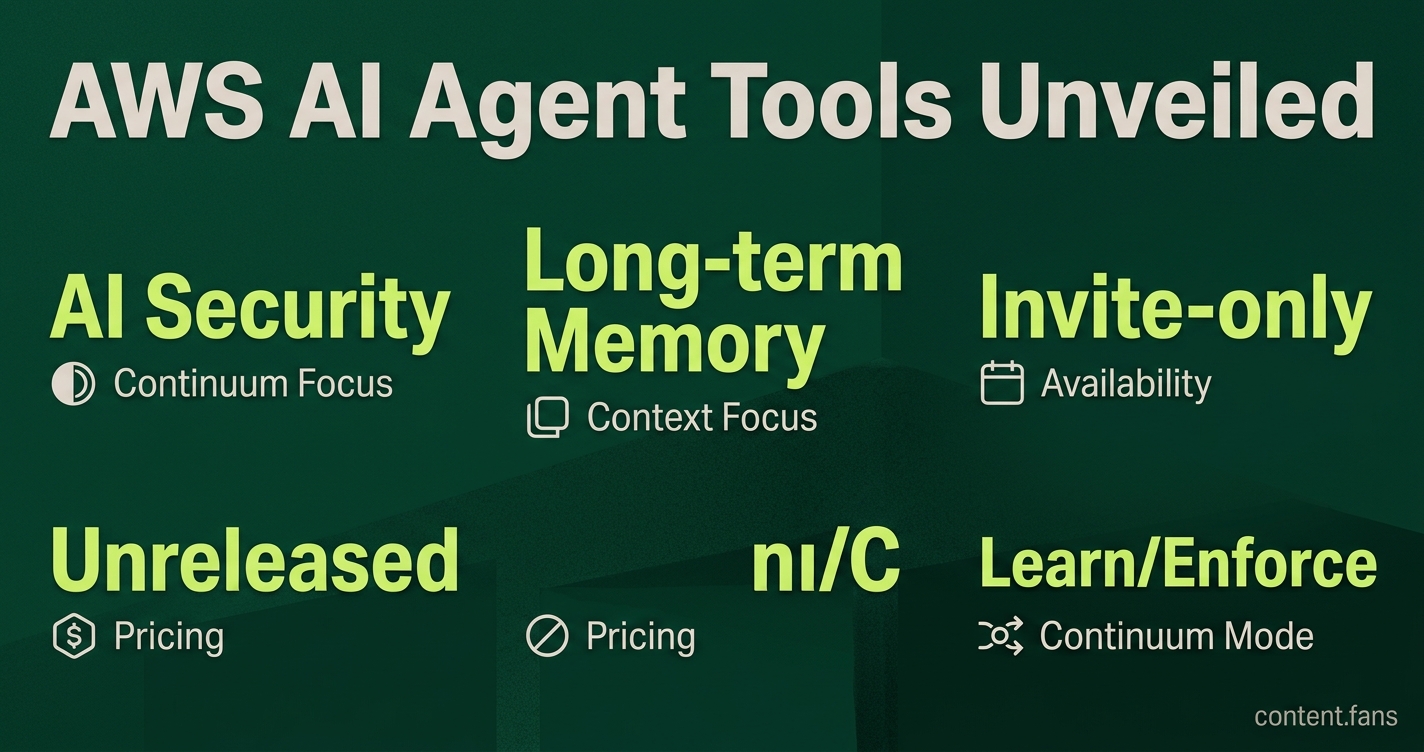
AWS Continuum is an AI-powered security agent designed to find and remediate code vulnerabilities at machine speed. Context is a managed service providing long-term memory, allowing multiple AI agents to share state and access enterprise data consistently. Both are currently in an invite-only preview.
Continuum directly targets software security, promoted by AWS as "security at machine speed." The agent autonomously scans source code for vulnerabilities, validates its findings, and can either propose or directly apply fixes. Initially, it operates in a "learn mode" before graduating to an "enforce mode" for automated remediation. According to industry reports, the service leverages LLMs trained on dependency graphs, and the current preview requires human sign-off for all production code changes.
Context solves the critical challenge of long-term memory for agentic AI workflows. It functions as a managed search layer, indexing enterprise data to provide a shared source of truth. This allows multiple agents to maintain state, recall past actions, and ground their reasoning. By connecting to sources like Amazon S3, DynamoDB, and SaaS APIs, Context enables consistent, permission-aware data access, which experts believe can prevent common errors caused by conflicting agent actions.
Availability, Pricing, and Limitations
Both Continuum and Context are currently invite-only previews. Official documentation does not yet specify supported regions, service level agreements (SLAs), or pricing models. A FAQ on the Continuum landing page states that pricing "will be communicated closer to general availability," indicating that early adopters are likely operating under custom agreements.
How Continuum and Context Compare to Competitors
The market for managing multi-agent workflows is highly competitive. Hyperscaler platforms like Azure AI Foundry, Google Vertex AI Agent Builder, and Amazon's own Bedrock Agents are direct rivals. At the same time, developer-focused frameworks like LangGraph and CrewAI offer greater code-level control. For workflow integration, tools such as n8n and Zapier connect agents to thousands of SaaS applications. Analysts suggest hyperscaler solutions are ideal for organizations committed to a single cloud, while open frameworks provide essential portability.
Key Adoption Challenges and Best Practices
Industry analysis highlights that the primary obstacles to adoption are not model performance but legacy system integration, governance, and auditability. Handoffs between agents can obscure accountability, while credential management for autonomous systems creates security risks. Key practices for successful implementation include:
- Establish bounded autonomy to require human escalation for high-impact decisions.
- Modernize the integration layer with granular, role-based access controls.
- Prioritize data quality and governance before scaling autonomous workflows.
- Implement robust observability and logging at the orchestration layer.
- Invest in upskilling engineering teams to debug and manage agent-based systems.
Future Outlook and Key Indicators
The evolution of Continuum from "learn" to "enforce" mode will be a key indicator of AWS's confidence in its automated remediation capabilities. Similarly, Context's ability to handle proprietary data formats will be crucial for its adoption in regulated industries. In response, competitors are expected to bolster their governance and security features rather than focusing solely on model capabilities.