
AWS signs $4 billion AI deal with Pinterest through 2031
Serge Bulaev
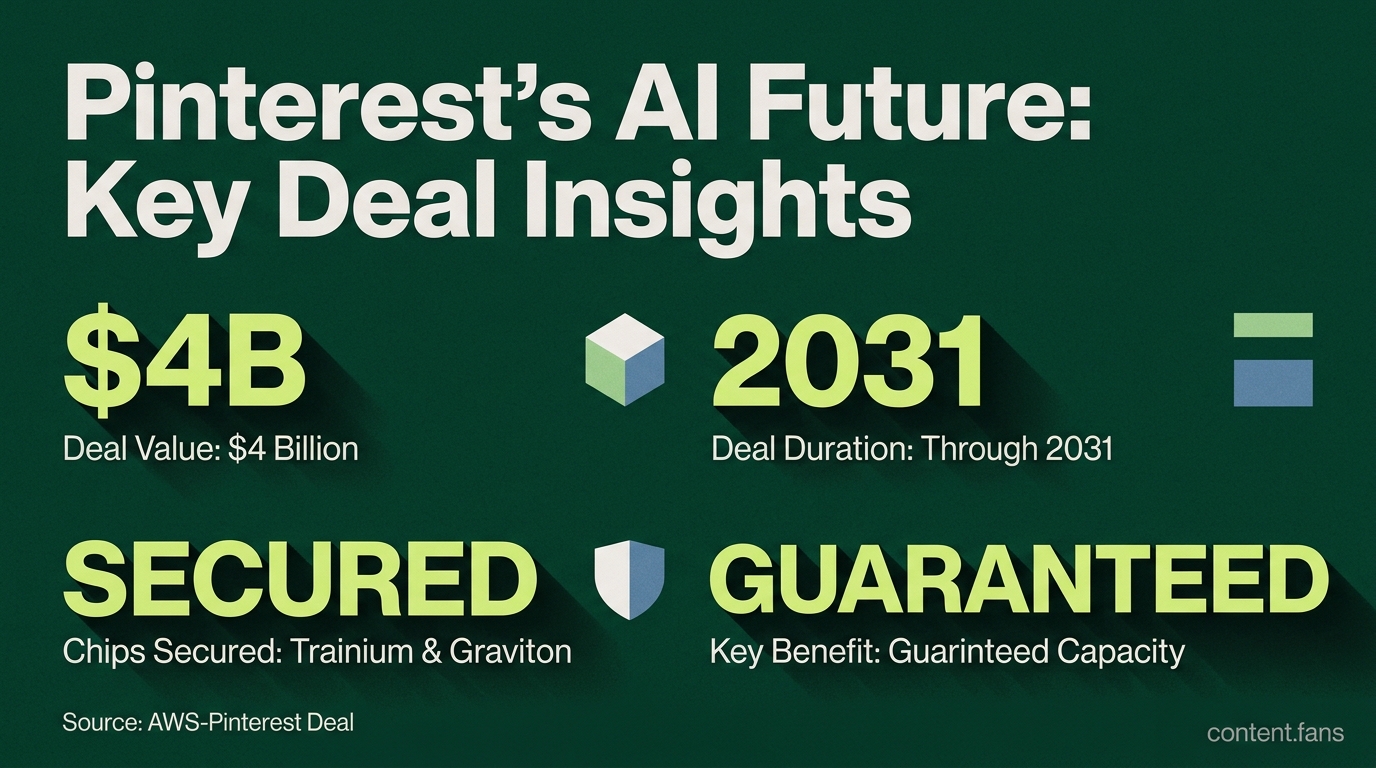
AWS and Pinterest have agreed to a $4 billion deal for AI compute power through 2031. This deal gives Pinterest guaranteed access to Amazon's Trainium and Graviton chips, which may help lower costs for training AI models, although some testing suggests that other chips could be faster. Experts note that this type of long-term deal may make Pinterest more dependent on AWS and limit its future hardware options. The contract reflects a bigger trend where companies are securing AI computing capacity for many years, as supply appears to be tight. Observers will watch if the cost benefits of AWS chips last and if Pinterest might diversify its cloud providers in the future.

In a landmark multi-year agreement, AWS has signed a significant AI deal with Pinterest, securing the social media giant reserved access to specialized AI hardware through 2031. This strategic partnership provides Pinterest with guaranteed capacity on Amazon's Trainium and Graviton chips, which are crucial for large-scale AI model training and powering its recommendation engines. The deal underscores a growing industry trend where securing long-term compute capacity is becoming more critical than the AI algorithms themselves.
Why Trainium Matters for Pinterest
Pinterest selected AWS Trainium chips to optimize the cost of training its large-scale AI models. While not the fastest chips available, Trainium offers a compelling price-performance ratio. This allows Pinterest to regularly retrain its complex vision-language models for its recommendation engine at a lower, more predictable cost.
AWS positions its Trainium2 chips as a cost-efficient solution for training large AI models. A CloudExpat analysis highlights this, showing Trainium2 instances offer competitive pricing compared to Nvidia's H100. Although the H100 offers higher raw throughput, Pinterest's focus on "cost per trained token" over raw speed makes Trainium a strategic choice. While AWS claims better price-performance for Trainium, realizing these savings depends on optimizing workloads with AWS's Neuron SDK, as third-party tests show H100 can deliver significantly faster BF16 throughput.
The Strategic Trade-Offs: Lock-In vs. Guaranteed Capacity
This long-term commitment highlights a critical trade-off for enterprises. While securing reserved capacity guarantees resources and shortens experimentation cycles, it also risks deep vendor lock-in. Research from Deloitte Insights suggests such deals transform AI strategy into an infrastructure governance challenge. For Pinterest, the partnership may incentivize AWS to align its silicon roadmap and data center expansion with the company's needs.
Key implications of the deal include:
* Predictable Spend: Pinterest gains the ability to forecast its AI infrastructure budget for the next seven years.
* Hardware Roadmap Risk: The company is now tied to the AWS ecosystem, potentially missing out on more advanced or cost-effective accelerators from other vendors.
* Data Locality: The long-term contract commits Pinterest's user data to reside within AWS's global data center regions.
Contextualizing the Deal in the AI Infrastructure Arms Race
While significant, Pinterest's commitment is part of a much larger trend of massive investments in AI infrastructure. Industry reports suggest numerous major agreements between cloud providers and AI companies, as detailed in a TechCrunch report on major compute deals.
The scale of investment is staggering: AI infrastructure spending is very large and rapidly rising across the industry. This intense competition for scarce resources is driving enterprises like Pinterest to secure multi-year deals, even as some analysts suggest hybrid or on-premises solutions could become viable alternatives for predictable, long-term workloads.
Key Questions for the Future: What to Watch Through 2031
The long-term nature of this deal raises several key questions that industry observers will monitor over the coming years:
- Will Trainium's Cost Advantage Last? The primary value proposition for Pinterest is Trainium's price-performance. This will be tested as competitors like Nvidia and other ASIC designers release new, more powerful, and potentially more efficient chips.
- Will Pinterest Diversify? Observers will watch to see if Pinterest expands its AWS commitment to include inference chips like Inferentia2 or if it chooses to de-risk by moving some workloads to other cloud providers to mitigate vendor lock-in.
- Is This the New Normal? The agreement serves as a major data point, framing enterprise AI strategy less as a race for the best algorithm and more as a long-term strategic game of securing essential computing resources.
What exactly does AWS provide to Pinterest under the deal?
According to industry reports, AWS will supply Trainium chips for large-scale model training and Graviton processors for everyday inference, reserving dedicated capacity for Pinterest through the multi-year agreement. The arrangement locks in hardware families that AWS claims offer better price-performance than comparable GPU offerings, which Pinterest hopes will keep both training cost and user-latency low as its AI features grow.
Why did Pinterest choose AWS Trainium over the more common NVIDIA H100?
Industry benchmarks suggest that H100 still delivers significantly higher raw BF16 throughput per chip, but AWS positions Trainium2 at a lower hourly cost. Pinterest's workloads appear to be cost-optimized, large-batch training runs where the lower price can offset any speed gap, especially when amortized over a seven-year horizon.
How does this fit into the broader trend of enterprise AI commitments?
According to industry reports, this deal is part of a significant trend of major AI infrastructure investments. The provided sources support a separate agreement between CoreWeave and OpenAI, indicating an industry-wide rush to secure long-term compute capacity.
What are the main risks Pinterest faces under a seven-year lock-in?
The academic consensus is that multi-year cloud commitments create three potential pitfalls:
1. Vendor lock-in if AWS changes pricing or sunsets Trainium
2. Reduced architectural flexibility when new chips (e.g., Trainium3) or competitor offerings emerge
3. Opportunity cost of being unable to shift to cheaper on-premises or hybrid setups if steady-state demand makes that more economical
Pinterest mitigates some risk by using containerized training jobs that can, in theory, be ported to future AWS generations.
How does Pinterest plan to measure ROI on the spend?
While Pinterest has not published its KPIs, public guidance from industry reports suggests enterprises track four levers:
1. Cost per token / per image in production
2. Service-level latency improvements against user engagement uplift
3. Reserved capacity utilization (avoiding idle expensive hours)
4. Model iteration velocity - how quickly new features move from notebook to global rollout
Internal dashboards will likely benchmark before-and-after metrics after every Trainium-based training cycle to ensure the promised price-performance edge translates into real savings.