
Arcade Raises $60M Series A for AI Agent Governance
Serge Bulaev
Arcade has raised $60 million in Series A funding to help manage and control AI agents, bringing its total funding to $72 million. The company offers a platform that may limit what actions AI agents can take and creates tamper-evident audit trails. Research suggests most large companies plan to use AI governance by 2026 due to stricter rules and increasing use of AI agents. Arcade appears to focus on real-time rules and security for machine identities and plans to add features like an agent registry. The new funds might be used for more integrations and expanding to new regions as demand for agent control grows.

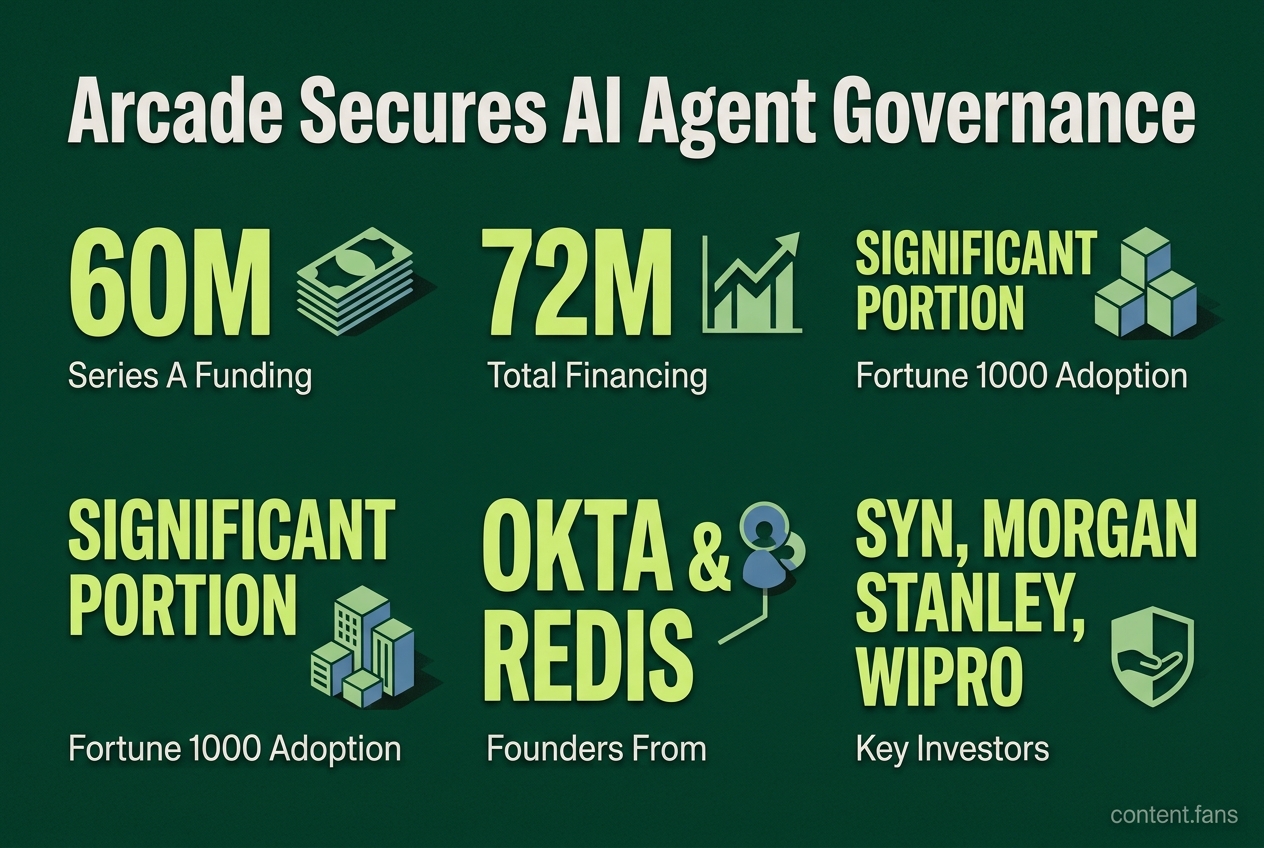
Arcade has secured $60 million in Series A funding to scale its platform for AI agent governance, bringing its total financing to $72 million. The investment highlights the growing need for infrastructure to manage autonomous AI systems. According to a WSJ report, the round was led by SYN Ventures with participation from Morgan Stanley and Wipro.
Founded by Okta and Redis veterans Alex Salazar and Sam Partee, Arcade provides a "secure action layer" for enterprises. This platform enforces real-time policies on AI agents, limits their actions, and creates secure audit trails. As agent adoption accelerates, demand is surging for solutions that apply least-privilege principles to machine identities, a trend noted by Silicon Angle.
Why the Governance Gap Is a Critical Market Opportunity
The rapid proliferation of AI agents in the enterprise has created an urgent governance gap. As organizations deploy hundreds of autonomous systems, they face mounting pressure from regulators and significant security risks from unmonitored agent activity, making real-time control and audibility essential business infrastructure.
This urgency is reflected in market trends. Industry reports suggest that a significant portion of Fortune 1000 companies are expected to implement formal AI governance platforms in the coming years. The primary drivers include tightening regulations, the sprawl of agents across complex SaaS environments, and the increasing frequency of security incidents like prompt injection attacks. Arcade's focus on real-time policy enforcement, rather than after-the-fact audits, directly addresses these critical enterprise needs.
Arcade's Core Platform Capabilities
Arcade's "secure action layer" provides a suite of tools designed to give enterprises granular control over their AI agents:
- Agent-Centric Identity & Access: Assigns a unique, cryptographically signed identity to every agent for precise action mapping.
- Policy-as-Code Engine: Proactively blocks unauthorized agent actions before they can be executed.
- Continuous Monitoring: Streams detailed agent telemetry to SIEM platforms for real-time anomaly detection.
- Human-in-the-Loop Controls: Implements kill-switches and mandatory approval workflows for high-risk operations.
- Automated Compliance Evidence: Generates immutable logs to simplify audits for regulations like the EU AI Act and ISO/IEC 42001.
The need for these capabilities is scaling rapidly. Industry reports indicate that large enterprises are managing growing numbers of AI agents, with this figure expected to grow exponentially as orchestration frameworks mature.
Competitive Landscape and Strategic Roadmap
The AI agent governance market is rapidly segmenting. According to Zylos research, the landscape includes solutions for observability, security, policy enforcement, access management, and auditing. Arcade positions itself as a comprehensive platform by focusing on policy, access, and audit while integrating with existing identity providers.
The new funding will support strategic growth initiatives, including platform development and market expansion. SYN Ventures partner Patrick Sutherland emphasized the shift, stating that rigorous agent controls are "moving from a nice-to-have to mandatory infrastructure."
A key feature on Arcade's roadmap is an agent registry to inventory all deployed agents, their owners, and permissions. This directly addresses the Cloud Security Alliance Labs' recommendation for CISOs to maintain a centralized, single source of truth for agent management.
What is Arcade and why did it just raise significant funding?
Arcade.dev is an AI-agent authorization platform that gives enterprises a single control plane for who - or what - can do what inside every production AI agent.
Arcade publicly announced a $60M Series A in June 2026 to become the 'secure action layer' behind production AI agents. The new capital will accelerate product development, integrations, and global go-to-market efforts.
How big is the market for AI agent governance?
Enterprise demand is growing rapidly:
- A significant portion of Fortune 500 companies have launched or expanded AI-governance programs in recent years.
- Large enterprises are now running substantial numbers of distinct AI agents or workflows - a number expected to grow dramatically in the coming years.
- Regulated industries (finance, healthcare, government) represent a major portion of market revenue, driven by EU AI Act penalties that can reach €30 million or 6% of global turnover.
Research houses now track "agentic access management" as a distinct category, with industry analysts forecasting substantial market growth as boards elevate agent risk to the same tier as cyber-security incidents.
What concrete problems does Arcade solve?
Inventory & ownership
Arcade keeps a central registry of every agent, its data sources, tools, and assigned owner - eliminating the "shadow agent" problem.
Least-privilege enforcement
Fine-grained policy-as-code blocks any action that falls outside an agent's approved scope, reducing blast radius from excessive permissions.
Real-time audit trails
Structured logs capture not only what an agent did but why it was allowed or denied, shortening incident response and supporting EU AI Act evidence requirements.
Human-in-the-loop controls
High-risk actions can trigger mandatory approvals or kill-switches before execution.
Who are Arcade's competitors and how is it positioned?
The current landscape is fragmenting into multiple capability layers:
- Observability (traces, reasoning logs)
- Security (prompt-injection defense)
- Authorization (Arcade's focus)
- Policy engines (OPA-based rule enforcement)
- Compliance & audit (evidence collection)
Arcade positions itself as a comprehensive platform that addresses multiple layers in a single secure action layer, positioning it as a control plane rather than a point tool. Early customers in finance and healthcare cite time-to-compliance as a key differentiator.
How should enterprises get started with agent governance?
A board-ready checklist distilled from enterprise playbooks:
- Build an agent inventory - catalogue every production agent, owner, autonomy level, and data accessed.
- Classify by risk - tag agents as low/medium/high based on sensitivity and regulatory exposure.
- Apply least privilege - use policy-as-code to grant minimum viable permissions.
- Continuous monitoring - stream agent telemetry to SIEM for anomaly detection.
- Human override - implement approval thresholds and documented kill-switches for actions above defined risk scores.
- Cross-functional governance - create an AI-governance council with legal, compliance, security, and business stakeholders.
Following these steps turns agents from shadow IT into managed infrastructure, unlocking faster deployment while satisfying regulators and risk committees alike.