
Apple's Overhauled Siri Launches in September, Uses Google Cloud and Nvidia Chips
Serge Bulaev
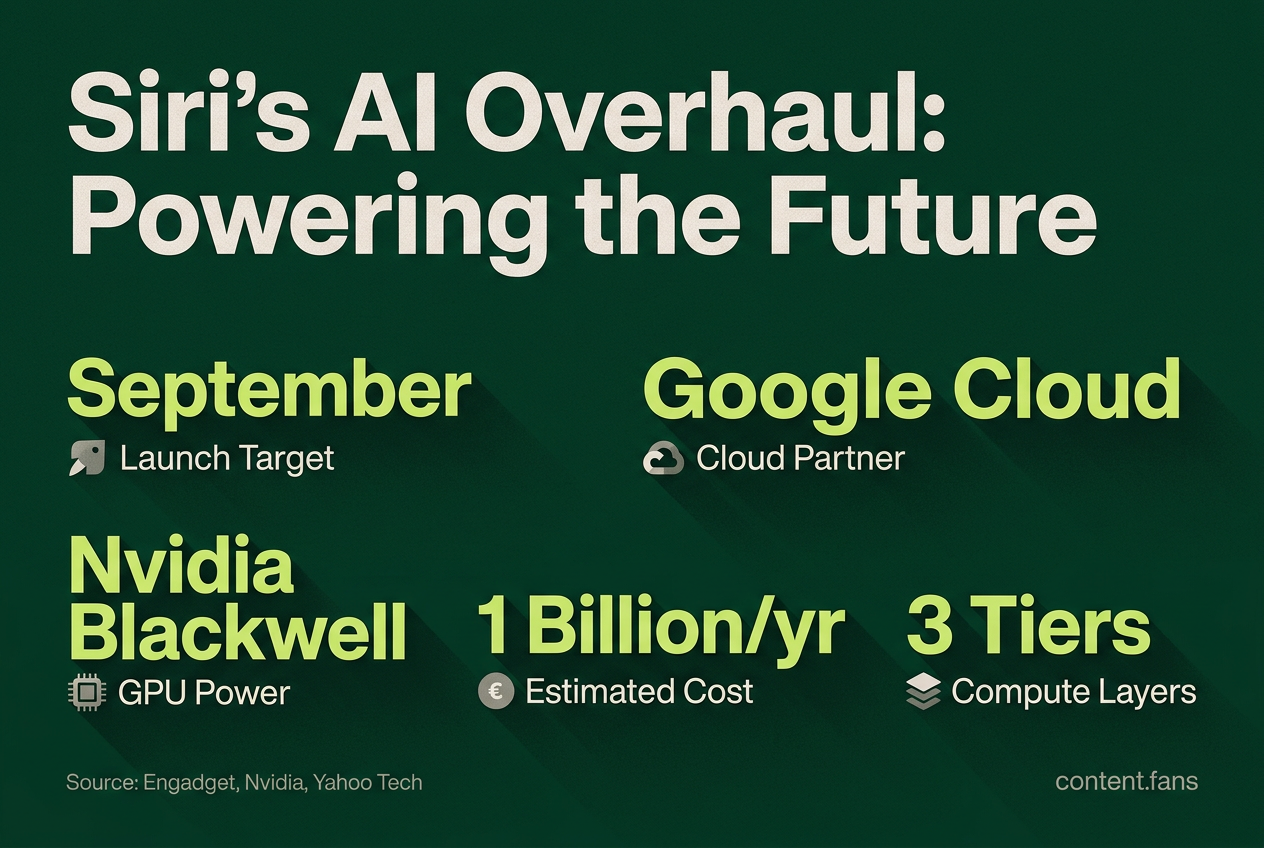
Apple plans to launch a new version of Siri in September that uses Google Cloud and Nvidia Blackwell chips for complex tasks. The new Siri may remember past questions, understand what is on-screen, and connect actions across apps. While Apple wants to keep most processing on devices for privacy, some work will go to Google Cloud, which is said to be more powerful for big requests. Privacy protections like data encryption are in place, but experts warn that some risks may remain. This change suggests Apple might be using this setup as a temporary solution until its own AI systems are ready.
Apple's overhauled Siri was reported to be targeting spring 2026 for the upgrade, with possible preview timing tied to a fall iPhone event rather than a confirmed WWDC-in-June preview and September launch. The upgrade relies on a significant infrastructure shift, including Google Cloud and Nvidia Blackwell GPUs, to power a more capable assistant. According to an Engladget report (link), the new Siri will leverage large language models for conversational memory, on-screen awareness, and multi-app actions.
While Apple remains committed to on-device processing for speed and privacy, complex AI tasks will be offloaded. Engineers reportedly determined that the company's own servers lack the power for advanced reasoning, leading to a partnership with Google Cloud. These intensive workloads will run on Nvidia Blackwell B200 GPUs, which feature confidential computing to encrypt data during processing, as detailed in Nvidia's documentation (link).
Cloud Partnership as a Bridge Strategy
Apple is overhauling Siri by adopting a hybrid AI model. While simple tasks remain on-device for privacy, complex requests will be processed on Google Cloud using powerful Nvidia Blackwell B200 GPUs. This strategy aims to significantly improve Siri's capabilities, including contextual understanding and cross-app functionality.
According to industry reports, this approach allows Apple to accelerate Siri's development while its in-house AI infrastructure matures (link). This move follows unsuccessful internal tests of Google's Gemini model on Apple's Private Cloud Compute, where performance reportedly suffered in multi-turn conversations. The estimated annual cost for the Google Cloud deployment is around $1 billion.
A Three-Tiered System for Performance and Privacy
Internally, engineers describe three layers of computation for the new Siri:
- On-device summaries for short prompts
- Apple-owned Private Cloud Compute for medium tasks
- Google Cloud with Blackwell B200 for high-complexity requests
This tiered architecture is designed to minimize external data exposure. Workloads sent to the cloud are protected by Nvidia's confidential compute, which encrypts data during inference. However, security experts emphasize that overall protection relies on correct implementation, as firmware or attestation errors could still expose user input.
What the Upgraded Siri Is Expected to Deliver
The redesigned Siri is poised to introduce several key features:
- A chat-style interface capable of remembering earlier questions in a session.
- On-screen awareness, allowing users to ask follow-ups like "add this address to my contacts."
- Cross-app actions that combine multiple steps, such as booking a table and adding it to the user's Calendar.
- A "Search or Ask" field that lets users type queries, consistent with reports of a dedicated Siri app.
To handle the demand, the Blackwell B200 infrastructure will reportedly scale across HGX racks, providing Apple access to tens of thousands of GPUs. Nvidia's B200 GPUs are highly efficient for large language models, offering significant performance gains and lower energy consumption compared to previous generations, which is crucial for delivering responses at scale.
Privacy Questions Remain
Although Nvidia's confidential computing is designed to prevent Google from accessing plaintext data, security experts warn that risks can remain through application-level logging or side-channel vulnerabilities. Apple has assured partners of "end-to-end encryption" and attested execution on Blackwell hardware but has not clarified its data retention policies on Google's network.
This partnership marks a significant departure from Apple's historical strategy of controlling its entire infrastructure. The success of the rollout will ultimately determine if this hybrid cloud model becomes a long-term solution or simply increases pressure for Apple to build out its own AI-focused data centers.
What is the release timeline for the new Siri and when will it be announced?
Apple was reported to be targeting spring 2026 for the Siri upgrade, with possible preview timing tied to a fall iPhone event rather than a confirmed WWDC-in-June preview and launch. The new version will debut as part of iOS 27, with an expected keynote reveal focused on AI features.
Why is Apple moving parts of Siri to Google Cloud?
Apple concluded its own Private Cloud Compute running on Mac-derived chips could not deliver the speed required for large-language-model workloads. A cloud switch lets Apple tap high-bandwidth Google infrastructure while still forcing all queries through Apple's privacy gateways.
Which hardware will power Siri in Google Cloud?
Apple has selected Nvidia Blackwell B200 data-center GPUs. These chips are paired with confidential compute firmware that keeps user prompts and model states encrypted in memory and during processing, lowering the attack surface for a third-party cloud.
How will user data remain private on another company's servers?
Nvidia's confidential computing stack provides:
- Encrypted GPU memory so Google cannot read prompts or model activations.
- Remote attestation that proves to Apple (and therefore to users) the workload is running on genuine, locked-down hardware.
- Zero-access guarantees covering the period when data is "in use," although logs or results delivered back to Apple's endpoints are still under Apple's control.
Does this mean Apple has abandoned its in-house AI strategy?
No. According to industry reports, the move represents a "bridge strategy": Apple licenses external performance now while continuing to build its own silicon and larger models. The approach aims to deliver a noticeably smarter Siri without waiting for Apple's datacenter scale to catch up to Google or Nvidia.