
Apple Delays Siri AI in EU Over DMA Device Access Demands
Serge Bulaev
Apple delayed its Siri AI update in the EU, saying that new EU regulations might require it to let other assistants access important device features. The EU Commission replied that Apple's choice appears to be its own, not required by law, showing there may be a disagreement. The way assistants work now depends more on rules and permissions than on technical improvements. Google and Apple are handling these rules differently, with Google giving rivals some access on Android while Apple focuses on device safety. How companies follow these regulations may shape which assistants people can use and what they can do.

Apple's delay of its Siri AI update in the EU underscores a critical shift where regulatory compliance and OS access, not just model improvements, determine an AI assistant's fate. This dynamic is playing out between Apple and Google, with the European Union serving as the key regulatory testbed.
Apple said Siri AI will not be available in the EU when iOS 27 and iPadOS 27 launch later this year, and it has no current timeline for EU availability on those platforms. Apple's stated concern is that DMA interoperability requirements could compel broader access to system-level data and functions than Apple says is safe or privacy-preserving. However, an EU Commission spokesperson stated the decision was "solely Apple's," signaling a significant regulatory disagreement.
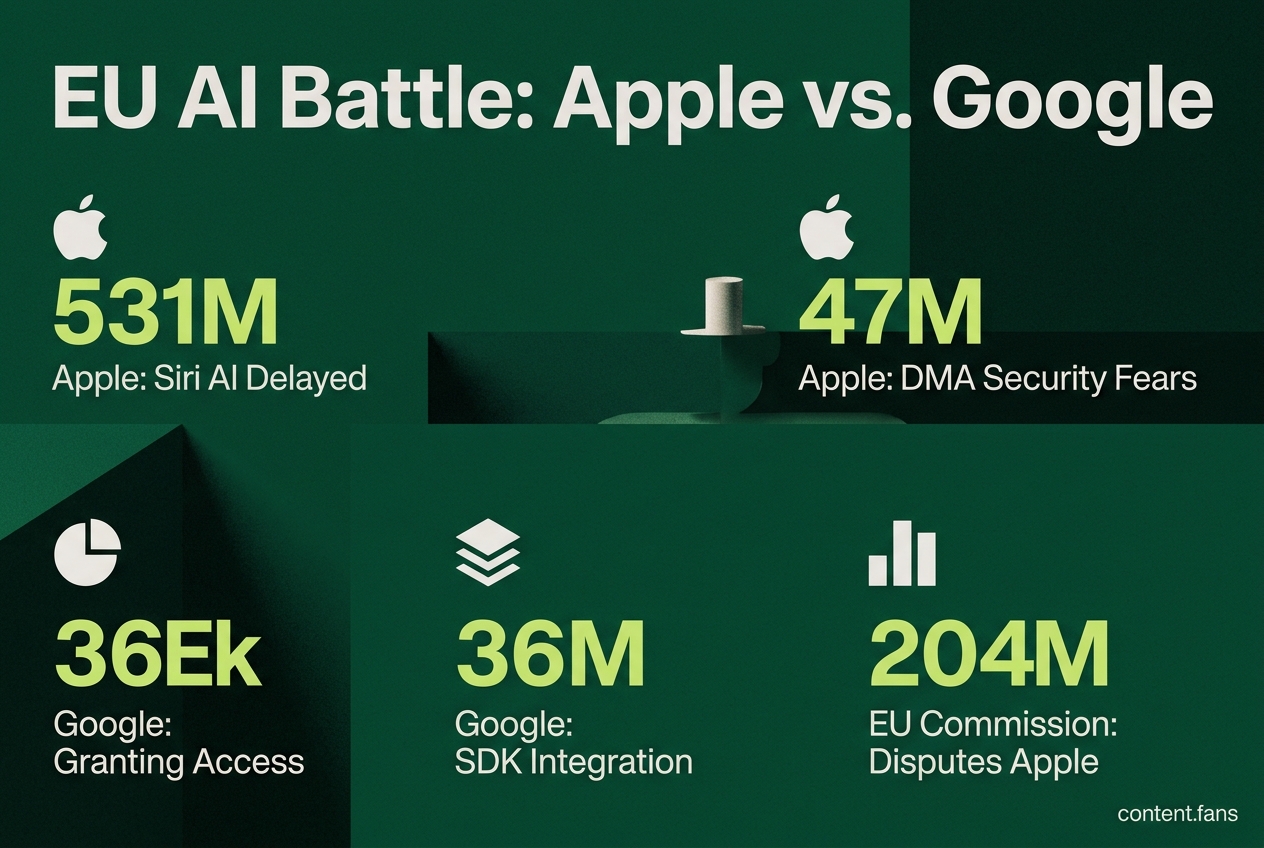
For product teams, the key takeaway is that an AI assistant's capabilities are no longer just about the model itself. Success now hinges on navigating operating system permissions, developer integrations, and complex compliance strategies, which collectively define what an assistant can actually do on a user's device.
Regulation splits Apple and Google
Apple is delaying its Siri AI rollout in the EU due to the Digital Markets Act (DMA). The company fears the DMA's interoperability rules could compromise user security by forcing it to grant third-party AI assistants deep access to device functions like messaging and payments, a claim the EU disputes.
Under the DMA, the European Commission is pursuing different actions against the two tech giants. According to industry reports, draft measures compel Google to grant rival AI services significant access to Android functions that its own Gemini assistant uses. Separately, regulators are considering rules that would force Google to share anonymized search data to help competing chatbots improve their performance.
Apple's dispute, in contrast, focuses on device security. The company argues that the DMA's interoperability mandate could create security risks, while EU officials insist the law does not require unsafe access. This highlights how a single regulation can have vastly different implications depending on the underlying platform architecture.
Developer hooks as a distribution channel
Google has strategically worked to enter the Apple ecosystem, publishing guidance on bringing Gemini models to Apple developers. This approach positions its AI as an SDK within Xcode, allowing it to leverage Apple's App Extension framework and sidestep the direct OS-level integration challenges currently blocking Siri AI's EU launch.
Meanwhile, according to industry reports, Apple is experimenting with its own "Extensions" framework. This would potentially allow users to select third-party AI models from partners like Anthropic and OpenAI to power native iOS features such as Writing Tools and Image Playground, although this functionality remains experimental.
Why OS access matters more than benchmark scores
The most powerful AI assistants are those that can perform high-value tasks like reading on-screen context, scheduling meetings, or making payments. These actions require deep integration with the operating system through secure APIs and clear privacy controls. The new regulatory landscape is now determining whether these deep integrations will remain exclusive to platform owners.
A brief comparison of strategies:
- Apple: Prioritizing device integrity, delaying its EU rollout until security concerns over DMA mandates are resolved.
- Google: Negotiating feature parity for Android rivals while defending its search data advantage.
- EU Commission: Using the DMA to enforce interoperability and dismantle digital gatekeeping.
Each party is protecting its core interests: Apple its platform security, Google its data advantage, and the EU its competitive market principles. This complex interplay demonstrates that the future of AI assistants will be defined not by model size, but by who controls OS-level access and the regulatory demands for openness.
Why is Apple delaying Siri AI in the EU?
According to industry reports, Apple announced that Siri AI will not ship in the European Union when iOS 27 and iPadOS 27 arrive. Apple's stated concern is that DMA interoperability requirements could compel broader access to system-level data and functions than Apple says is safe or privacy-preserving, including the ability to read messages, send purchases, open files, and control any app. The Commission counters that the law does not prevent Apple from launching new products and calls the delay Apple's own decision. The stand-off centers on whether Apple must expose its on-device context, app intents, and user data to rival AI assistants under DMA requirements.
How is the DMA affecting Google's AI strategy?
While Apple is withholding a feature, the Commission is forcing Google to open two key assets:
- Android feature parity - according to industry reports, draft DMA measures require Google to give competing AI services equivalent access to voice activation, on-screen content capture, and cross-app actions that Gemini enjoys.
- Search data feeds - regulators are preparing rules that would make an anonymized slice of ranking, query, click, and view data available to AI chatbot providers on fair, reasonable, and non-discriminatory terms.
According to industry reports, final binding measures are expected in the coming months.
What does OS-level access mean for developers?
According to industry reports, both mobile platforms are moving from standalone AI apps to OS-brokered intelligence:
- Apple's "Extensions" framework (reportedly in development but not yet released) would let iOS users choose Google, Anthropic, or OpenAI as the backend for Siri replies, Writing Tools, and Image Playground.
- Android is building an agent platform where the OS itself routes tasks among approved models, with Samsung already previewing multi-agent orchestration under One UI 7.
The takeaway for developers: future success will depend less on model performance and more on how deeply your assistant can plug into system-level intents and private user context.
Can user privacy be preserved while granting AI broader access?
According to industry reports, emerging best practices follow a privacy-by-design playbook:
- No-training defaults - many vendors ship with model-improvement toggles disabled and ephemeral chat modes enabled.
- Data minimisation - only the exact data needed for the requested action is exposed, filtered by on-device privacy budgets.
- Enterprise-grade audit trails - every AI interaction is logged, limited to role-based access, and reviewable.
These steps keep companies compliant with the EU AI Act and emerging U.S. state privacy rules, turning privacy from a roadblock into a competitive differentiator.
When might EU users finally get Siri AI?
Apple and EU regulators have given no firm date. According to industry reports, the next milestones include:
- Coming months - Commission finalises Android and search-data measures; the outcome may signal how much additional negotiation Apple faces.
- iOS 27 beta activity is centered on developer beta testing, with public release expected in September; Apple has not provided a timeline for when EU availability might be restored.
Until both sides resolve the scope of DMA-mandated device access, Siri AI remains off the table for EU residents.