
Anthropic's new token pricing causes enterprise cost uncertainty
Serge Bulaev
Anthropic has changed its pricing from per-seat plans to token-based charges, which may make costs less predictable for enterprise customers. Buyers now need to estimate monthly spending based on token use, and pay even if their actual use is lower. Former bulk discounts appear to be gone, so costs might be higher and harder to forecast. Finance teams may need to closely track usage and make three-case forecasts, as swings in token use and model changes could affect the bills. The situation suggests that companies are looking for better tools to monitor costs and are testing new contract terms to limit financial surprises.

Anthropic's new token pricing model is creating significant cost uncertainty for enterprise customers by replacing predictable seat-based plans. According to IT Brief, this shift to metered charges with monthly spending commitments disrupts traditional budgeting, forcing finance teams to overhaul their forecasts.
The company has discontinued its former pricing tiers, introducing role-based seat fees on top of separate API fees for all usage. Critically, NPI Financial reports that enterprises must commit to a minimum monthly spend and pay that amount even if actual usage is lower.
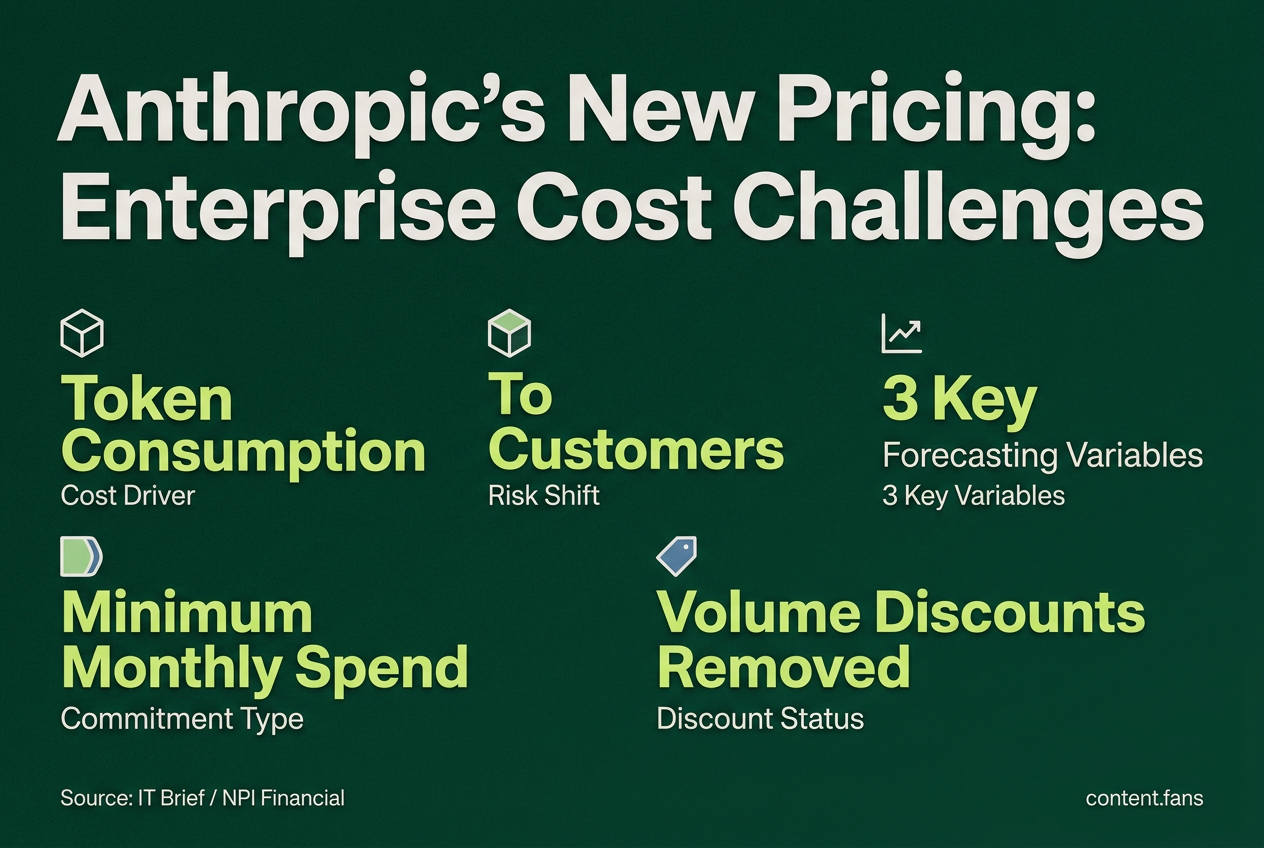
Why Token-Based Billing Increases Financial Volatility
The new model shifts financial risk to customers, as costs scale with token consumption rather than a fixed headcount. The removal of previous volume discounts, combined with mandatory spending commitments and variable usage patterns, makes it significantly harder for finance teams to forecast and control AI expenditures.
This structure introduces volatility because spending is tied to token volume instead of a predictable employee count. The removal of former volume discounts further compounds the issue. Financial controllers must now model three key variables: the number of users, token intensity per workflow, and financial exposure from usage commitments. According to industry reports, the wide variance in potential costs highlights why complex scenario planning is replacing simple budgeting.
Key Forecasting Pain Points
- Usage Volatility: Complex prompts, multiple retries, and automated agent workflows can unexpectedly double or triple token consumption.
- Inflexible Commitments: Companies are locked into paying for their estimated usage, even if projects are paused or adoption slows.
- Loss of Volume Discounts: The elimination of bulk discounts means a higher marginal cost for every token used, increasing overall spend.
- Complex Cost Allocation: Attributing the cost of a shared AI model to specific projects or departments requires granular, real-time tracking.
- Model Evolution: Frequent updates to model capabilities, like larger context windows, can alter token requirements and disrupt forecasts.
Emerging Governance and Cost Control Responses
In response, finance leaders are demanding more sophisticated cost management tools. AI vendors providing real-time, granular dashboards that track usage by user or project are gaining a competitive advantage in renewals. Where native tools are insufficient, enterprises are deploying their own middleware to log prompt and completion data for pre-invoice cost analysis and control.
New Contract Tactics for Enterprises
To regain control, procurement teams are testing new contractual safeguards to mitigate budget risks.
| Clause | Purpose |
|---|---|
| Overage guardrail | Caps spend at a preset multiple of commitment |
| True-up window | Lets customer re-size commitment mid-term |
| Token-level audit | Grants right to inspect vendor metering logic |
| De-scoping exit | Allows model mix change if costs exceed threshold |
Beyond these clauses, negotiators are also pushing for credits that roll over for at least one quarter to reduce the financial impact of slow adoption. Industry advisors now recommend tying renewal discounts to verified usage growth rather than flat commitment volumes.
Outlook for Future Budgeting Cycles
Looking ahead, many organizations are adopting multi-scenario forecasting to model potential token trajectories. As NPI Financial observes, teams experimenting with Claude-powered agents often fall into the high-cost scenario until their workflows are fully optimized. This trend signals a broader market shift where predictable AI costs will depend more on disciplined implementation and internal governance than on the vendor's list price. Finance teams must continuously adapt these controls as Anthropic's models and features evolve.