
Anthropic's Claude Adopts Brand Skills for Consistent AI Content
Serge Bulaev
A 2024 guide explains how to make Anthropic's Claude assistant use the same brand tone, words, and colors by loading a special ZIP folder with clear instructions. Experts suggest this method may help Claude write faster and more consistently, especially when prompts match the skill description. Early reports from companies like Cox Automotive show possible business benefits, but clear numbers on voice consistency are still limited. Some users find that simple prompts might not always trigger the brand skill, hinting that prompt design still matters. Final checks by humans are needed, as the guide says QA steps remain important to avoid mistakes in brand language or color use.

Industry reports suggest a growing standardization in how to use Anthropic's Claude Brand Skills for consistent AI content, turning a niche developer trick into a repeatable process. The method uses a compact ZIP folder to give Claude a persistent brand identity, complete with a specific tone, terminology, and color palette. Practitioners are already reporting on what works and what remains experimental.
Experts note the primary benefit is the fusion of speed and consistency. By encoding brand rules once, the model can automatically reference them whenever a prompt aligns with the skill's description, ensuring reliable output.
Inside the SOP: How to Build a Brand Skill That Makes Claude Sound Like Your Brand (Full SOP)
The recommended folder structure is simple but opinionated:
- SKILL.md (skill description that triggers loading)
- Brand foundation
- Voice and tone spec
- Visual guidelines with machine-readable assets
- Channel formats
- Content formats
A Claude Brand Skill is a folder of instructions that codifies a company's brand guidelines for the AI. By defining voice, tone, and formatting rules in specific files, the Skill enables Claude to generate content that is consistently on-brand, improving both speed and quality assurance for marketing teams.
Early effectiveness signals
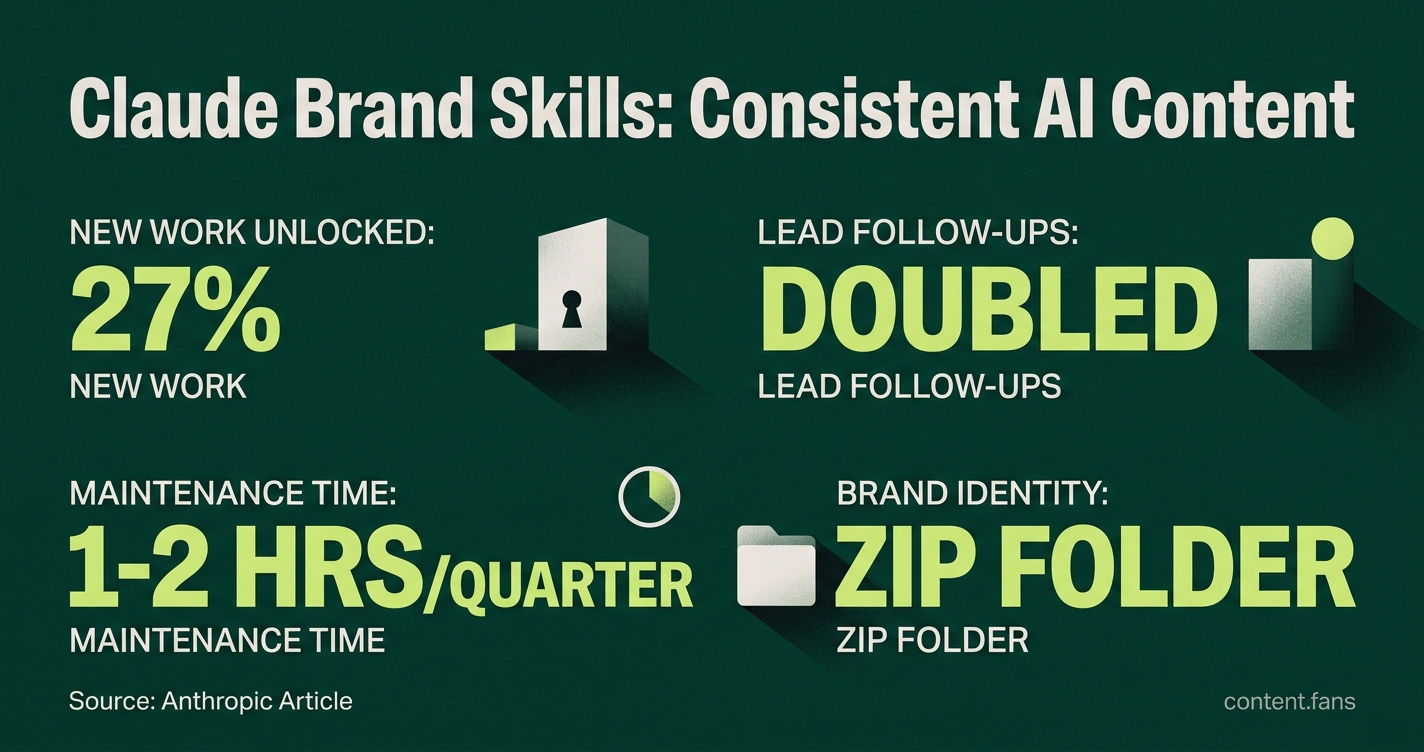
Internal research from Anthropic reveals that 27% of Claude-assisted work involved tasks "that wouldn't have been done otherwise" (anthropic.com), suggesting these reusable skills can unlock new creative potential beyond just accelerating existing workflows.
Externally, success stories include Cox Automotive, which reportedly doubled lead follow-ups and test drive appointments by using Claude for personalized emails and landing pages. While not explicitly tied to a formal Brand Skill, this result highlights the business value of consistent, on-brand language.
Writing for his newsletter, Simon Willison explains that Skills function as "folders with instructions, scripts, and resources" that Claude loads on demand (simonw.substack.com). This on-demand loading minimizes prompt drift and reduces context window size, making the process more efficient.
Governance mechanics
The SOP recommends a formal Quality Assurance (QA) rubric to catch deviations before publication. For each personality trait, the rubric should define three calibration points - "in practice," "too far," and "too flat" - to serve as guardrails. Ongoing maintenance is minimal, estimated at one to two hours per quarter to update examples and banned phrases.
To adapt to different contexts, practitioners can add metadata tags within the SKILL.md file, guiding Claude to use the correct tone for blog posts versus social media. Similarly, embedding CSS variables for brand colors allows the AI to reference them directly without manual input, preventing errors.
Limitations to monitor
Quantified, public case studies on voice consistency are still emerging. Many companies are adopting these approaches but detailed metrics remain limited. Furthermore, field tests indicate that simple prompts may not reliably activate a skill, suggesting that effective prompt engineering remains crucial for consistent performance.
Ultimately, human oversight remains essential. The SOP emphasizes that even a well-built Skill augments, not replaces, editorial judgment. The QA rubric acts as the final safeguard against off-brand messaging or accessibility issues like poor color contrast.
What exactly is a "Brand Skill" in Claude and how do I create one?
A Brand Skill is a ZIP folder that contains a SKILL.md manifest plus five supporting files, all uploaded to Claude under Customize > Skills.
The five core files are:
1. Brand foundation - mission, audience, positioning
2. Voice & tone - personality traits with three calibration points each (in-practice / too far / too flat)
3. Visual guidelines - CSS variables, logo rules
4. Channel formats - email, social, release notes
5. Content formats - persona docs, blog posts, landing pages
Add 8-12 hand-picked reference samples and a QA rubric to stop voice drift. Total set-up: 4-6 hours; maintenance: 1-2 hours per quarter.
Does Claude Brand Skill work for real companies and what results have they shared?
Public case studies are still limited, but available numbers look strong:
- Cox Automotive - Claude-generated emails and vehicle descriptions doubled lead follow-ups and test-drive appointments.
- Brand.ai - Anthropic lists the firm as a customer story; although the detailed metrics are not released, the listing confirms Claude is used to "make brands more human."
- An independent developer write-up reports that after building a 20-minute brand-guidelines skill, every document Claude produced automatically followed brand standards and saved "hours per project."
How do I curate the reference corpus so Claude stays on-brand without noise?
Keep it tight and intentional:
- Size: 8-12 best-in-class pieces (not your entire archive).
- Scope: include a social post, a technical deep-dive, a support reply - enough for Claude to learn across contexts.
- Annotation: tag each sample with audience, funnel stage, and tone trait; add positive/negative rewrites.
- Quality gate: review by brand stakeholders; exclude legacy or SEO-first copy that no longer reflects the desired voice.
This "small enough to review manually, broad enough to cover contexts" approach is consistently recommended by industry practitioners.
How does Claude's Brand Skill compare with OpenAI Custom GPTs or Microsoft Copilot Studio?
| Tool | Brand-voice strength | Main note |
|---|---|---|
| Claude Skills / Brand Skill | Purpose-built folder system that encodes voice rules once and re-uses them everywhere Claude runs (web, API, SDK). | Consistency is high, but quality still depends on the skill author. |
| OpenAI Custom GPTs | Good for persona-driven chat, yet sources frame them as less portable across environments. | Best if you already live inside ChatGPT. |
| Microsoft Copilot Studio | Powerful for enterprise automation, but more of a workflow builder than a file-based brand bundle. | Ideal if your stack is Microsoft-first. |
VentureBeat summarizes: "Anthropic's Skills are packaged, reusable instructions that travel with the model," making Claude the clearest fit for teams that want portable, reusable brand governance.
What ongoing maintenance keeps a Brand Skill from drifting off-tone over time?
Quarterly 1-2 hour touch-ups are enough:
- Audit the corpus - swap in two or three fresh high-performing assets, drop dated ones.
- Update banned-phrases list - add any new words or claims competitors have started to use.
- Run spot checks - generate sample copy, score against the QA rubric for voice, tone, and visual match.
- Version-control the ZIP - treat it like code so rollback is painless.
Teams that skipped these steps saw noticeable tone drift within six months; those that kept the cadence maintained brand consistency without extra overhead.