
Anthropic's Claude 4.6 outperforms OpenAI's GPT-5.2 in finance benchmarks
Serge Bulaev
Early 2025 data suggests that Anthropic's Claude 4.6 may perform better than OpenAI's GPT-5.2 on some finance benchmarks. Other studies show Claude 3.5 Sonnet also appears to be more accurate than GPT-4o in certain stock-forecasting tests. These results indicate that choosing the best AI model depends on the specific task, not just the brand. Many investment firms are still testing AI agents and seem to prefer having humans involved until rules and processes are more defined. No single tool does everything, so teams often use a mix of platforms to get the best results for their needs.

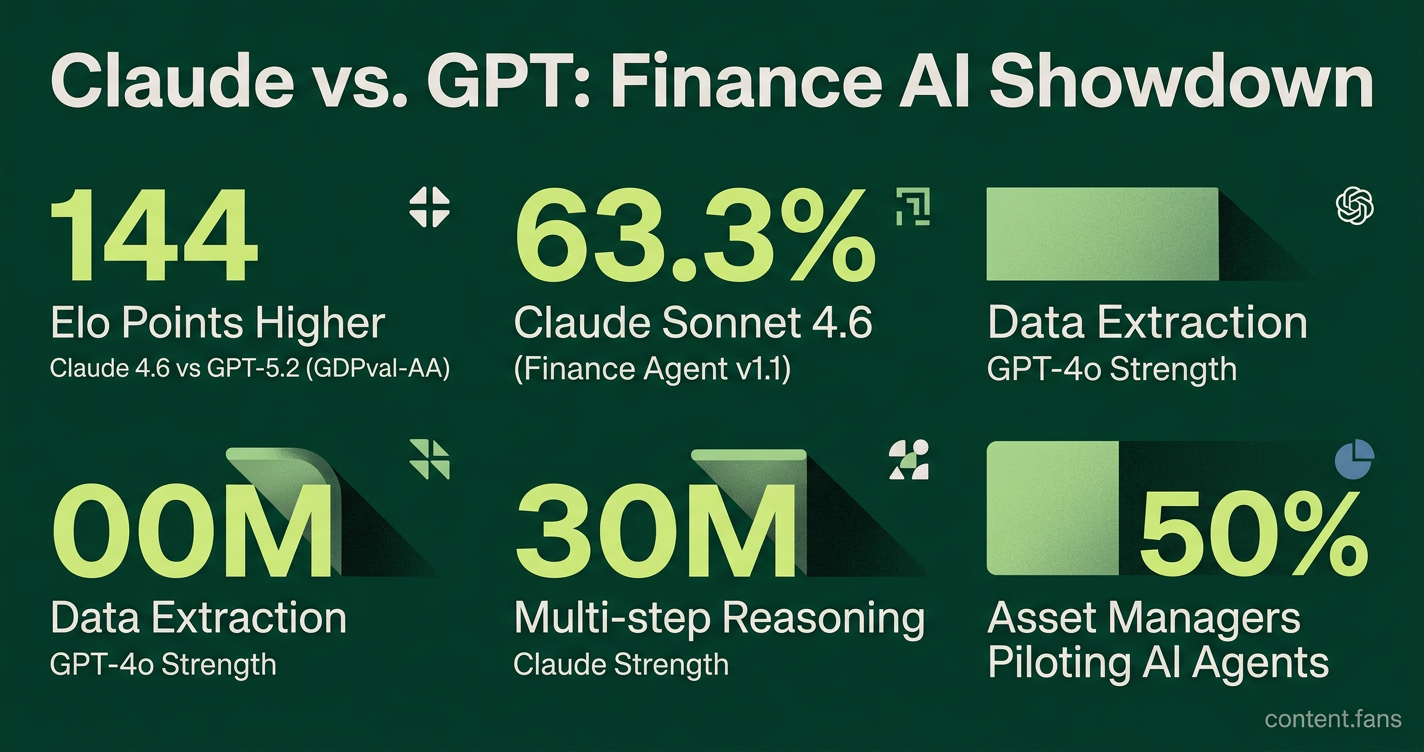
Anthropic says Claude Opus 4.6 outperforms OpenAI's GPT-5.2 on GDPval-AA, an economically valuable knowledge-work benchmark that includes finance, by around 144 Elo points, signaling a pivotal shift for institutional investors. While large language models (LLMs) are now central to the modern AI stack, emerging evidence from sources like Anthropic shows that model selection is becoming highly task-specific. According to industry reports, Claude models have shown advantages in certain financial forecasting tasks. This data underscores that choosing the best AI is no longer about brand loyalty but about matching the right model to a specific financial workflow.
Institutional investors now approach the AI stack in three distinct layers: foundational horizontal LLMs, agentic workflow orchestration, and finance-specific intelligence platforms. The value of each layer is judged on its performance across accuracy, latency, domain coverage, and cost.
Horizontal LLMs: Core Strengths and Trade-offs
Anthropic says Claude Opus 4.6 outperforms GPT-5.2 on GDPval-AA by around 144 Elo points; another third-party summary claims Claude Sonnet 4.6 scored 63.3% on Finance Agent v1.1, but not the exact 64.4% vs 60.0% figures in this claim. While GPT-4o maintains an edge in specific data extraction tasks, Claude models have shown strong performance in multi-step financial reasoning and forecasting workflows according to industry reports.
While benchmark summaries provide a high-level view, neither model provider offers a direct, apples-to-apples comparison of hallucination rates, forcing investment desks to rely on internal guardrails. In practice, this leads to a task-based routing strategy:
- Forecasting or multi-step reasoning: The Claude Opus family is often preferred.
- Structured extraction or template-driven output: GPT-4o remains a strong choice.
Agentic Automation in the Modern Investor's AI Stack
Adoption of agentic AI in finance is accelerating, though cautiously. Industry reports from ScienceSoft indicate that while a significant portion of asset managers are piloting AI agents, a smaller percentage have moved them into production environments. Initial successes are concentrated in administrative support for adviser workflows, with slower, more deliberate scaling for compliance and document drafting. This cautious approach highlights a strong preference for human-in-the-loop (HITL) oversight until formal AI governance frameworks are fully established.
Finance-Tailored Intelligence Platforms
While AlphaSense is a leader in unstructured document search, the market for financial intelligence is highly segmented. Different platforms excel at specific workflows, creating a competitive and specialized ecosystem.
| Workflow | Closest Alternatives | Relative Edge vs. AlphaSense |
|---|---|---|
| AI Document Research | Hebbia, Fintool | More end-to-end diligence workflows |
| Structured Data Terminals | Bloomberg, FactSet, S&P Capital IQ Pro | Real-time market data and analytics |
| Private-Market Intelligence | PitchBook, Crunchbase | Deeper venture and PE coverage |
| Competitive Intelligence | Contify | GenAI-validated alerts from 1M+ sources |
| Expert Insights | Third Bridge, GLG | Human-led interview transcripts |
As highlighted on Contify's platform comparison, the competitive landscape is structured around specific use cases. This reinforces a key industry trend: investment desks are not seeking a single 'do-it-all' tool but are strategically weaving together multiple platforms to build a comprehensive intelligence stack.
Putting the Stack to Work
An effective modern research workflow often involves a multi-stage process: discovery using a specialized platform like AlphaSense, summarization via a powerful LLM, and workflow orchestration through an agentic layer - all followed by mandatory human review. To manage risk, firms implement robust controls like versioned prompts, automated hallucination checks, and strict audit logs before insights are delivered to portfolio managers. As costs remain a factor, teams continually evaluate tools based on the marginal time saved per research hour, adjusting their stack annually.
Ultimately, the evidence points toward a strategy of selective deployment. The most successful teams map specific use cases to the optimal layer of the AI stack - using foundational models for reasoning, agents for automating workflows, and specialized platforms for deep domain expertise. This layered approach enables firms to harness AI's efficiency gains while maintaining critical safeguards against over-automation.
How does Claude Opus 4.6 actually outperform GPT-5.2 on finance tasks?
A provided third-party comparison says Claude Sonnet 4.6 scored 63.3% on Finance Agent v1.1, while Anthropic's original Claude Opus 4.6 announcement cites a GDPval-AA lead over GPT-5.2 of about 144 Elo points. Furthermore, its predecessor, Claude 3.5 Sonnet, has shown advantages in certain stock-forecasting tasks according to industry reports, highlighting the Claude family's strength in reducing hallucinations and delivering superior financial reasoning.
Which parts of the research workflow favor horizontal LLMs vs. finance-specific platforms?
- Discovery & Filtering: Specialized platforms like AlphaSense, Bloomberg, or PitchBook excel due to their vast, proprietary datasets of filings, transcripts, and private-market data, plus real-time alerting capabilities.
- Summarization & Reasoning: Claude 4.6 is superior for synthesizing complex documents like 10-K risk sections, earnings call takeaways, or macroeconomic scenarios, often with better citation.
- Structured Extraction: GPT-4o can have an edge for tasks requiring absolute precision, such as converting XBRL data to tables or generating strictly formatted output for other models.
- End-to-End Workflow: Most firms currently combine platforms, such as running AlphaSense queries → Claude summary → human review, deferring full agentic automation until governance matures.
What does industry data say about agentic automation in institutional investing?
- Production Use: A significant portion of asset managers and PE firms now have AI agents in production, according to industry reports cited by ScienceSoft.
- Piloting: A growing number are actively piloting multi-step agents for tasks like compliance checks, earnings preparation, and portfolio rebalancing.
- Rapid Growth: Adoption is accelerating quickly across the industry.
- Primary Barrier: The main obstacle is not model accuracy but trust and governance. Firms universally insist on human-in-the-loop approvals before an agent can execute a trade or make a filing.
How do cost and latency compare across the three tool categories?
| Tool Category | Typical Cost Range | Avg. Latency | Notes |
|---|---|---|---|
| Horizontal LLMs (Claude 4.6 / GPT-5.2) | Low to moderate | <2 s | Cheapest for summarization; costs scale with token volume. |
| Agentic Layer (LangGraph, custom) | Moderate | 5 - 15 s | Adds orchestration and memory; cost rises with step count. |
| Finance Platforms (AlphaSense, Bloomberg) | High annual licensing | <1 s for alerts | Priciest but includes data rights and compliance features. |
Rule of Thumb: Use LLMs for drafts, agents for multi-step tasks, and finance platforms for source-of-truth data.
How are risk controls evolving for Claude-first finance workflows?
Firms adopting Claude 4.6 as their primary reasoning engine are implementing four key safeguards to ensure reliability and compliance:
1. Versioned Prompts: Prompts are stored in version control systems (e.g., Git) with formal review processes, creating a complete audit trail.
2. Automated Hallucination Checks: A secondary AI call is often used to verify that all figures and claims in a summary are traceable to a source document.
3. Data Access Controls: Models are granted read-only access to financial data lakes and are firewalled from any direct trading or execution APIs.
4. Human Sign-Off Gates: Workflows are designed to pause and require human approval if any step falls below predefined confidence thresholds, aligning with emerging regulatory guidance on model governance.