
Anthropic's AWS Spend Highlights AI Vendor Lock-In Risks
Serge Bulaev
Anthropic's large spending commitment to AWS may show the risks of getting locked in with one AI cloud provider, especially after Amazon changed its billing model and costs reportedly increased. Legal teams may use contracts to keep exit options open, keep control of data, and limit sudden price hikes, while new rules in the EU could require easier switching between providers. Architecture teams suggest building systems that work with many AI models so companies can switch providers more easily if needed. These steps may not remove all risks, but they help companies stay flexible if costs or rules change suddenly.

The Anthropic-Amazon deal starkly illustrates the AI vendor lock-in risks facing modern enterprises. According to industry reports, Anthropic has committed to significant cloud spending on AWS, and enterprises are increasingly reporting unexpected cost increases from changing billing models, showing how quickly leverage can vanish. This guide offers executives clear strategies for negotiating rights and building portable systems to maintain flexibility before a supplier alters terms or pricing.
Contractual Guardrails to Mitigate Lock-In
To avoid AI vendor lock-in, enterprises should focus on two key areas. Legally, contracts must include clear exit rights, data ownership clauses, and price stability terms. Architecturally, systems should be built using multi-model abstraction layers that decouple applications from any single AI provider, ensuring portability.
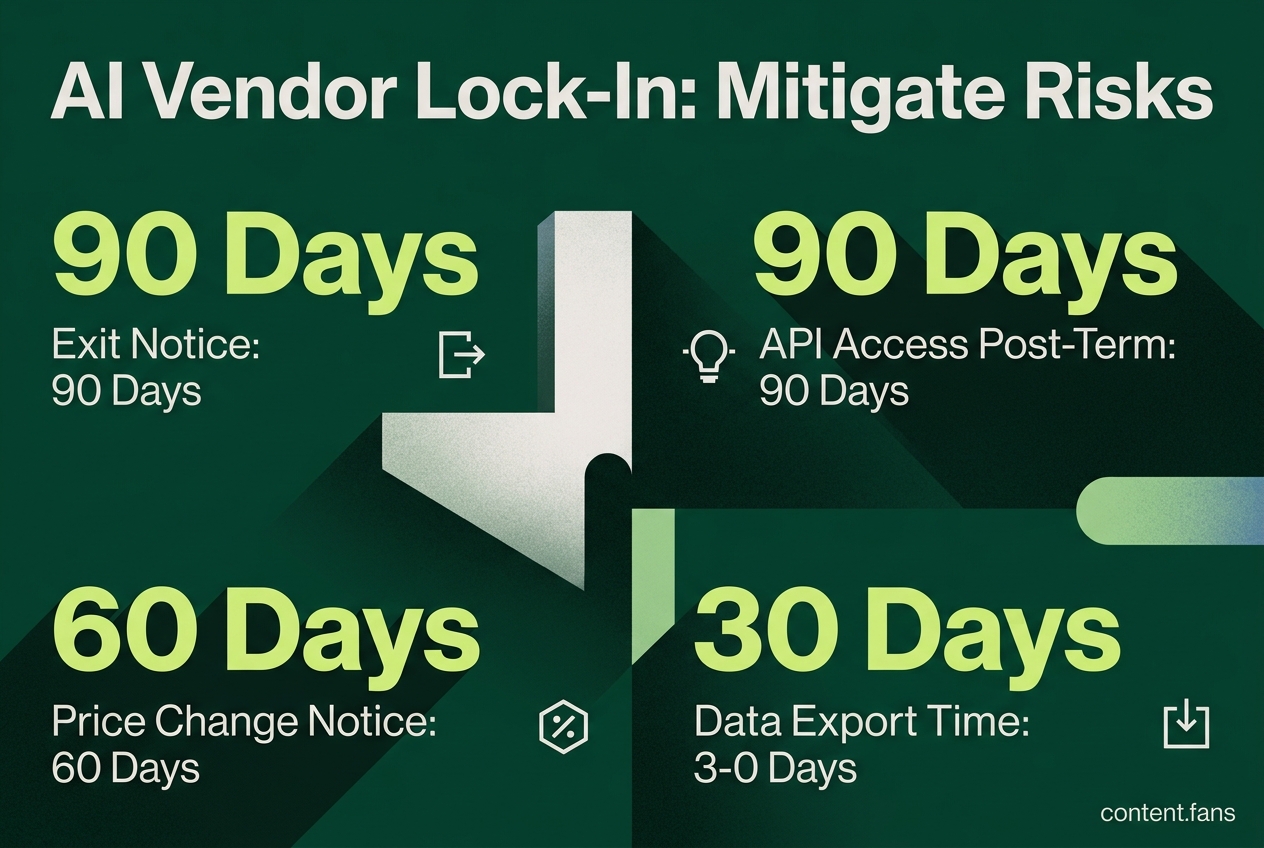
Legal teams should build contracts around three pillars:
1. Exit Rights: Secure a 90-day termination-for-convenience clause and ensure at least 90 days of post-termination API access to facilitate a smooth transition.
2. Data Control: Mandate contract language that grants your organization unlimited rights to all training data and any derivative model weights.
3. Price Stability: Include clauses that cap rate increases and require a minimum 60-day notice for any pricing changes, creating a window to evaluate alternatives.
Regulatory requirements, like Article 23 of the EU Data Act, also compel providers to remove switching barriers. An audit-rights clause for training data provenance is also crucial for EU AI Act compliance.
Portable Architecture Patterns Keep Options Open
Architecture teams can prevent deep integration with a single vendor by decoupling application code from specific models. Adopting a multi-model abstraction layer allows you to treat LLMs as interchangeable inference engines, a concept detailed in Stop Marrying Your Model (Architecture and Governance). This approach enables task-based routers that direct simple queries to cheaper models, reserving premium models for complex tasks.
Key portability enablers include:
- Containerization: Using Kubernetes for cloud-neutral deployments.
- Infrastructure as Code (IaC): Employing templates to replicate environments across different clouds quickly.
- Unified Observability: Using OpenTelemetry agents to consolidate logs and traces into a shared stack.
When billing models change unexpectedly, having fallback chains with cached, lightweight models can preserve core functionality without incurring high costs.
Checklist Before Signing or Deploying
- Verify the vendor can provide a structured data export (JSON or Parquet) within 30 days of a request.
- Require vendor support for standard routing libraries like LangChain.
- Test a second provider monthly, documenting performance and cost differences.
- Align contract renewal dates with major product milestones to strengthen your negotiating position.
- Conduct a tabletop exercise simulating an API shutdown to validate your exit strategy.
Proactive contracting and a layered, portable architecture do not eliminate dependency, but they convert a potential crisis into a manageable negotiation. Companies that budget for redundancy and insist on explicit rights can confidently switch providers when economics or ethics require it.
What just happened between Anthropic and Amazon and why should I worry about vendor lock-in?
According to industry reports, Amazon has made significant investments in Anthropic, with Anthropic committing to substantial AWS spending over multiple years.
- The deal reportedly secures Anthropic access to dedicated Trainium chips - hardware that exists only inside AWS.
- Such contracts often include spending commitments that can create dependency relationships.
Because these types of agreements are becoming more common, other enterprises can see how quickly a preferred cloud can turn into a mandatory cloud. Any provider relationship that reaches significant scale can create situations where price or billing model changes have limited notice periods, leaving your product roadmap or budget exposed.
Which contract clauses should I negotiate before signing with an AI vendor?
The 2026 Pentagon designation of Anthropic as a supply-chain risk did not block commercial access; AWS and other providers confirmed Claude remains available for non-defense customers. There is no specific 'template' to treat as a cautionary tale in the commercial sector. Key clauses to consider:
- 90-day termination-for-convenience after the first 12 months, with no claw-back of implementation credits.
- Price-change notice periods and rate protection (enterprises are increasingly reporting significant price changes with limited notice).
- Portability mandate: the vendor must commit to maintaining an open-format export (JSON, Parquet) of all data, prompts and fine-tuned weights within 30 days of request.
- Audit rights over training provenance to satisfy incoming EU AI Act duties.
- Post-termination API access for at least 90 days to prevent a hard cut-off during migration.
What technical architecture patterns keep me vendor-agnostic?
Build for interchangeable inference engines, not a single model. Recommended patterns from recent implementations:
- Multi-model abstraction layer (LangChain, AutoGen) so switching providers is a configuration change, not a re-write.
- Task-based router: classify the query, then send simple tasks to cheap/fast endpoints and complex reasoning to premium endpoints. Organizations report meaningful cost reductions without quality loss.
- Fallback chain: attempt the most cost-effective model first; escalate only when confidence is low.
- Containerised inference (Docker/Kubernetes) so the same code runs on any cloud or on-prem cluster.
- Open-weight backup: keep a distilled 7-13 B parameter model on standby for critical features if upstream costs spike.
How can operations teams monitor and test for lock-in risk?
Set up monitoring practices before the contract is signed:
- Monthly vendor-spend tracking: monitor actual vs forecast spending patterns and establish review triggers for significant deviations.
- Model-output drift alert: run a parallel shadow request to an open-weight model and measure BLEU/ROUGE similarity; if scores drop below agreed SLA, escalate.
- Renewal timeline alignment: schedule renewal windows well ahead of major product launches so you have real bargaining power.
- Quarterly disaster-recovery drill: actually migrate a non-production workload to an alternative provider and measure RTO/RPO; teams that rehearse this significantly reduce migration complexity and time.
Is there a simple checklist my procurement and engineering teams can share?
Yes. Consider this AI lock-in checklist for your vendor evaluation:
| Area | Checkpoint | Owner | Evidence |
|---|---|---|---|
| Data | Export in JSON/Parquet within 30 days | Eng | Signed clause & sample export |
| Price | Reasonable notice + annual protection | Legal | Contract appendix |
| Exit | 90-day termination + 90-day API grace | Legal | Contract schedule |
| Arch | Abstraction layer tested quarterly | Eng | Git repo + CI test |
| Ops | Shadow model accuracy ≥ baseline | Ops | Grafana dashboard screenshot |
Teams that implement comprehensive vendor evaluation processes report smoother contract negotiations and reduced switching complexity in pilot migrations.