
Anthropic's 2026 AI model ban for foreign nationals sparks talent risk playbook
Serge Bulaev
Anthropic's decision in June 2026 to block access to its latest AI models for all foreign nationals, following a U.S. government order, may shrink the talent pool and could influence other labs to do the same. A playbook has been created to help companies manage risks from such policy changes, including mapping employee status, diversifying hiring, upskilling local staff, and monitoring legal changes. The playbook suggests that companies may need to make backup plans for crucial roles, recruit from more regions, and support staff affected by restrictions. It also recommends companies prepare for sudden policy shifts and keep track of key talent metrics. Experts suggest these steps may help companies keep projects on track despite ongoing uncertainty.

The urgent need for an AI talent risk playbook has become an operational reality due to policies like Anthropic's AI model ban for foreign nationals. In June, Anthropic responded to a U.S. government export control order by blocking its newest models from all foreign nationals, including its non-citizen staff. Experts suggest this move will shrink the available frontier-model talent pool and set a precedent for other labs. This playbook provides HR, legal, and engineering leaders with a strategic reference to ensure that access controls and visa uncertainty do not derail product timelines.
1. Map exposure across roles and workflows
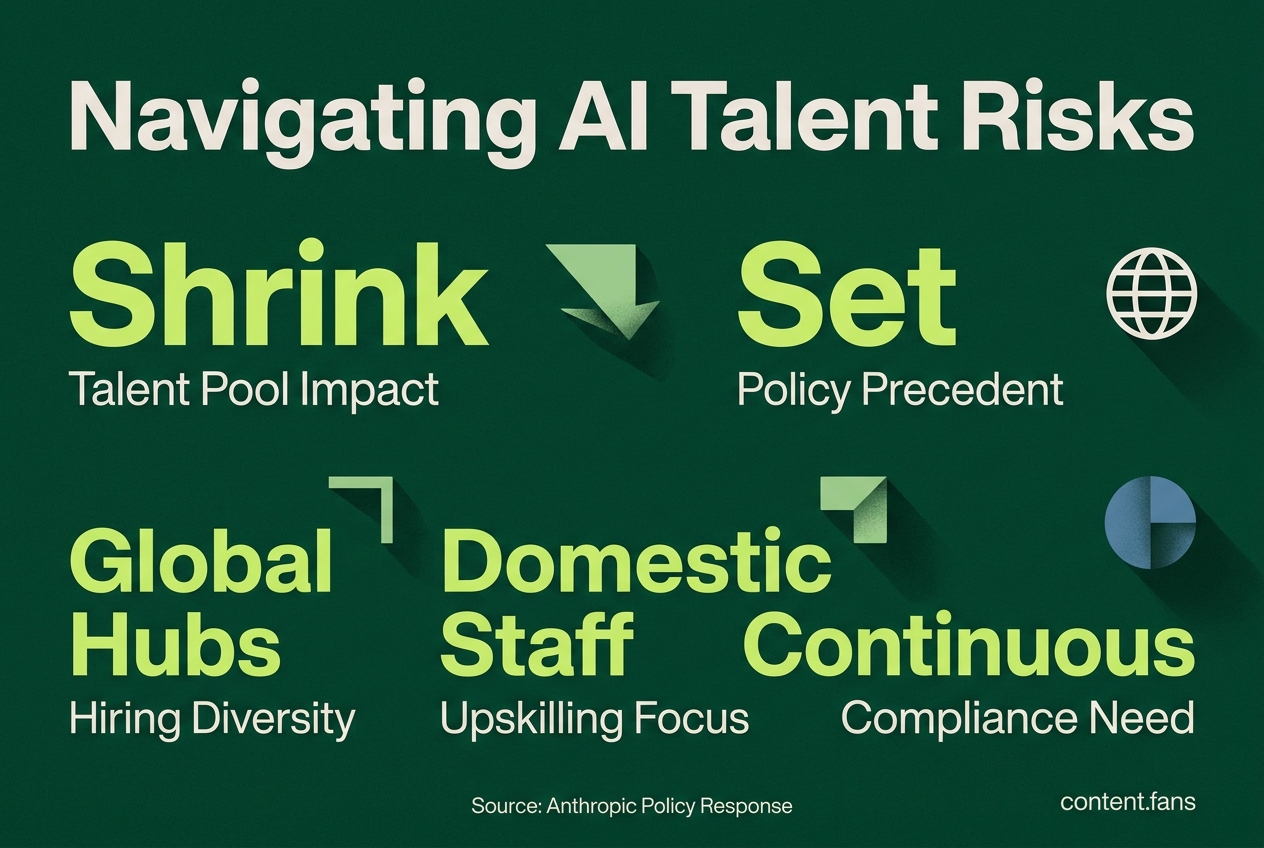
Companies can manage talent risk by implementing a strategic playbook. Key actions include mapping employee citizenship and visa status against critical projects, diversifying hiring pipelines to include global talent hubs, accelerating internal training for domestic staff, and establishing a proactive compliance and advocacy process to navigate regulatory changes.
Start by conducting a comprehensive skills census to document each AI employee's citizenship, visa status, and model access needs. Industry reports recommend aligning the census with business value streams so critical workflows are visible to executives. For any role where a foreign national has sole ownership of a potentially restricted capability, implement a shadow assignment plan to prevent single-point delays.
2. Diversify hiring pipelines
Proactively mitigate recruiting risks by diversifying your hiring pipeline before a policy crisis hits. Adopt a hybrid staffing model that combines full-time employees for core platform and governance roles with contractors for specialized MLOps and data-labeling projects. Broaden your talent search to international hubs in Latin America, Eastern Europe, and India, which can lead to faster hiring and lower salary costs. To ensure quality at scale, implement inclusive sourcing metrics like diverse interview panels, structured questions, and conversion rate tracking.
3. Upskill domestic employees at pace
Invest in upskilling your domestic workforce to build internal resilience. Following advice from the World Economic Forum, establish a clear AI skills taxonomy to connect training initiatives directly to business-critical projects. Offer role-based learning paths, internal hackathons, and mentorship programs to help employees develop practical AI skills. According to industry reports, tying upskilling efforts to recognized credentials and clear career paths significantly improves employee retention.
4. Build a compliance and advocacy loop
Establish a continuous compliance and advocacy loop. Your legal team must actively monitor regulatory shifts, including export control updates, H-1B visa fee changes, and adjustments to student-to-work visa pathways. Create a standing review board to assess whether AI components, weights, or datasets could trigger 'foreign person' controls like those affecting Anthropic. Simultaneously, engage in policy advocacy through direct comment letters, industry coalitions, and strategic public statements to help shape regulatory interpretations.
5. Scenario planning kit
Prepare for multiple contingencies with a scenario planning toolkit. The following are key scenarios to model:
- 48-hour lockdown: simulate immediate revocation of foreign-national model access.
- 30-day visa cost spike: model extra budget for proposed H-1B fee increases.
- Multi-quarter research gap: plan for collaboration pauses with foreign universities.
- Partial geofence: assess productivity impact if data centers must filter traffic by IP plus citizenship.
- Talent relocation: outline incentives for affected staff to move to more permissive jurisdictions.
Develop clear communication templates that help managers distinguish between facts, forecasts, and opinions, enabling them to brief their teams transparently without making guarantees the company cannot honor.
6. Retention strategies under restriction stress
Develop retention strategies specifically for employees impacted by access restrictions. When foreign-national engineers lose access to key models, prevent them from feeling sidelined by assigning them to high-value alternative tasks, such as benchmarking open-source models, leading internal tooling initiatives, or mentoring junior talent. Combine these reassignments with exit-risk monitoring, accelerated promotion reviews, and transparent communication to reduce surprise departures. Industry reports suggest that firms implementing these steps with transparent updates see significant reductions in turnover.
7. Metrics for continuous adjustment
Implement key metrics to continuously measure and adjust your strategy. Track essential data points like the lead time to backfill restricted roles, the ratio of domestic to foreign AI contributors, and the number of training hours per employee. Quantify the ROI of your preparedness efforts by comparing these metrics against the cost of product delays. A quarterly talent risk dashboard presented to the board will ensure this issue receives the same level of attention as cybersecurity and supply chain risks.
What exactly did the U.S. export-control order require of Anthropic and why?
A federal directive compelled Anthropic to disable access to its advanced models for any foreign nationals anywhere in the world, including foreign staff inside the United States.
Key points:
- No exception for employees - H-1B, O-1, or green-card applicants already on payroll were cut off from the models.
- Worldwide reach - the restriction covered remote log-ins from London, Bangalore, or Toronto, not just traffic from outside the U.S.
- National-security rationale - the Commerce Department cited risks that advanced weights could leak to strategic competitors.
CNN and the New York Times emphasized that this is the first time an LLM itself was treated like controlled munitions rather than the usual hardware export limits.
How are other frontier AI labs reacting to the precedent?
OpenAI, Google DeepMind, and Meta have all placed internal "compliance readiness" teams on high alert.
Operational changes being tracked:
- Proactive geofencing - restricting model downloads by IP ranges before a formal order arrives.
- Talent re-classification - tagging every employee file with citizenship or residency status to speed future lockouts.
- Legal escalation budgets - setting aside significant portions of annual AI R&D spend for potential licensing fees and legal challenges.
The Information reports that lab leaders fear a "rolling cascade" in which a similar ban could hit future models as soon as they near release.
See The Information's coverage
Which roles inside U.S. labs are most exposed to the ban?
Four archetypes face immediate disruption:
1. Model-training staff - anyone who needs low-level weight access for pre-training or safety fine-tuning.
2. Red-team researchers - non-citizen specialists hired to probe jailbreaks or bio-risk misuse.
3. MLOps engineers - staff who push new checkpoints to production clusters.
4. Post-doc academic affiliates - visiting scholars from universities in Europe or Asia who were historically granted cloud credits.
Industry reports estimate that a significant portion of active contributors on frontier-grade training runs currently hold non-U.S. passports.
What tactics reduce risk while staying fully compliant?
A three-pillar playbook distilled from interviews with CHROs at AI companies:
-
Diversify sourcing
- Expand pipelines to Montreal, Singapore, and Berlin hubs that still allow model access.
- Contract specialist boutiques for MLOps or data-labeling instead of hiring full-time non-citizen staff. -
Accelerate domestic upskilling
- Map every existing engineer to an "AI fluency sprint" with tracked ROI via reduced contract spend.
- Pair senior U.S. citizens with junior green-card holders on shadow-training rotations to retain knowledge if access is suddenly revoked. -
Scenario planning templates
- "Day-zero" checklist (legal, IT, HR) to revoke model keys within 30 minutes of a new order.
- Retention letter templates explaining how the company will redeploy affected staff to open-source projects or policy work while visa issues are resolved.
Industry reports show that companies adopting this hybrid model significantly reduce time-to-restore-model-access during mock drills.
Review the WEF AI-age workforce blueprint
How should companies communicate the changes to affected employees and external stakeholders?
Internal message framework - 3 bullet e-mail sent by CEOs within 24 hours of any new restriction:
- Acknowledgement - "You received this because the federal government has limited model access based on citizenship."
- Support plan - "We will sponsor O-1 or EB-1 petitions, offer paid leave for alternative projects, and guarantee role continuity."
- Next steps - Calendar invite for a 15-minute 1-on-1 with HR + legal by end-of-week.
External positioning - one-pager for investors and partners:
- Emphasize "zero-knowledge pipeline" (training runs stay inside U.S. sovereign cloud).
- Quote compliance cost as minimal percentage of ARR to signal minimal financial impact.
- Re-affirm road-map dates using conservative assumptions.
Industry playbooks include pre-approved Slack snippets and media sound-bites that legal teams can release without further sign-off, reducing average response latency significantly.