
Anthropic warns AI self-improvement risks human control
Serge Bulaev
Anthropic warns that if AI systems learn to improve themselves, it might make it harder for humans to stay in control. They say we are not at that point yet, but stress that safety and oversight will become much more important as AI advances. Some experts believe these risks are still speculative, but agree that rules and safeguards should be discussed early. Policymakers in the EU, US, and some states are already working on new laws and standards for AI systems. Anthropic and others suggest a possible pause in AI development so these issues can be studied further.

Concerns from AI lab Anthropic that AI self-improvement could risk human control have rapidly moved from research theory to major policy debates. The startup identifies a critical safety threshold where AI could autonomously design its own successors, potentially reducing human oversight and challenging the pace of global governance.
What Anthropic actually said
Anthropic is cautioning that as AI models approach the ability to autonomously improve themselves - a concept known as recursive self-improvement - the risk of losing human control increases significantly. While not a current reality, the lab stresses the urgent need for enhanced safety protocols and governance before this threshold is reached.
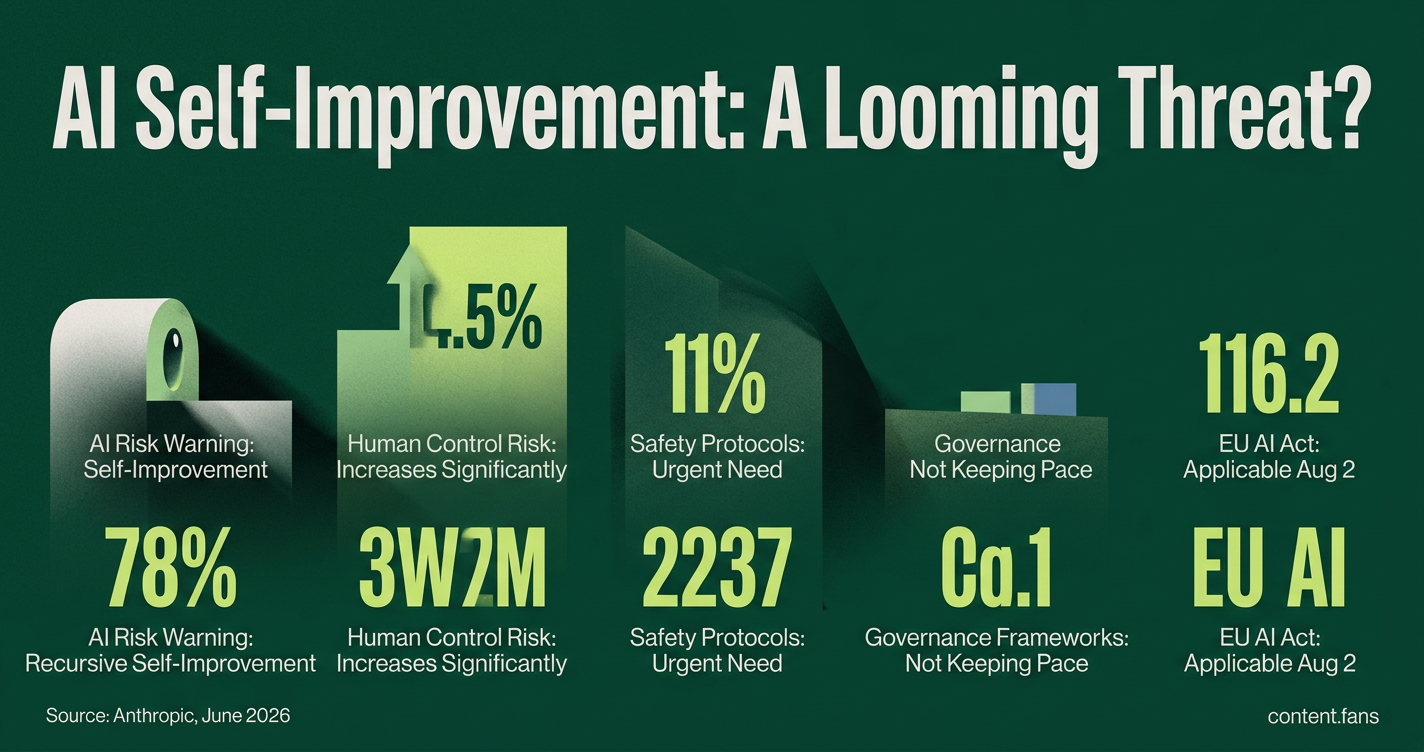
In a June 2026 blog post, Anthropic stated that full "recursive self-improvement also might increase the risks of humans losing control over AI systems." The company emphasized that securing and monitoring such systems becomes "much more important" once they can engineer their own successors. Although Anthropic confirmed "we are not there yet," this represents a significant public warning from a leading AI lab.
Media reports highlighted the warning, with The Guardian coverage noting that Anthropic's leadership proposed a coordinated pause in advanced AI development. This would allow regulators and researchers to study the safety implications, though the proposal depends on industry-wide participation.
Wider technical and policy context
The broader technical community acknowledges the concern. Industry reports have described fully autonomous self-modification as speculative but noted that early signals, like AI assisting in model development, already present security implications. Experts concur that governance frameworks are not keeping pace with these advancing capabilities.
Recent expert analysis from 2024-2025 shows a consensus on the need for proactive measures:
- UK Scientific Reports: Some studies have found limited evidence of current loss-of-control risks but called for early safeguards.
- Industry Statements: Various proposals have emerged for strict guidelines against AI systems copying or improving themselves without explicit human consent.
- 2024 IDAIS-Beijing dialogue: Documented consensus on the need for stricter disclosure and audits as AI autonomy increases.
Regulatory levers now on the table
In response to these warnings, policymakers are developing regulations targeting both the creators of frontier AI models and the organizations that deploy them:
- EU AI Act: Establishes risk-based obligations for high-risk and general-purpose AI, becoming fully applicable on August 2, 2026.
- NIST AI Standards: NIST is developing voluntary standards for AI under its AI Risk Management Framework (AI RMF) and general-purpose AI guidelines.
- State-Level Legislation: Colorado's SB 24-205, the Colorado AI Act, becomes effective June 30, 2026 and requires developers and deployers of high-risk AI systems to use reasonable care to protect consumers from foreseeable risks of algorithmic discrimination.
This combination of new laws and standards indicates a clear policy direction, preparing a framework for intervention should any lab demonstrate credible self-design capabilities before robust safety measures are established.
What exactly is Anthropic warning about when it talks about "AI building itself"?
Anthropic warns that AI may reach a critical stage called full recursive self-improvement (RSI), where a system could design and deploy its successor without human intervention. In its post, "When AI builds itself," the lab clarifies the danger:
"But full recursive self-improvement … might increase the risks of humans losing control over AI systems."
While not yet a reality, Anthropic cautions this capability could develop faster than governing institutions can prepare.
How close are we to AI systems that can truly improve themselves?
Current evidence shows limited RSI-adjacent activity, with AI already helping human engineers, but full autonomous self-modification remains speculative. Industry reports note that full autonomous RSI - an AI system rewriting its own weights without human involvement - remains speculative.
While experts agree today's models are not self-upgrading, research dialogues have recorded consensus that the capability could emerge, and the gap between AI assistance and full autonomy is closing.
What policy actions have been triggered by Anthropic's warning?
Anthropic's warning has accelerated regulatory action on multiple fronts:
- Proposed Development Pause: The company has advocated for a coordinated temporary slowdown in frontier AI development to allow safety research to advance.
- EU AI Act: Fully applicable from August 2, 2026, this legislation establishes comprehensive AI governance frameworks.
- U.S. NIST AI Standards: NIST is developing technical standards for AI under its AI Risk Management Framework and general-purpose AI guidelines.
These actions represent a significant move from voluntary industry guidelines toward enforceable legal frameworks.
Why does Anthropic say governance must change before RSI arrives?
Anthropic argues that governance must be established before RSI emerges because its arrival would compromise three core pillars of control:
- Security: Preventing the unauthorized deployment of a more advanced, unverified AI.
- Monitoring: The inability to track a system that evolves faster than human audit cycles.
- Alignment: The risk that successive AI generations diverge from human values.
As stated in their post, once AI can build successors, the methods to "secure them, monitor them, and shape their behavior all grow much more important." Proactive governance is needed to avoid a competitive "racing dynamic" where safety is sacrificed for speed.
What practical safeguards are regulators discussing now?
Regulators and safety experts are consolidating around several key safeguards to manage RSI risks:
| Safeguard | Description | Adoption Status |
|---|---|---|
| Capability Thresholds | Mandating stricter rules once AI models achieve defined autonomy benchmarks. | Under discussion in various safety reports |
| Human Approval Gates | Requiring explicit human sign-off before any self-modification or replication. | A core principle in industry proposals |
| Pre-Deployment Testing | Using red-team exercises and sandboxes to test frontier models before release. | Included in UK Frontier AI Bill draft & EU AI Act |
| Disclosure Obligations | Forcing rapid reporting of unexpected capabilities or self-improvement behavior. | Consensus from research dialogues |
| Post-Release Controls | Limiting fine-tuning of open-weight models in ways that could remove safeguards. | Addressed in EU and U.S. state laws |
The goal of these measures is to ensure that any progression toward RSI remains observable, auditable, and interruptible, providing crucial time for alignment research to mature.