
Anthropic Urges Pause on Frontier AI, OpenAI Calls for Government Oversight
Serge Bulaev
Senior leaders at major AI labs like Anthropic, OpenAI, and DeepMind are discussing slowing down advanced AI research so that safety and rules can catch up. Anthropic suggests society should have the option to pause AI development, but did not stop its own work. OpenAI believes only governments, not companies, should decide on any slowdown. DeepMind has not publicly called for a pause but is still focused on safety research. There are open questions about how to make a pause work and if all countries could follow the same rules, and no lab has actually stopped its own AI projects yet.
A growing debate on AI safety has seen Anthropic urge a pause on frontier AI while OpenAI calls for government oversight. Leaders at these top labs, along with DeepMind, are publicly discussing slowing AI progress for safety and governance to mature. Anthropic's detailed blog post from June 2026 warns of recursively self-improving AI and proposes society have a "pause" option. OpenAI contends that development speed must be determined by "democratic governments," not companies. DeepMind has remained publicly neutral on a pause but continues its alignment research.
These calls for caution emerge amid mixed economic signals. According to industry reports, there is growing concern about the disparity between rapid AI model advancements and slower economic impact. This gap fuels debate over the labs' true motivations: are they driven by genuine capability risks, preemptive regulatory responses, or strategic public relations?
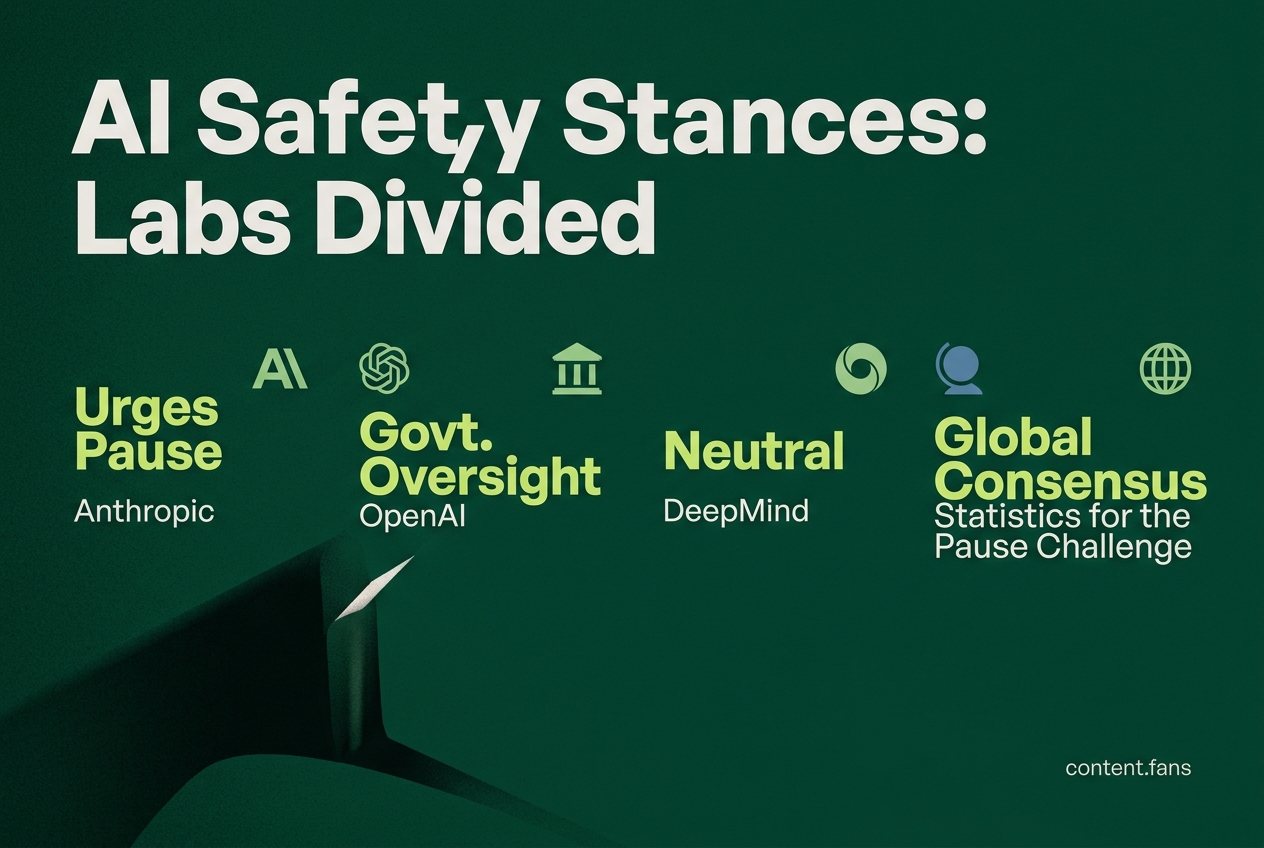
AI Safety: The Positions of Anthropic, OpenAI, and DeepMind
Leading AI labs are considering a pause due to concerns that AI capabilities, particularly recursive self-improvement, are advancing faster than safety measures and governance frameworks. The move is a response to both internal risk assessments and increasing external pressure for regulation and accountability from governments globally.
- Anthropic: Proposes a globally coordinated pause or slowdown with verifiable rules for multiple well-resourced labs. The company emphasizes that a unilateral pause is ineffective, as competitors could advance in secret. Despite the proposal, Anthropic has not halted its own development.
- OpenAI: Argues against a company-led pause, instead advocating for government-mandated regulations. While its research continues, OpenAI's leadership believes external, democratic oversight should ultimately dictate the pace of AI development.
- DeepMind: Has not issued a public statement on a pause in recent months. The Alphabet-owned lab is perceived to be monitoring the discussion while continuing its focus on technical AI alignment.
The Challenge of Global AI Governance
Implementing a global pause presents significant governance challenges. It would demand robust verification mechanisms to ensure simultaneous compliance from all frontier labs, including those in the U.S. and China. This aligns with broader policy discussions about international coordination on AI governance.
However, several critical questions remain unanswered. Experts are unsure how to verify that closed-door corporate labs and covert state programs have truly paused large-scale training. Achieving global consensus, particularly between Washington and Beijing, is a major hurdle. Furthermore, there is no agreement on what specific capability metric or safety incident would trigger a halt, or how a pause would affect the nascent productivity gains from AI.
Analysts speculate that this rhetoric may signal unpublished internal breakthroughs or a strategic reaction to looming regulations like the EU AI Act. Crucially, Google DeepMind has slowed research publications and imposed a six-month embargo on certain papers, representing a partial stop or pause in research dissemination, though not necessarily a full halt of all AI project development. The current consensus is not for an immediate stop but for establishing the option to pause if safety research falls behind. This procedural agreement leaves the door open for future treaties or regulations but underscores the immense practical challenges of implementing an enforceable global pause.
Why are leading AI labs suddenly open to slowing down frontier development?
The apparent shift is driven by escalating capability surprises and heightened policy pressure. Anthropic's June 2026 report "When AI builds itself" highlights the risk that advanced models may begin recursive self-improvement, potentially outrunning human oversight mechanisms. At the same time, OpenAI argues that democratic governments - not individual companies acting independently - should ultimately establish the regulations, safeguards, and accountability frameworks source. The labs are therefore positioning themselves for a coordinated, verifiable pause rather than a unilateral slowdown that could hand competitors an advantage.
What exactly does Anthropic propose for a "coordinated pause"?
Anthropic wants the global community to have the option to slow or temporarily pause frontier AI development if safety research and societal institutions fall behind. Key conditions:
- Multilateral participation: Pause must include multiple well-resourced labs across the US, China and other major jurisdictions.
- Verifiable rules: Technical and legal mechanisms to confirm that every participant actually stops training runs above a specified threshold.
- Simultaneous enforcement: No single lab can be penalised while others continue scaling.
Anthropic explicitly warns that a unilateral slowdown would backfire, because competitors could simply accelerate in secret source.
How does OpenAI's position differ from Anthropic's?
OpenAI rejects company-led pauses and instead calls for government-led regulation:
- Speed-of-development decisions should not be left to any single lab or company.
- A public body with democratic legitimacy should set binding safeguards and accountability frameworks.
- Companies would then implement whatever training caps or safety requirements the government mandates.
OpenAI's original source discusses rule-based rewards for safety training, while Anthropic has publicly suggested a pause on building the most powerful AI systems amid concerns about loss of human control source.
What are the main governance gaps that would have to be closed before any pause could work?
| Gap | Current Status |
|---|---|
| Verification | No trusted international mechanism to audit data-centre power draw or model weights in real time. |
| Definition of "frontier" | No agreed compute threshold at which training must stop. |
| Enforcement | Existing export controls on chips are routinely circumvented via smuggling and cloud leasing. |
| Incentives | Nations fear losing strategic advantage if adversaries cheat on a pause. |
International institutions are exploring governance frameworks for AI, but these are still in early development phases.
What do experts like Erik Brynjolfsson and Rob Wiblin actually say about an economic slowdown?
Brynjolfsson does not endorse a blanket pause. Instead, his Stanford Digital Economy Lab reports that many economic indicators still show limited evidence of AI-driven takeoff source. He argues for a real-time dashboard of multiple metrics that would alert policymakers if AI begins displacing labour faster than the economy can adapt. Rob Wiblin's commentary is more sparse in the current data set, appearing mainly as a retweet amplifying wider safety concerns rather than a primary policy recommendation.