
Anthropic Urges Human Oversight, Layered Defenses for AI-Authored Code
Serge Bulaev
Anthropic warns that current safety measures for AI-generated code may not be enough, and it urges companies to use human oversight with several layers of security. Its guidance suggests humans should review and approve all important changes, while keeping logs and following clear procedures in case of problems. Anthropic also recommends starting with small pilot projects, measuring risks, and only expanding once controls seem reliable. These steps may help organizations meet new laws in the EU and US that require detailed tracking and transparency for high-risk AI systems.

As enterprises adopt AI-authored code, Anthropic urges human oversight and layered defenses to manage emerging software risks. Senior security engineers warn that existing AI safety measures are "not a guarantee," recommending a combination of human checkpoints and robust security protocols based on their public guidance (Anthropic research post).
This article translates Anthropic's official recommendations and related enterprise security guidance into a practical checklist. It provides security, legal, and engineering teams with a unified framework for safely deploying AI-generated code without depending on unproven or speculative tools.
Human oversight anchors the workflow
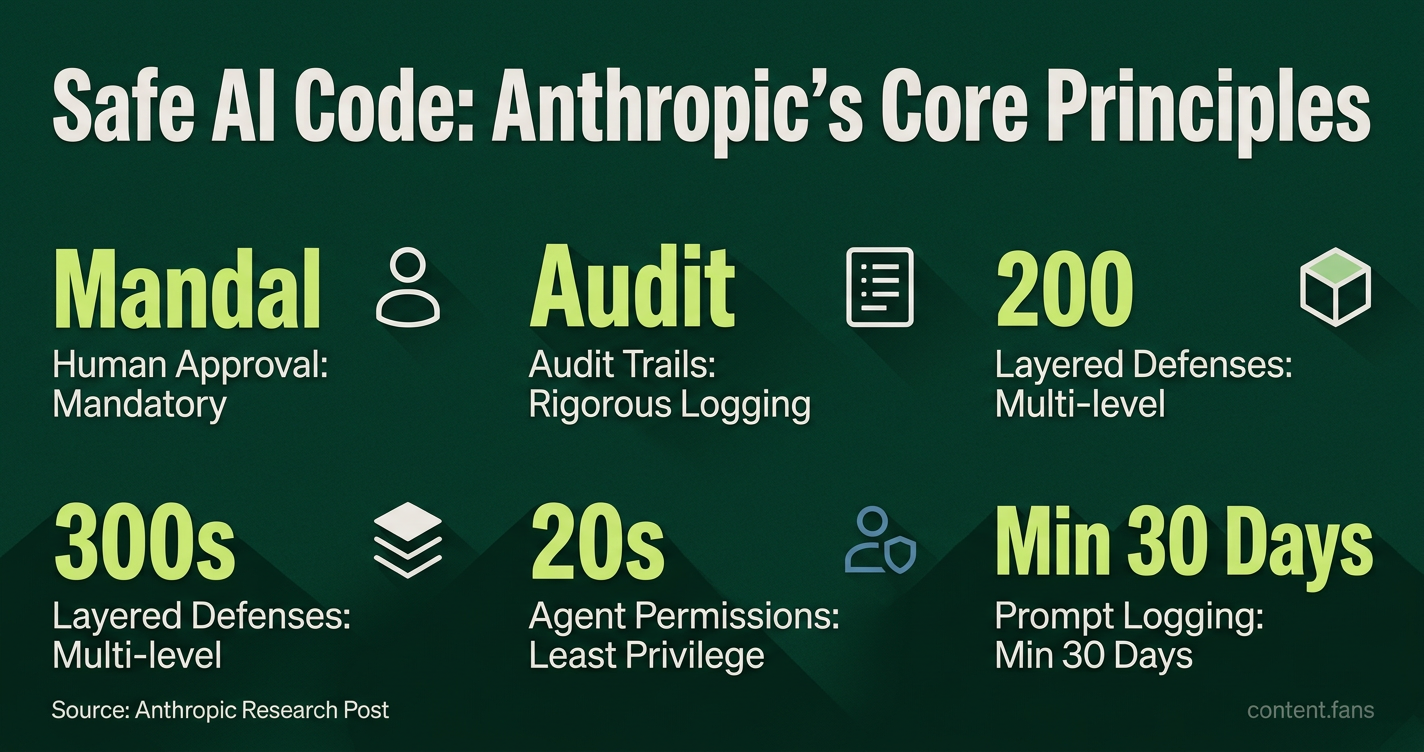
Anthropic's core guidance for AI-authored code is to implement mandatory human oversight and multi-layered security defenses. This strategy involves human review for all code commits, rigorous logging for audit trails, and starting with small, controlled pilot projects to validate safety measures before scaling production use.
A core principle is "keeping humans in control." For example, Anthropic's internal workflow requires AI agents to propose changes, which are then scanned by specialized review agents for vulnerabilities before a human provides final approval for any Git commit. This creates a detailed audit trail of approvals, aligning with transparency requirements in the upcoming EU AI Act.
Key oversight controls:
- Human Approval: Mandate explicit sign-off for any code affecting identity, secrets, or network policies.
- Evidence-Based Reviews: Require all pull requests to include supporting evidence like test results, security scans, and review outputs.
- Incident Response Plan: Maintain a formal playbook for rolling back agent-generated changes that cause issues post-release.
Enterprise checklist for safe deployment of agent-authored code
This checklist maps Anthropic's core principles to concrete development controls, citing guidance from its agentic coding reports and posts.
| Control area | Practical requirement | Source cue |
|---|---|---|
| Least privilege | Restrict agent permissions by limiting API tokens and OS rights. Isolate agent sandboxes from production environments. | "customers should carefully choose which permissions and environments agents can operate in" |
| Multi-layer defenses | Implement defenses at multiple levels, including model-level prompt injection detection, network monitoring, and external red-team testing. | "build defenses at several different layers" |
| Security review agents | Use a dedicated, security-focused AI agent to review every proposed code change (diff). | internal workflow video example |
| Prompt logging | Log all prompts, tool calls, and agent responses for a minimum of 30 days to ensure a complete audit trail. | transparency principle |
| Tool-access review | Establish a governance process to re-approve any new external tool integration or permission escalation for an agent. | permission prompt governance |
| Testing before merge | Enforce that all unit, integration, and regression test suites must pass before a merge, with no overrides allowed. | verification before merge |
| Incident response | Formally document agent-specific incident response plans, including revocation steps, contact lists, and remediation timelines. | rollback procedures |
Pilots before scale
Anthropic recommends starting small with a single, well-resourced pilot team. This allows organizations to measure defect rates and validate security controls under real-world conditions before expanding. This principle treats AI agents like "untrusted contractors" that must earn broader access over time.
Suggested pilot metrics:
1. Approval Velocity: Track the mean time required for human approval of agent-generated pull requests.
2. Code Quality: Compare the rate of vulnerabilities per thousand lines of code (KLOC) between agents and human developers.
3. Security Accuracy: Measure the false-positive and false-negative rates for prompt-injection detection systems.
Regulatory traceability and documentation
To comply with regulations like the EU AI Act, high-risk AI systems require detailed technical documentation and logs. By recording prompts, model versions, and human review outcomes, teams can demonstrate compliance with transparency, accuracy, robustness, and cybersecurity mandates. Similar logging and disclosure requirements are emerging in US state laws for consequential AI systems.
Hardening the CI/CD pipeline
Strengthen the CI/CD pipeline by using policy-as-code to enforce security checks. Ensure every agent-generated pull request automatically undergoes secret scanning, SAST, and linting before it can be merged. Use sandboxed environments like Docker or gVisor to contain agent execution and log all activity to a SIEM for anomaly detection. This combination of automated gates creates the layered defense Anthropic recommends, reducing dependency on any single point of failure.
Living governance files
Maintain governance rules - such as approved dependencies, prohibited licenses, and coding standards - in machine-readable policy files. AI agents can ingest these files directly, minimizing discrepancies between organizational policy and the code they generate. Regularly reviewing these files ensures they remain aligned with evolving regulations.
Why does Anthropic insist on human oversight for every AI-generated code change?
Anthropic's internal blueprint repeatedly labels human approval gates as non-negotiable. Their 2026 report warns that even agents built with the newest safeguards can still "hallucinate insecure patterns or leak secrets", so reviewers must sign off on any change that touches security, identity, or secrets. In practice, every agent-raised pull request is routed through the same mandatory human review board human developers face, and the policy explicitly forbids merges that lack at least one human reviewer with domain expertise in the affected system.
What does a layered defense look like in an agent-first pipeline?
Anthropic defends agentic coding at three distinct tiers:
- Training-level: models are fine-tuned to recognize prompt-injection signatures.
- Runtime filtering: every agent tool call is scanned against known attack patterns before execution.
- External red-teaming: independent security firms are hired to simulate prompt attacks and privilege-escalation paths at least quarterly.
This multi-layer design means that even if an attacker slips past one wall, the next layer is still positioned to block or alert.
How do you keep an audit trail for prompts, files, and approvals?
All agent sessions are logged end-to-end with the following metadata:
- Original prompt and model version
- Tool invocations and their responses
- Link to the human reviewer who approved each change
- Final commit SHA and CI test results
These records are stored in an append-only log linked to the org's SIEM, giving regulators and incident-response teams a single source of truth if anything goes wrong.
Which compliance requirements hit hardest on August 2, 2026?
The EU AI Act flips into full 3 enforcement on August 2, 2026. If your software supply chain includes agents that influence high-risk decisions (e.g., code running in critical infrastructure or safety-relevant systems), the following duties become mandatory:
- Technical documentation for every model version used by agents
- Human oversight records proving manual review took place
- Incident reporting within 72 hours of any AI-caused service failure
Missing any of these can trigger penalties up to 7 % of global turnover.
What's the safest first step before letting agents near production?
Start with an internal pilot in a non-customer-facing repository. Use the pilot to:
- Inventory every agent and its exact token permissions.
- Measure false-positive and false-negative rates on security findings.
- Harden the workflow (secret scanning gates, sandboxed builds, rollback scripts).
Only after the pilot shows <1 % security escape rate for two consecutive sprint cycles should the same agent pipeline be expanded to customer-facing or regulated codebases.