
Anthropic updates Claude agents with memory, evaluation, orchestration
Serge Bulaev
Anthropic has added memory, evaluation, and orchestration tools to its Claude Managed Agents service, which may make it easier for companies to use multiple AI agents together. Early users report they can build and test projects faster because the service keeps track of long-term information and provides built-in tools. However, experts warn this update might make companies more dependent on Anthropic and could raise concerns about who controls the data. Some teams may need to review security and compliance, and switching away from this service in the future might require extra work. The changes seem to lower setup time but may create new challenges for data management and vendor lock-in.

In a significant platform update, Anthropic updates Claude agents with memory, evaluation, and orchestration features integrated into its Managed Agents service. This move consolidates the agent execution layer into a single, vendor-managed runtime, providing a ready-made path for building persistent, multi-agent workflows but introducing new questions about compliance and vendor dependence.
What changed inside the hosted runtime
Anthropic's update integrates agent memory, evaluation, and orchestration into a managed cloud service. This decouples the AI's reasoning from its execution tools, centralizing state management on Anthropic's infrastructure instead of requiring customers to build and manage their own using external databases or workflow engines.
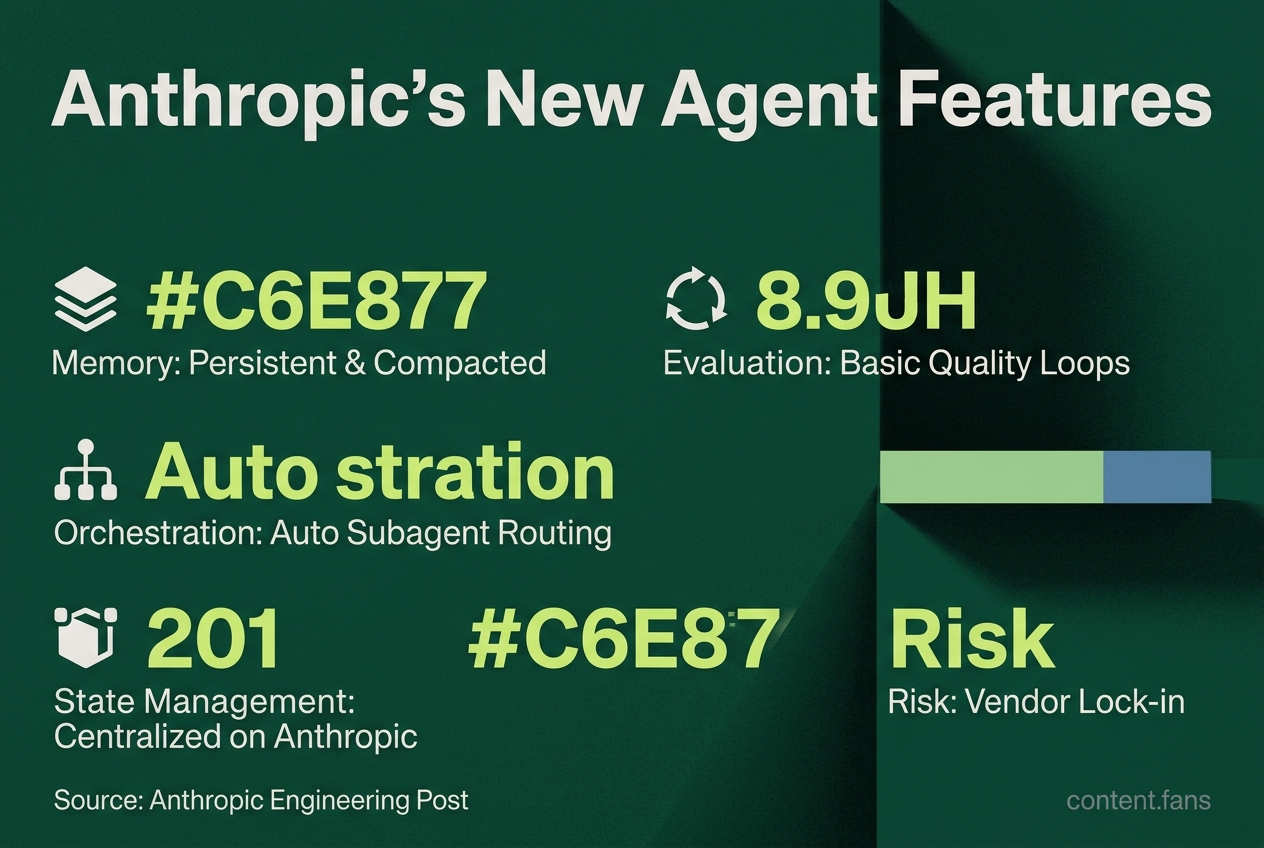
In an official engineering post, Anthropic's team explains the new architecture "decouples the brain from the hands." It separates Claude's reasoning from the tool sandboxes and session logs. This design moves long-term state management into the hosted service, potentially simplifying deployments that previously relied on external vector databases or workflow engines.
Key Benefits for Enterprise AI Projects
Early adopters and pilot programs are reporting significant advantages, primarily faster integration timelines. The managed runtime provides several built-in features that once required separate tools:
- Persistent memory and compaction utilities
- Automatic subagent routing with shared state
- Offline dreaming jobs that refine context
- Basic quality loops without third-party eval stacks
As noted by industry analysis, these integrated capabilities help reduce platform sprawl and offer a more direct path to production. This positions Anthropic's service as a direct competitor to open-source frameworks like LangGraph and CrewAI, which also aim to solve multi-agent orchestration (lock-in analysis).
The Risks: Vendor Lock-In and Data Control
While the consolidation offers convenience, analysts warn it significantly increases the risk of platform lock-in. Because the core tooling, memory, and orchestration logic reside within Anthropic's service, migrating to a different model or platform in the future would require a substantial rebuild. Furthermore, with execution and state managed on Anthropic's infrastructure, organizations in regulated industries face critical data residency and compliance questions.
This creates a challenge for teams already invested in a custom AI stack using components like Pinecone for vector search or LangGraph for state management. The managed runtime abstracts away many internal operations, which can limit the granular observability and control that self-managed, open-source solutions provide.
Early lessons for enterprise adopters
Initial feedback from pilot users highlights a consistent pattern of benefits and new operational challenges:
- Accelerated Prototyping: Proof-of-concepts (POCs) advance to functional demos in days, not weeks.
- Improved Task Persistence: Long-running agent tasks are more stable and suffer fewer context resets, especially with the "dreaming" feature enabled.
- New Governance Hurdles: Governance teams often require new manual review gates before the system can write new long-term memories.
- Security and Compliance Reviews: Security teams must conduct fresh diligence to ensure session logs and memory storage align with internal data policies.
Ultimately, these observations show the managed runtime can reduce operational overhead but introduces new diligence requirements for data control and portability. Decision-makers must weigh the immediate benefit of faster time-to-value against the long-term strategic cost of exiting the platform.
What exactly is Anthropic's new hosted runtime for Claude Managed Agents?
Anthropic now bundles memory management, evaluation tooling, and multi-agent orchestration inside a single Anthropic-hosted runtime.
This means every agent session, memory write, and sub-agent hand-off happens on Anthropic servers - not on customer infrastructure. The change removes the need to stitch together separate services for state, routing, and QA, but it also concentrates control inside one vendor environment.
How does the "dreaming" feature improve agent reliability?
"Dreaming" is a background process that reviews completed agent sessions, extracts error patterns, and writes new memory entries before the next job starts.
Early descriptions say it can cut repetitive mistakes by surfacing forgotten constraints or successful work-arounds, reducing human-in-the-loop reviews. Teams can let the system auto-apply lessons or queue suggestions for human approval - a guard-rail that matters in regulated environments.
Which third-party tools are most directly challenged by this update?
LangGraph, CrewAI, and vector stores such as Pinecone face the biggest squeeze. If Anthropic provides native orchestration and memory, budget lines for separate workflow engines or retrieval databases shrink. LangGraph has already counter-emphasised deterministic state-machine control and human checkpoints, while Pinecone is positioning itself as the neutral retrieval backbone for firms that still want model-choice and data-layer ownership.
What are the main trade-offs for enterprise adopters?
Pros
- Faster pilot-to-production cycles - no need to wire up memory, eval, and orchestration pieces.
- Lower maintenance - upgrades, scaling, and security patches move to Anthropic.
Cons
- Vendor lock-in at the orchestration layer - migration later means rewriting agent logic.
- Data-residency questions - logs, memory, and tool outputs reside on Anthropic infrastructure, a potential red flag for GDPR, HIPAA, or FedRAMP workloads.
- Preview-feature risk - "dreaming" is still research-labelled; enterprises with strict SLAs may need to wait for GA.
Should organisations already invested in custom agent stacks migrate now?
Most should pilot first, migrate selectively. If your current stack already delivers reliable evaluation traces, vector memory, and audit-ready logs, the savings from switching may not outweigh re-platforming costs. Companies starting from scratch or hitting scaling pain on self-hosted orchestration will see the clearest ROI, especially for internal use-cases where data-sovereignty is relaxed.