
Anthropic unveils Claude Tag, an AI agent for Slack teams
Serge Bulaev
Anthropic has introduced Claude Tag, an AI agent for Slack teams, which may be aimed at large organizations already experimenting with AI. Claude Tag acts as a shared team assistant, helping with tasks, flagging messages, and learning from conversations in authorized Slack channels. Pricing is based on how much the agent is used, and companies get usage credits that expire in 2026. Analysts suggest this tool might impact repetitive, structured jobs but may not eliminate whole professions. Claude Tag is joining a competitive market, and Anthropic appears to plan wider access soon, depending on feedback from early users.
Anthropic is targeting large enterprises with Claude Tag, its new AI agent for Slack, signaling a strategic move to capture corporate AI budgets. With a limited rollout, the company aims to embed its new collaborative tool within major organizations before a wider public release to the Slack Marketplace.
How the shared agent works
Claude Tag is a collaborative AI agent for Slack designed to function as a shared team member. Rather than a personal assistant, it operates with a single 'multiplayer' identity in authorized channels, building a persistent, shared knowledge base from conversations and connected tools for the entire group.
Unlike an array of personal bots, Claude Tag acts as a single "multiplayer" identity. Anyone in an authorized channel can continue a thread, enabling the agent to build what LinkedIn News described as a shared institutional memory. Key functions highlighted in its launch materials include:
- Task breakdown: Decomposes requests, integrates with tools like Jira or GitHub, and reports results.
- Ambient mode: When active, the agent proactively flags relevant messages or forgotten tasks (Fortune).
- Granular scope: Administrators can restrict access to prevent data leaks between departments, such as Legal and Engineering.
According to TechCrunch, the agent learns by "following" channel activity, which reduces the need to re-explain context as projects evolve.
Pricing model and usage credits
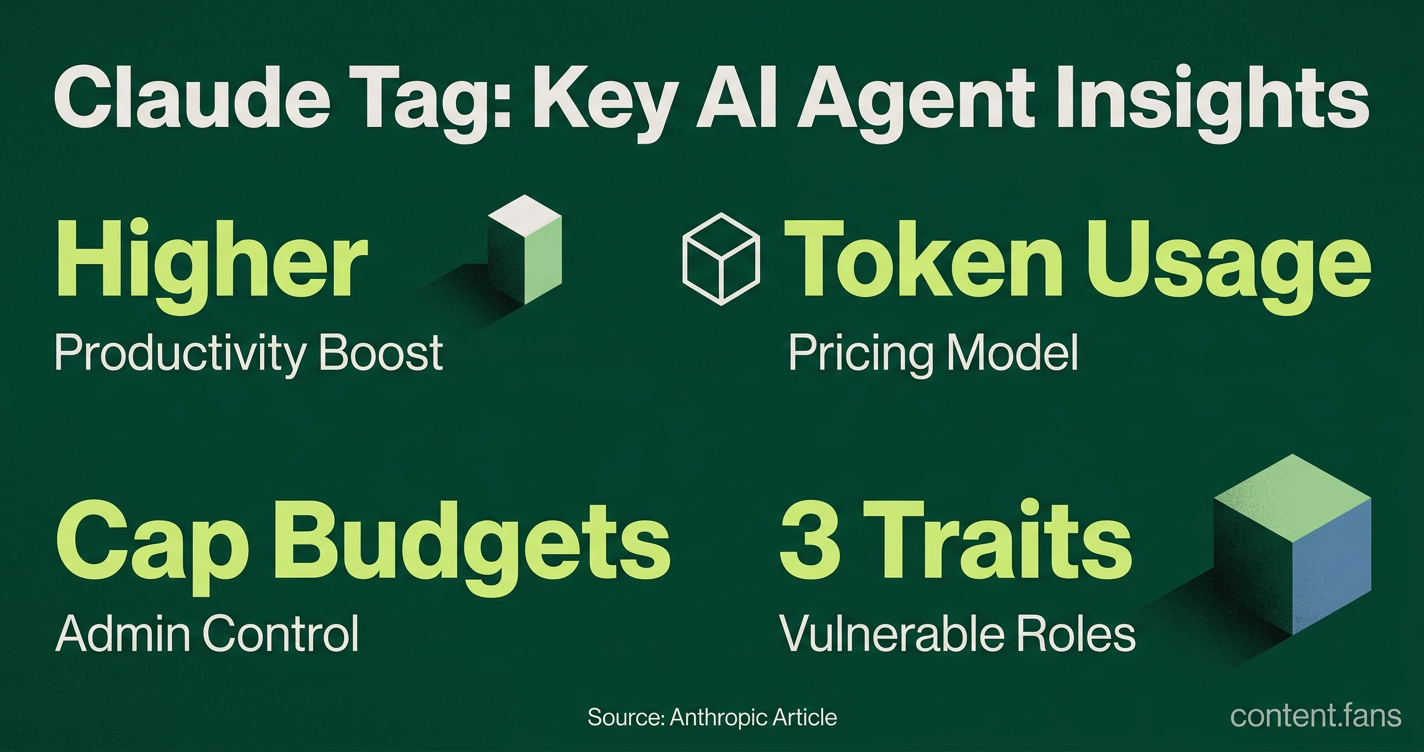
Anthropic is implementing a consumption-based model, billing for token usage rather than per-user seat fees. As LinkedIn Pulse observed, costs will scale with context and complexity, making the ambient setting a potential primary cost driver. Fortune highlighted that administrators can cap token budgets by channel and workspace, a key control for managing potential runaway costs.
Early signals on workplace impact
While AI agents are set to boost productivity, their effect on the workforce is a critical consideration. Industry reports suggest teams using AI agents report significantly higher self-rated productivity compared to non-agent users. Analysts suggest this will primarily affect high-volume, template-driven roles through automation of routine drafting and ticket triage. These dynamics are expected to reshape entry-level career paths rather than erase entire professions.
Researchers identify three traits that make a Slack-based role vulnerable to automation:
- High volume of repetitive tasks
- Strongly structured workflows
- Low ambiguity around "right" answers
Industry analysis suggests one experienced operator using multiple AI agents can now absorb the workload of several junior employees, though exact displacement figures are still emerging.
Competitive landscape inside Slack
Claude Tag enters a crowded market of agentic Slack integrations. The official platform already features peers like OpenAI's ChatGPT and Google's Gemini Agentspace, both available for drafting and data lookup via the Real-Time Streaming API, per a Slack announcement. Other competitors include Salesforce's Agentforce, which specializes in CRM actions, and Viktor, which aims for full autonomy across thousands of SaaS integrations.
Analysts note that new protocols are standardizing how agents access external data, lowering the barrier for all players - including Anthropic - to expand beyond simple text generation. Reuters reports that Anthropic plans broader access "within weeks," pending feedback from its initial preview.
What exactly is Claude Tag and how does it join a Slack channel?
Claude Tag is a shared AI teammate rather than a private assistant. Once an admin adds it to any Slack channel, all members can summon it with @Claude; the agent sees the same history as the team and can pick up a conversation where someone else left off. This creates a single multiplayer identity that remembers context across messages, files and threads.
Who can use Claude Tag right now and how much will it cost?
The product is currently in a research-preview beta and is available only to Claude Enterprise and Claude Team customers. There is no extra subscription fee; usage is billed by tokens consumed.
How does Anthropic keep company data safe inside Slack?
Administrators set granular scopes that decide which channels, documents, repos and tools Claude is allowed to access. The agent runs on its own service credentials, never impersonating a human, and every action is logged for auditing. It cannot see or report on private channels that have not been explicitly granted access.
Will Claude Tag start replacing human teammates?
Industry data shows the change is more role compression than wholesale replacement. Teams report significantly higher self-rated productivity, but the work most often handed to agents is high-volume, high-structure and low-ambiguity - tasks that used to fill junior roles like data entry, ticket triage and first-draft writing. One experienced operator plus Claude Tag can now cover work that once required several junior staff, indicating entry-level positions face the greatest pressure, while senior staff who direct and verify agent output become more valuable.
How does Claude Tag compare with other AI agents already inside Slack?
Slack users can already choose from ChatGPT, Google Gemini Enterprise, Salesforce Agentforce and more. What sets Claude Tag apart is its shared context memory across an entire channel and an ambient mode in which it can proactively follow up on forgotten threads or flag cross-channel issues without constant nudging. Competitors such as Salesforce Agentforce excel at CRM updates, while Google Agentspace focuses on surfacing live workspace insights; Claude Tag's pitch is that it becomes an institutional teammate that keeps learning the more the group uses it.