
Anthropic unveils Claude Fable 5, Mythos 5 models with new pricing, safety routing
Serge Bulaev
Anthropic has released two new AI models, Claude Fable 5 and Claude Mythos 5. Fable 5 is available to most users and is described as the company's most capable public model so far, while Mythos 5, which has fewer safety limits, is only for approved partners. Fable 5 may reroute or block certain high-risk prompts, such as those about cybersecurity or biology, using a safety system that affects less than 5 percent of sessions. The price for Fable 5 is $10 per million input tokens and $50 per million output tokens, with some users getting free access until June 2026, although this might change. Mythos 5 access and pricing are limited and not publicly listed.

Anthropic has launched Claude Fable 5 and Claude Mythos 5, a new duo of powerful AI models featuring distinct capabilities, access tiers, and a sophisticated safety routing system. The company is positioning Fable 5 as its most advanced, generally available model, while Claude Mythos 5 is in limited availability for approved customers in Project Glasswing.
Fable 5 and Mythos 5: Capabilities and Performance
Claude Fable 5 is Anthropic's most capable public model, built for complex multimodal tasks involving text, code, and vision. It operates with safety guardrails that may route sensitive prompts. In contrast, Claude Mythos 5 is in limited availability for approved customers in Project Glasswing.
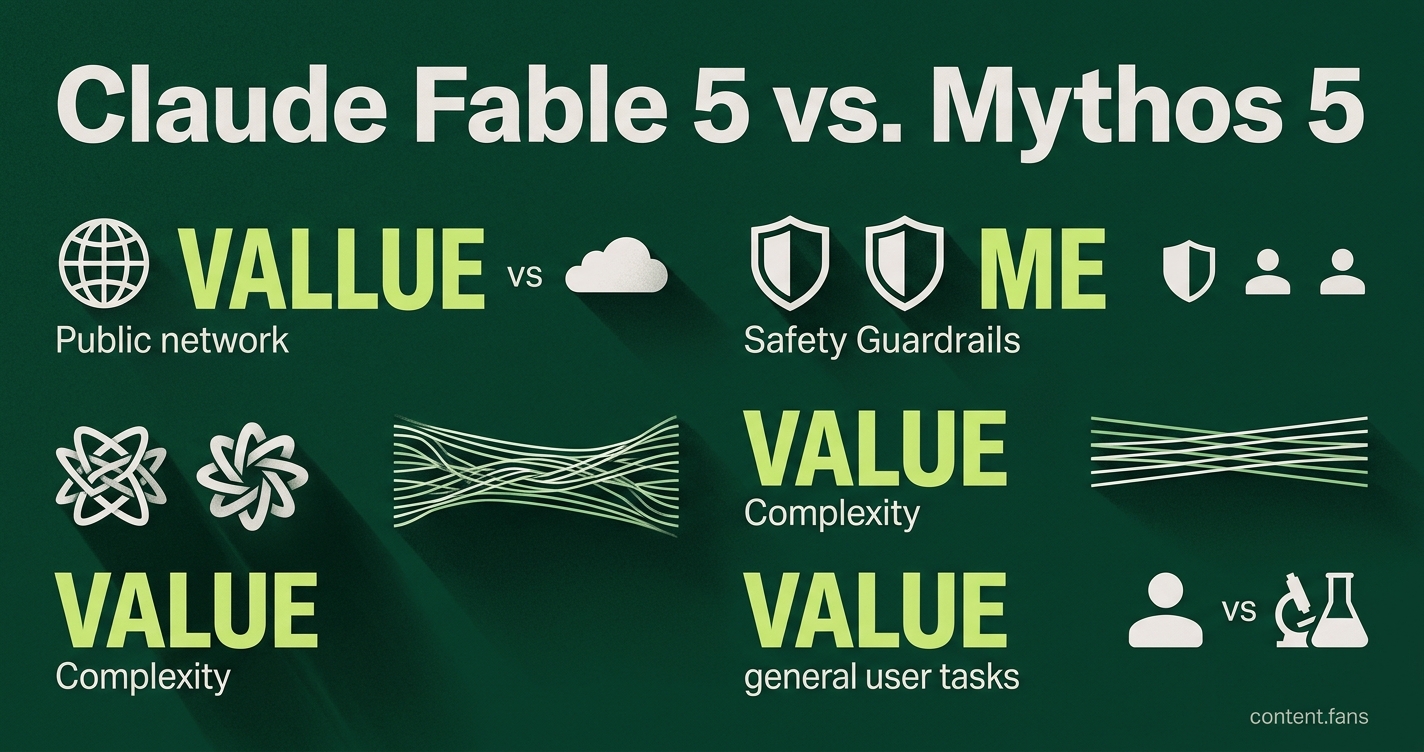
Fable 5 delivers multimodal reasoning with an extensive context window and can generate substantial output tokens per request. Anthropic highlights its strengths in "multi-hour builds, vision-heavy workflows, agent loops, research synthesis, and extensive coding projects." While early testers report significant speed improvements on large codebases, some note that throughput can slow on prompts requiring sustained, complex reasoning.
Mythos 5, available to select partners, has fewer safety constraints and is limited to Project Glasswing partners and select life-sciences researchers. According to industry reports, Anthropic's internal teams used Mythos 5 to significantly accelerate protein-design workflows, showcasing its potential for extended autonomous operation in scientific fields.
Understanding Fable 5's Safety Guardrails
Fable 5 integrates a classifier-driven system to manage high-risk prompts. Queries flagged for risks related to cybersecurity, biology, chemistry, or model distillation are automatically redirected to Claude Opus 4.8 or blocked entirely. According to Anthropic's system card, these fallbacks occur in a small percentage of user sessions. For queries about frontier model development, the system uses an invisible intervention that does not switch models, a practice some users have noted could impact reproducibility.
The model's system card indicates biological risk levels for specific capabilities, indicating Anthropic acknowledges a potential for misuse but opts for selective throttling over a complete ban.
Access, Pricing, and Data Policies
Claude Fable 5 is available via the Claude API under the identifier claude-fable-5. According to industry reports, API usage pricing includes competitive rates for input and output tokens, with significant discounts for cached inputs.
Per industry reports, the model is temporarily included at no extra cost for Pro, Max, Team, and seat-based Enterprise subscribers for a limited time. The company notes, "If capacity allows, we'll extend the included window," but makes no firm commitment.
- API Access: Competitive pricing for input and output tokens. Significant discounts are applied to cached input tokens.
- Subscription Access: Included in Pro, Max, Team, and Enterprise plans at no extra cost for a limited time, subject to extension.
- Mythos 5 Access: Limited preview via Project Glasswing and select AWS Bedrock customers; pricing is not publicly listed.
Anthropic's standard traffic-retention rule keeps request logs for 30 days. Developers requiring unrestricted performance for sensitive applications must apply for Mythos 5 access through Anthropic, AWS, or Google Cloud. Most public users will benefit from Fable 5's high throughput, encountering occasional fallbacks only on regulated topics.
What is Claude Fable 5 and how does it differ from Claude Mythos 5?
Claude Fable 5 is the public-facing iteration of Anthropic's latest model family. It is available today via the Claude API under the model name claude-fable-5 and is optimized for long-horizon, vision-heavy, agentic workflows such as multi-hour coding builds, research synthesis, and complex document analysis.
Claude Mythos 5 is available with fewer guardrails, offered only to vetted partners (Project Glasswing members and select biology researchers). It can be used for higher-risk scientific work that Fable 5 automatically blocks or routes away from.
What new pricing applies to Claude Fable 5 after the temporary inclusion window?
- API pricing: According to industry reports, competitive rates for input and output tokens
- Prompt-caching bonus: Anthropic prompt caching can reduce cached input costs by up to 90%, but the base pricing in available sources shows different rate structures for various models
- Subscription grace period: Fable 5 remains included at no extra cost on Pro, Max, Team, and Enterprise plans for a limited time. After that date, usage credits will be required unless Anthropic explicitly extends the window.
Which high-risk requests are blocked or routed, and what happens to them?
Anthropic's classifier-and-fallback layer scans prompts in cybersecurity, biology, chemistry, distillation, and frontier-model development.
- Visible routing: biology-, chem-, or cyber-related queries are handed off to Claude Opus 4.8 and the user is notified.
- Invisible intervention: requests judged to target model weights or training data are silently dropped with no fallback.
The system triggers these safeguards in a small percentage of sessions, leaving most day-to-day tasks unaffected.
How capable is Claude Mythos 5 for biology research, and who can access it?
Recorded performance: According to industry reports, Mythos 5 significantly accelerated internal drug-design steps and independently selected binding sites, tools, and recovery strategies normally handled by senior scientists. In extended internal genomics runs, the model assembled single-cell data across many species and trained custom ML classifiers, with internal reviewers showing strong preference for its hypotheses.
Access: available exclusively through Project Glasswing, AWS Bedrock limited preview, or by contacting an Anthropic account team.
What transparency measures and retention rules accompany these models?
- System card (published alongside launch) documents the Opus 4.8 fallbacks, API-level blocks, 30-day traffic-retention policy, and biological-risk notation for certain model behaviors.
- GitHub mirror hosts the Fable 5 system prompt (or a close copy) for reproducibility.
- Anthropic positions the split deployment (public Fable vs. gated Mythos) as a deliberate alignment and safety experiment, not simply a staggered release.