
Zylos.ai and FutureAgi Detail LLM Error Recovery Strategies for 2026
Serge Bulaev
Zylos.ai and FutureAgi describe strategies for handling errors in LLM-powered applications. They suggest that classifying errors into different types and responding to each type specifically may help avoid bigger problems. The reports recommend validating every step, retrying only some errors with careful limits, and using fallback models when needed. Full logging and traceability appear to help teams understand and fix failures. Both sources suggest that constant measurement and layered defenses might improve system reliability by 2026.

Zylos.ai and FutureAGI each published separate 2026 guidance on AI agent error handling, recovery, and graceful degradation. Developing robust LLM error recovery strategies is a critical priority for engineering teams building with generative AI. Their findings show that success hinges on moving beyond simple retries toward a multi-layered defensive approach, including comprehensive validation and failure classification for targeted responses.
LLM-powered systems function less like single API calls and more like complex distributed workflows. A request must successfully navigate prompt engineering, data retrieval, model inference, tool execution, and output validation. Treating all failures identically can lead to cascading issues like rate limit violations, budget overruns, or silent data corruption.
A Modern Taxonomy for LLM Application Errors
Effective LLM error handling involves classifying failures into distinct types, such as transient network issues, permanent request errors, and output quality problems. This taxonomy enables surgical responses - like bounded repair, activating fallback models, or escalating for review - instead of a generic retry, ensuring greater system stability and reliability.
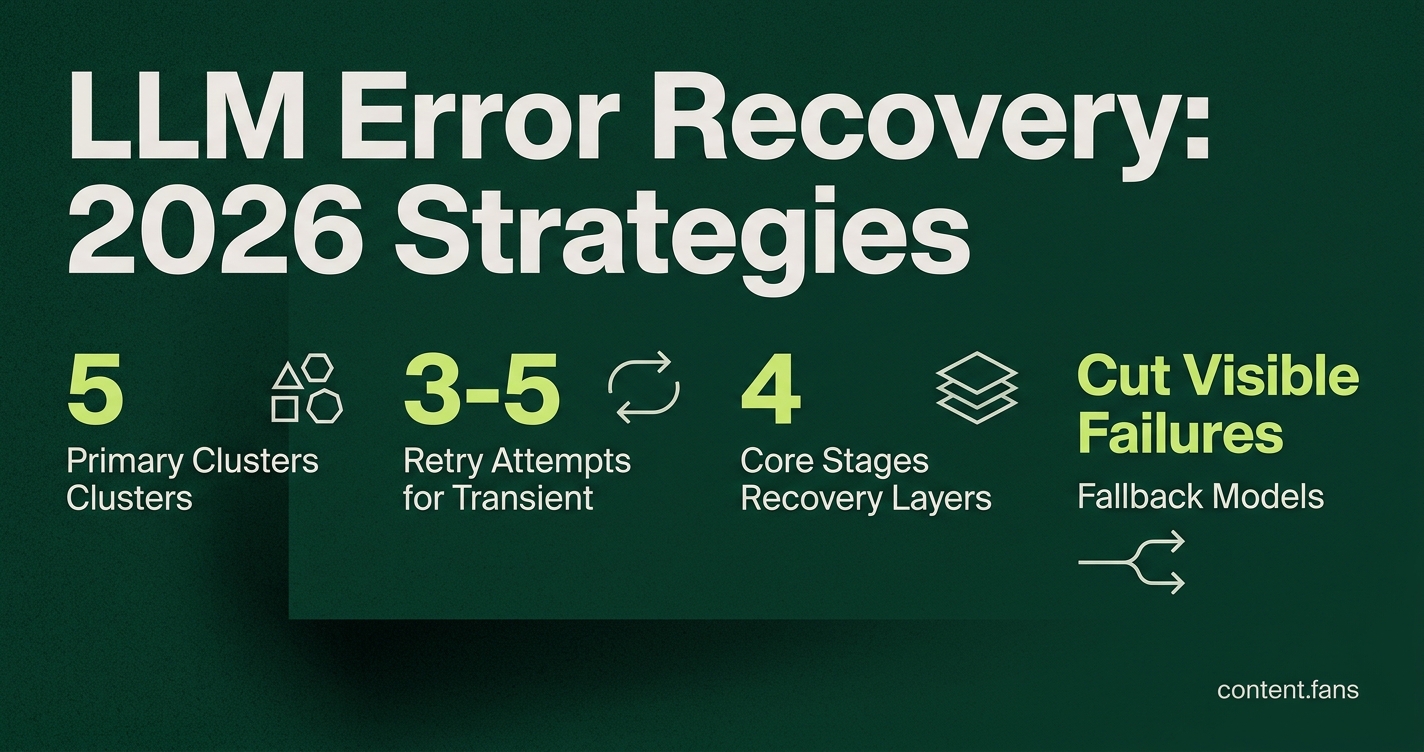
Current best practices, synthesized from both reports, group production problems into five primary clusters:
- Transient Transport Errors: Timeouts, 429 rate limits, and intermittent 5xx server errors.
- Permanent Request Errors: Schema violations, context window overruns, and content policy refusals.
- Quality Failures: Hallucinated fields, malformed JSON, and low-confidence or irrelevant answers.
- Workflow Failures: Downstream tool crashes, idempotency key conflicts, and partially completed tasks.
- Dependency Failures: Vector store outages, browser-side crashes, and message queue backlogs.
Zylos.ai recommends retrying only the transient group, always with exponential backoff and jitter. Meanwhile, FutureAGI notes that permanent errors should trigger a bounded repair attempt or a fallback model, not an endless retry loop.
Designing a Layered Architecture for Service Resiliency
A resilient architecture anticipates failure at every stage and keeps requests flowing. The core layers include:
- Input Validation: Pre-emptively check user text, tool arguments, and token counts before model invocation.
- Execution Rules: Apply strict per-call timeouts and capped retries. The Zylos.ai playbook suggests 3-5 attempts are sufficient for most transient issues.
- Output Validation: Rigorously parse all structured data (e.g., JSON) against a schema, enforce business rules, and reject unsafe or non-compliant content.
- Recovery Logic: If validation fails, re-prompt the model with specific corrective feedback or invoke a smaller, faster backup model. FutureAGI reports that fallback chains can cut visible failure rates by a significant portion.
- Degradation and Escalation: When all automated paths fail, return a safe, pre-defined response to maintain service and flag the failure for human review.
The Critical Role of Observability and Replay
FutureAGI's guidance emphasizes the need for full-trace logging for every LLM call, capturing the prompt version, model identifier, latency, token usage, validation outcomes, and complete retry history. These replayable traces empower teams to cluster related failures, identify root causes, and automatically add them to continuous integration (CI) test suites. This marks a shift toward data-driven error budgets, mirroring classic Site Reliability Engineering (SRE) principles.
Core Resilience Patterns for LLM Systems
| Pattern | Primary Benefit |
|---|---|
| Exponential Backoff + Jitter | Spreads retry load during provider service recovery |
| Circuit Breaker | Prevents cascading failures from a degraded model |
| Schema Validation | Catches silent data corruption before it impacts tools |
| Graceful Degradation | Maintains a minimum service level for end-users |
| Replayable Checkpoints | Makes complex, multi-step agent failures debuggable |
Key Metrics and Thresholds for Production Monitoring
Zylos.ai provides concrete examples for production thresholds: cap consecutive retries at five, and configure circuit breakers to open after three failures in 30 seconds, probing for recovery every 60 seconds. FutureAGI's 2026 guidance suggests alerting above 0.85 utilization and using compaction/summarization triggers around 80 - 95% of the context limit.
A quick-win checklist for engineering teams includes:
- Attach idempotency keys to any tool call that mutates state.
- Validate every structured response against a schema before use.
- Log model refusals and malformed outputs for offline analysis and clustering.
- Use a smaller, cached model as the first-line fallback to reduce latency.
- Establish a weekly review of failure dashboards to inform regression testing.
The combined evidence from both sources suggests that reliability now depends on constant measurement and adaptation. Emerging 2026 guidance points to quality-aware circuit breakers that open based on repeated low-confidence scores, bringing semantic awareness into classic resilience tooling.
How do Zylos.ai and FutureAGI classify LLM errors differently from traditional software failures?
Unlike conventional software where errors are binary (success/failure), LLM outputs are probabilistic. A technically successful API call can still yield semantically incorrect results like hallucinations or malformed JSON. Zylos.ai and FutureAGI advocate for typed error handling that categorizes failures into groups like transient transport issues, permanent request errors, quality failures, and workflow failures. This allows systems to respond specifically to the problem, a significant departure from a generic "call failed" state.
What makes 2026 error recovery strategies fundamentally different from earlier approaches?
The key evolution is the shift from single-call resilience to distributed workflow resilience. Earlier practices focused on retrying a failed API call. 2026 strategies treat LLM systems as stateful distributed systems that require checkpoints, durable execution, and handoff validation. FutureAGI's analysis of production incidents revealed that this complexity is necessary. This data drives new patterns like quality-aware circuit breakers that trip on poor output, not just HTTP errors, and formal human escalation paths designed into the system from the start.
Which retry and backoff patterns do both organizations recommend for production systems?
Both Zylos.ai and FutureAGI endorse exponential backoff with jitter for transient issues like rate limits and network instability, combined with a finite retry budget (typically 3-5 attempts). However, they critically advise selective retry discipline. This pattern dictates that only transient errors should be retried. Blindly retrying permanent errors (like schema violations) or semantic failures (like hallucinations) is ineffective and can amplify harm, according to Zylos.ai's guidance. Instead, these errors should trigger a different remediation path, such as repair, fallback, or escalation.
How should teams design fallback chains when primary LLMs fail?
The recommended architecture is a degradation ladder that ensures service continuity. This chain typically flows from the primary frontier model to a smaller backup model, then to a cached or predefined response, a deterministic rule-based path, and finally, human handoff. Zylos.ai calls this graceful degradation, which prioritizes a safe, reduced user experience over a system crash. For agentic workflows, FutureAGI adds checkpointed recovery, allowing failed processes to resume from the last valid state rather than starting over.
What validation layers are essential before accepting LLM outputs for downstream use?
Best practices for 2026 mandate three critical validation checkpoints: input validation (prompts, arguments), execution validation (timeouts, retries), and, most importantly, output validation (schema, business rules, safety). FutureAGI's guidance stresses that a success code from the model is insufficient; outputs require aggressive parsing and semantic checks before being used by any downstream tool. This has led to two-tier rescue protocols, where a primary response is evaluated for a confidence score, with automatic escalation to a stronger model or human review if it falls short.