
Anthropic S-1 filing signals end of 'cheap AI' era
Serge Bulaev
The era of cheap, subsidized access to AI is ending, as companies now move toward charging based on actual usage. Anthropic may go public in late 2026, but the timing seems uncertain and depends on market conditions. As subsidies fade, both investors and enterprise buyers are focusing more on cost efficiency, and spending on generative AI appears to be rising due to higher overall usage. Enterprises are being advised to closely monitor and manage their AI costs at a detailed level. This shift suggests that both vendors and customers will need to adapt to new, usage-based pricing models.

The era of subsidized, cheap large language model (LLM) access appears to be closing, according to industry reports, as venture capital subsidies that once masked true compute costs recede. The industry is shifting decisively toward metered, usage-based pricing. This transition means enterprise finance teams are now scrutinizing the cost of every token, marking an end to the "growth-at-all-costs" phase for AI services.
Investors are now demanding stronger unit economics from AI companies. Reports suggest Anthropic may be considering public market options, which would bring increased scrutiny where gross margins will be paramount. While OpenAI and SpaceX are also considered potential IPO candidates, they have no confirmed filing dates; OpenAI's CFO has stated a public offering is "not in the immediate plan."
What fading subsidies mean for prices
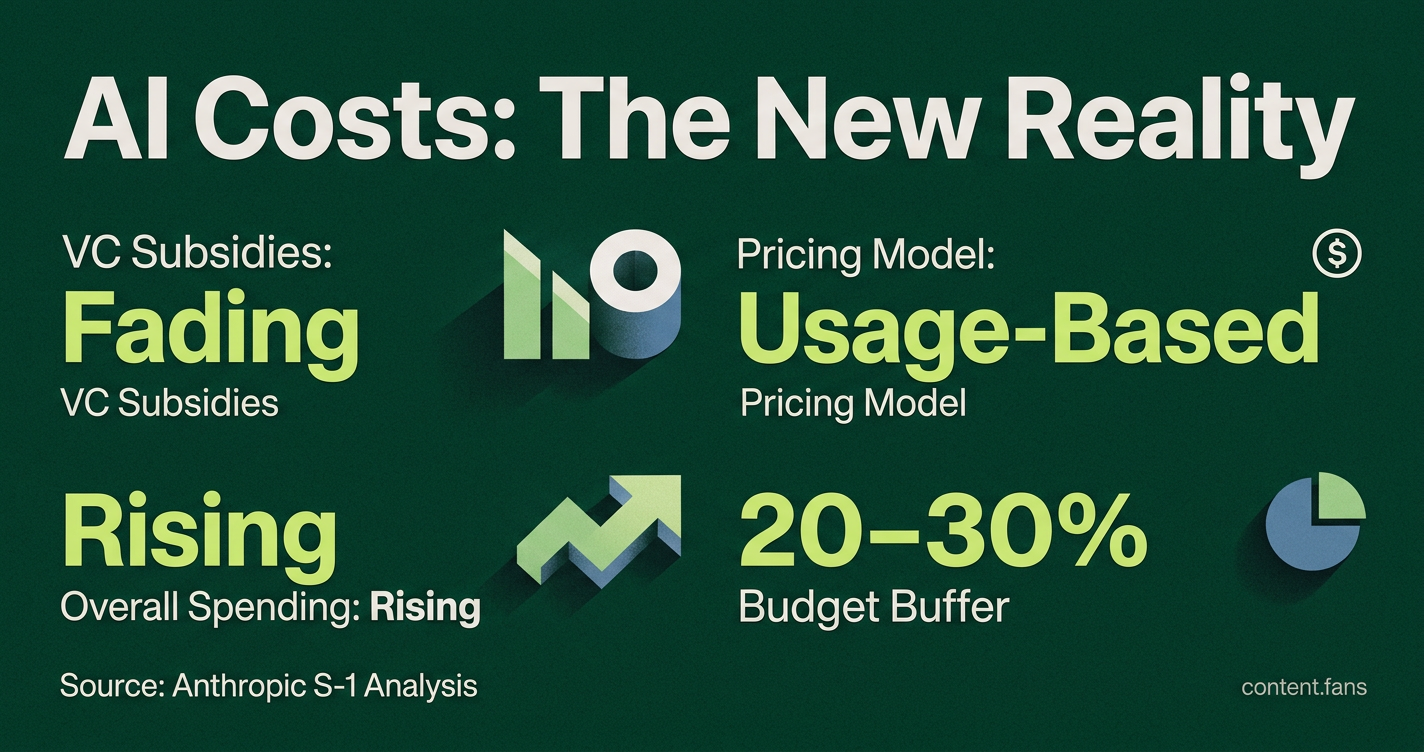
As venture capital subsidies for AI services disappear, pricing is shifting from flat-rate subscriptions to usage-based models. Enterprises are seeing net costs rise despite lower per-token prices due to massive increases in usage volume. This forces vendors to adopt metered billing to manage variable compute demands.
The capital required to train and run AI models is outgaining any drop in per-token prices. Investors now prioritize inference efficiency and payback periods over pure growth metrics. According to Gartner's Arun Chandrasekharan, startups that depended on token subsidies now face "sharp margin pressure," accelerating the move to metered billing. A Menlo Ventures survey confirms this, finding that while per-token costs may be down, overall enterprise spending is rising due to explosive usage volume that flat subscriptions cannot sustain.
Enterprise playbook for metered reality
Enterprises must now treat AI consumption as a core financial metric. Deloitte advises that finance and engineering teams collaborate to gain token-level visibility through real-time monitoring, budget alerts, and project-level chargebacks. Key strategies for managing costs in this new metered reality include:
- Tag every AI request by model, feature, and user to trace costs.
- Route low-complexity tasks to smaller local or open models when quality permits.
- Trim prompt and context size to avoid runaway context-window charges.
- Negotiate contracts with export guarantees and multi-year price caps.
- Maintain a 20 - 30 percent buffer in consumption budgets to absorb traffic spikes.
CloudZero's guidance further emphasizes using cost-per-outcome dashboards to help product teams make informed decisions about when to use expensive frontier models.
Market implications for AI vendors
Prospective public companies like Anthropic are incentivized to move to metered pricing to demonstrate profitability. Public filings will expose gross margins, and ongoing subsidies would likely depress valuations. As companies consider public offerings, their prospectuses will be scrutinized for metrics like inference cost and average revenue per user, setting new industry benchmarks for how Wall Street values large-scale AI.
Looking ahead
While the timing of potential IPOs from companies like Anthropic, OpenAI, or SpaceX remains uncertain, the end of subsidies is forcing both vendors and customers to adopt metered consumption habits. Proven strategies for adaptation, such as Deloitte's token spend framework, highlight the need for financial discipline. Deloitte Insights advises treating AI tokens as a core variable cost, similar to cloud bandwidth, and implementing financial guardrails immediately.