
Anthropic reports Claude boosts engineer code output 8x by 2026
Serge Bulaev
Anthropic reports that by 2026, engineers using Claude may be merging eight times more code each day compared to 2024, with over 80 percent of new code coming from Claude. However, company leaders say that measuring lines of code is not a perfect way to judge productivity, and reviewers warn that quality and review time also matter. The biggest gains appear in tasks where Claude can write and test code with some help from engineers, but results might vary for harder problems. Some studies suggest AI helpers may speed up work, but others found engineers were actually slower on certain tasks, so results seem to depend on the type of work and tools used. Anthropic also notes there are risks and is being careful about sharing its most advanced systems, and it is unclear if the current gains will last long-term.

According to industry reports, Anthropic's AI assistant Claude boosts engineer code output, with projections showing substantial increases in daily merged code per developer by 2026 compared to 2024. Industry analysis indicates that a significant portion of production code is now written by Claude, a figure highlighted in an analysis of Anthropic's metrics (Anthropic Claude 80 percent code).
However, Anthropic executives caution that measuring raw lines of code is an imperfect productivity metric. According to industry reports, while employees perceived significant productivity lifts, factors like code quality and review time are critical considerations (How AI Is Transforming Work at Anthropic).
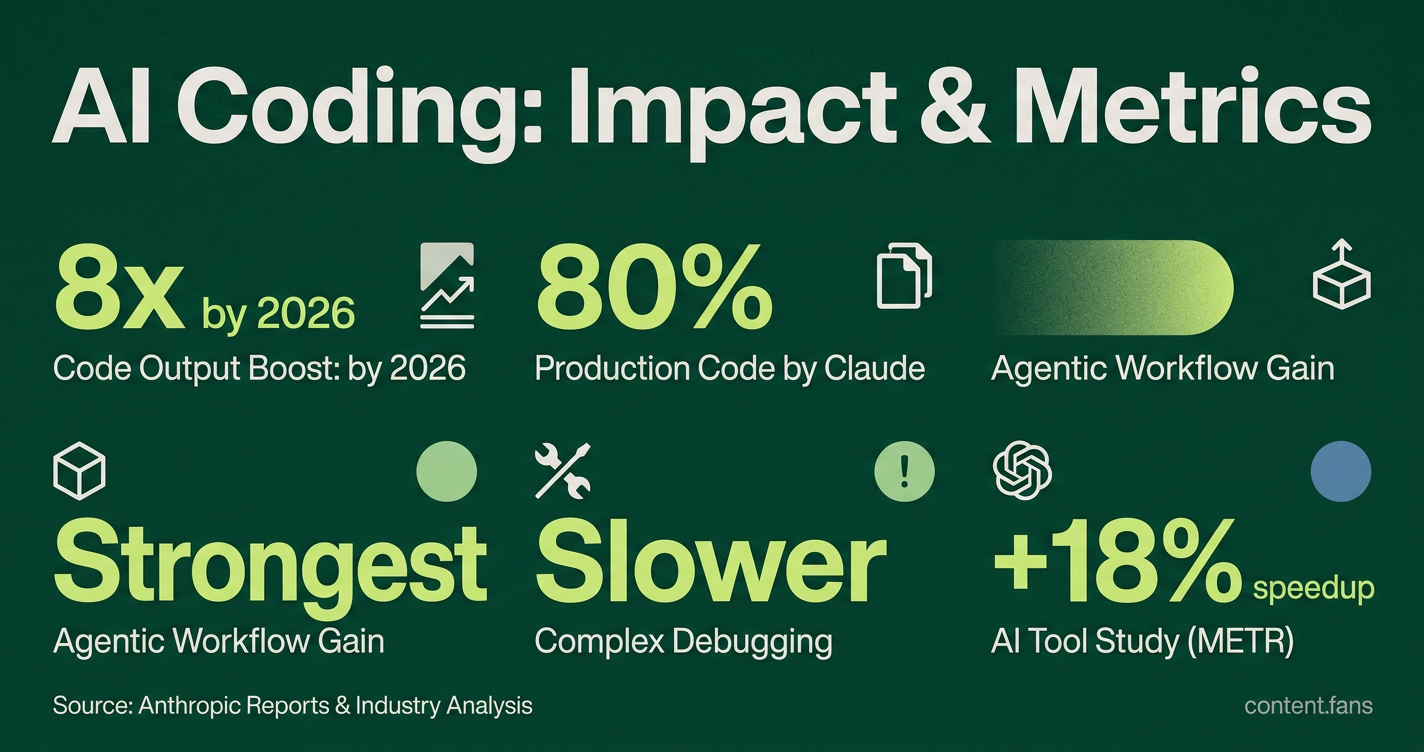
Where the productivity jump appears strongest
The productivity jump is most prominent in 'agentic' workflows where engineers supervise Claude in writing, running, and testing code. These gains are concentrated in boilerplate tasks like tests and refactors, while performance on more complex assignments, such as debugging, shows more varied results.
The most significant productivity gains are attributed to "agentic coding," where developers direct Claude as it writes, runs, and tests code. This workflow dramatically reduces time spent on boilerplate tasks such as writing tests, refactoring, and managing dependencies. However, the benefits are not universal; independent studies show developers can be slower on complex debugging tasks, indicating performance varies by task.
Debate over metrics
The substantial productivity figures have sparked a debate over using lines of code (LOC) as a primary productivity metric, as it can incentivize verbose or superficial changes. In response, industry analysis from 2025-2026 advocates for quality and delivery-focused indicators over simple activity measures. More meaningful alternatives include:
- Lead time for changes
- Deployment frequency
- Change failure rate
- Code churn or rework rate
- Developer satisfaction
These metrics better assess if AI tools are accelerating the delivery of high-quality, stable code rather than just increasing commit volume.
Early signs beyond Anthropic
Broader industry studies echo this complex picture. While developers using AI assistants often anticipate significant speedups, METR's early-2025 study found that when experienced developers were allowed to use AI tools, tasks took 19% longer on average; a later METR update reported a +18% speedup estimate for a subset of original participants and -4% for newly recruited developers, with wide confidence intervals. The data suggests that productivity outcomes are highly dependent on the specific task, team workflows, and the maturity of the AI tools being used.
Risk notes and future disclosures
Anthropic has coupled its transparency with caution, issuing warnings about the risks of "recursive self-improvement" cycles in its advanced AI. The company also demonstrates a guarded approach to deployment by limiting access to Mythos, a powerful internal security model, due to its potential for dual-use. This suggests a careful strategy for releasing its most capable systems. The key takeaway for the industry is that impressive throughput figures must be balanced against concerns about review bottlenecks, code quality, and creating sustainable development practices.
How big was the jump in Anthropic's internal code output?
According to industry reports, typical engineers merged substantially more code per day in Q2 2026 than in 2024. Public reporting and Anthropic materials support a 2025 inflection point around Claude Code and Claude 4. Today a significant portion of the code that reaches production is authored by Claude, up from minimal levels before the research preview.
Why does Anthropic warn that "lines-of-code" can mislead?
Raw volume rewards verbose patches and ignores review, rework and downstream failure risk. Industry reports show engineers finish more tasks in less wall-clock time, but the metric that actually correlates with release stability is lead time for changes, not LOC.
What is Mythos and who already has access?
Mythos is an internal Anthropic cybersecurity model that can spot and reason through decades-old vulnerabilities. Outside Anthropic, access is gated under a program called Project Glasswing. According to industry reports, government agencies are among those with early access to the system.
Which productivity metrics are replacing LOC in 2025-2026?
Teams watching AI impact are moving to four DORA-style throughput numbers-deployment frequency, change failure rate, mean time to restore, and lead time-plus code-churn, PR cycle time and developer-satisfaction scores. These metrics capture whether AI is accelerating delivery or just shifting bottlenecks to review and rework stages.
Are the gains universal across all tasks?
No. Anthropic's research summary shows the largest wins in tests, refactors, type additions and dependency bumps. METR's early-2025 study found that when experienced developers were allowed to use AI tools, tasks took 19% longer on average; a later METR update reported a +18% speedup estimate for a subset of original participants and -4% for newly recruited developers, with wide confidence intervals, so the return depends heavily on task type and measurement window.