
Anthropic Rebuilds Workflows Around Claude, Boosts Productivity
Serge Bulaev
Anthropic rebuilt its work processes around the Claude AI agent, making it the main tool for tasks like code fixes and calendar searches. Reports suggest this change may have led to faster work cycles, though exact numbers are not available. Other companies, like Deloitte and Snowflake, appear to get similar benefits by putting AI agents at the center of their workflows. Broader access to these AI tools may boost experimentation and productivity, especially as more employees use them for key tasks. Some surveys and studies suggest that companies embedding AI deeply in their processes might see higher returns and time savings, but some tasks still need human oversight.

To boost productivity, Anthropic is rebuilding its internal workflows around its Claude AI, making the agent central to company operations. This strategy moves generative AI from a simple helper to the core engine for tasks, data, and collaboration. This report details Anthropic's approach and the emerging evidence from enterprise adopters who are also placing AI agents at the center of their business processes.
Practical playbook: integrate AI by making agents central to workflows
Placing an AI agent like Claude at the center of workflows allows companies to fundamentally redesign processes for maximum efficiency. Instead of using AI as an add-on, this agent-first approach automates core tasks, reduces manual steps, and unlocks measurable productivity gains, echoing historical tech-driven transformations.
Anthropic now centers its daily operations on Claude, with staff using the AI for everything from code fixes to expense policy queries and calendar searches. This shift, where agent calls replace traditional Slack requests, reflects a principle from business research: productivity gains come from reorganizing around new technology, not just adding it peripherally.
Cherny recommends three operational moves:
- Issue generous model-access tokens to every team, including non-engineers.
- Remove legacy approval steps so the agent can sit inside the flow, not above it.
- Track which unexpected roles generate the highest-value prompts, then formalize those patterns.
While specific figures remain private, internal tracking at Anthropic reportedly confirms measurable reductions in cycle times for tasks like documentation and code review.
Early enterprise evidence
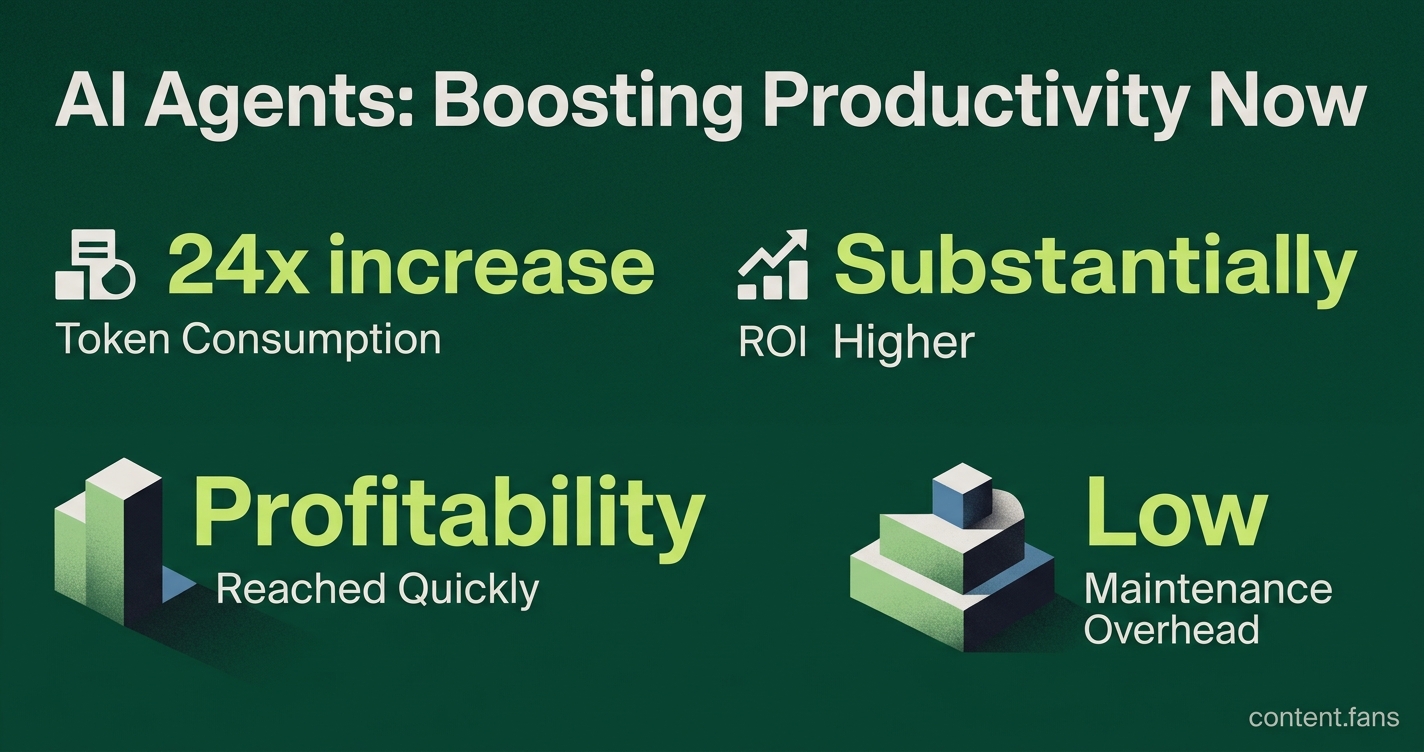
The trend extends beyond Anthropic, with major enterprises reporting similar results. An IntuitionLabs article notes that Deloitte has established a Claude-focused initiative, training a significant number of practitioners to embed the AI in core workflows for research and proposal drafting. Similarly, Snowflake has developed a Claude-powered text-to-SQL assistant that shows strong performance in internal tests, streamlining data analysis. Supporting this, industry reports suggest that workflow-centric AI delivers substantially higher ROI and reaches profitability more quickly, with maintenance overhead remaining low when tightly integrated.
Why broad access matters
Providing broad access to AI tools is crucial for driving experimentation and identifying high-value applications. A Goldman Sachs analysis forecasts a 24-fold increase in monthly token consumption by 2030 as consumers and enterprises adopt agentic AI. This widespread adoption translates into tangible benefits; field surveys show knowledge workers save significant time weekly, particularly in customer service, code review, and marketing. As integration deepens, token usage evolves from experimental queries to becoming an essential part of durable business processes, though highly regulated tasks still demand human oversight.
Operating checklist for implementation
- Map one repetitive, cross-system workflow where an agent could execute bounded actions.
- Expose the process to a broad user pool with tracked token budgets.
- Capture cycle time, error rate, and escalation data before and after deployment.
- Iterate guardrails based on real exceptions, not hypothetical scenarios.
- Retire the legacy path to prevent drift back to manual work.
The evidence from historical precedent, early adopters, and market forecasts converges on a single conclusion: significant productivity gains are unlocked when an AI agent like Claude is deployed as a core workflow engine, not merely as an optional add-on.
Why did Anthropic choose to "restructure around Claude" instead of treating it as a peripheral tool?
According to industry research, firms that reorganized their processes around new technologies reaped productivity gains, while those that kept them on the side did not. The same pattern is repeating with AI. By asking Claude for code help, expense answers, or calendar queries, employees remove entire legacy steps and free up substantial time each week. When processes are rebuilt for the agent rather than merely with it, the value compounds and shows up in measurable cycle-time reductions.
What measurable benefits are companies already seeing with this workflow-first approach?
- Deloitte has built a Claude-focused initiative and trained a significant number of practitioners to embed the agent in advisory and proposal workflows.
- Snowflake reports strong performance in internal tests of a Claude-powered text-to-SQL agent that lets non-technical staff query complex data sets in plain language.
These examples mirror Anthropic's internal cases, where teams that redesigned work around Claude recorded substantial time savings per knowledge worker per week and faster profitability cycles.
How does giving every employee "tokens" lead to higher-value use cases?
Anthropic's experience shows the biggest productivity ideas often come from non-obvious places. When every staff member can experiment with Claude tokens, unexpected roles surface winning use cases:
- Customer-success reps automated ticket triage.
- HR coordinators built self-service onboarding flows.
The policy is simple: distribute tokens widely, then track where usage concentrates. Goldman Sachs projects a 24-fold increase in token consumption by 2030 as consumers and enterprises adopt agentic AI, driven by broad access that enables deeper and more valuable integrations.
What is the fastest way to move from peripheral AI assistance to core workflow integration?
Anthropic recommends a three-stage ladder:
- Suggest-only mode - agent drafts but humans act.
- Execute with approval - agent acts after a one-click sign-off.
- Governed autonomy - agent runs bounded tasks with built-in guardrails and audit trails.
Companies that follow this route report substantially higher ROI and reach profitability more quickly, compared with teams that keep AI forever in "ask-me-anything" chat windows.
Which specific workflows are safest and most lucrative for early integration?
Start with repetitive, cross-system processes that already have clear inputs, outputs, and compliance rules:
- Customer support ticket resolution (ServiceNow, Zendesk).
- Marketing campaign asset generation (CRM + CMS orchestration).
- Monthly close checklists in finance.
These tasks show the largest time savings and the lowest regulatory risk, making them ideal candidates for an initial bounded-autonomy rollout.