
Anthropic Passes OpenAI in Paid Business AI Adoption, Ramp 2026 Data Shows
Serge Bulaev
New data from Ramp suggests that Anthropic has passed OpenAI in paid business AI adoption for the first time, with 34.4% of sampled companies paying for Anthropic in April 2026, compared to 32.3% for OpenAI. These figures are based on spending data from over 50,000 U.S. businesses. The report also notes that Anthropic's business has grown much faster than OpenAI's in the last year. However, about half of all companies studied are still not paying for any AI services, so there may be room for more growth and changes in the market. Ramp warns that business choices may shift as companies keep looking at costs, features, and compliance needs.

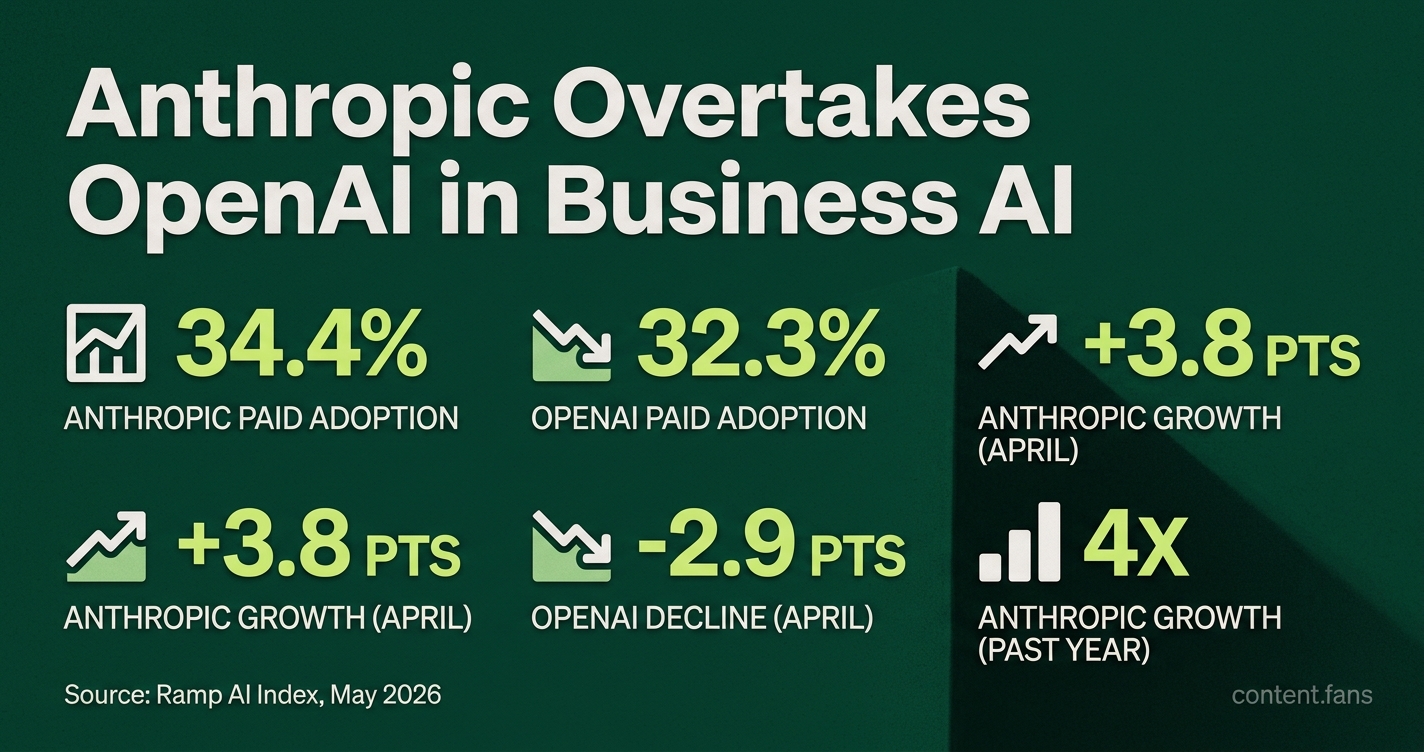
In a significant shift for the enterprise AI market, Anthropic has passed OpenAI in paid business AI adoption for the first time, according to the May 2026 Ramp AI Index. The new data, based on real corporate spending, shows 34.4% of sampled companies paid for Anthropic in April, while 32.3% paid for OpenAI.
The figures originate from Ramp's analysis of anonymized corporate card and invoice data from over 50,000 U.S. businesses. This methodology tracks actual financial expenditure, providing a spending-weighted measure of market share rather than relying on user licenses or headcount.
Inside the April crossover
New data from Ramp's May 2026 report shows Anthropic overtaking OpenAI in paid business AI adoption. The index, based on spending from 50,000+ U.S. firms, found 34.4% paid for Anthropic in April, compared to 32.3% for OpenAI, marking a first in the index's history.
Ramp's report details how Anthropic's paid adoption share grew by 3.8 percentage points in April, as OpenAI's share declined by 2.9 points. This created a 2.1-point lead for Anthropic, a milestone highlighted by VentureBeat as the first instance of OpenAI losing its top position in Ramp's data. Furthermore, Anthropic's paid business presence has quadrupled over the past year, while OpenAI saw minimal growth during the same period.
Despite this leadership change, the overall market is far from saturated. Paid enterprise AI adoption has crossed the halfway point, with a significant portion of businesses in the dataset not yet paying for any AI services, suggesting substantial room for growth and future market shifts.
Why cost and features matter
Ramp emphasizes that the market is fluid and highly cost-sensitive. As enterprises scrutinize rising AI expenses, purchasing decisions are increasingly driven by price tiers, model capabilities, and compliance features. Analysts note that Anthropic's Claude model family has gained traction in sectors like finance and software due to its larger context windows and robust policy controls.
While OpenAI's ChatGPT Enterprise maintains a wide user base, its spending growth has slowed in Ramp's sample. This trend indicates that AI vendors can capture market share from larger incumbents by focusing on specific enterprise needs like enhanced security, governance, or specialized workflows.
Possible boost from Microsoft silicon
Anthropic's competitive position could be further strengthened by a potential partnership with Microsoft. According to industry reports, Anthropic is exploring opportunities to run its models on Microsoft's custom AI chips. Such a deal would grant Anthropic access to crucial non-Nvidia compute capacity. This could help manage costs and improve margins, while Microsoft would gain a major customer to validate its custom silicon.
Methodology snapshot
- Data source: card and invoice spend across businesses (Ramp AI Index May 2026)
- Measurement unit: percentage of companies with paid spend in a given month
- Timeframe: April 2026 spending, reported May 2026
- No user counts or seat licenses included
Competitive landscape through Ramp's lens
The Ramp Economics Lab highlights a critical point: a substantial portion of all businesses have yet to adopt a paid AI tool. This unsaturated market creates opportunities for challenger models that can differentiate on cost, industry-specific features, or governance. The April data demonstrates that market leadership is not guaranteed and can shift rapidly as businesses prioritize ROI and specific feature sets.
What exactly do the Ramp May 2026 numbers show?
Ramp tracks real corporate spend across more than 50,000 U.S. businesses.
In April 2026 Anthropic captured 34.4% of paid business use while OpenAI slipped to 32.3%.
Overall, many companies now pay for at least one AI service, meaning the market is still expanding even as share shifts.
Why is this a milestone?
It is the first time in Ramp's index that any vendor has overtaken OpenAI.
Over the last twelve months Anthropic has quadrupled its business footprint; OpenAI saw minimal growth in the same period.
How reliable is spend-based adoption as a signal?
Ramp's method counts dollars, not user log-ins, so it directly reflects budget priority.
Because finance teams approve every transaction, a vendor must show provable ROI to keep getting paid - making the data a forward-looking proxy for enterprise commitment.
Could Anthropic's lead disappear quickly?
Yes. Ramp stresses the market is fluid and cost-sensitive; April alone saw Anthropic rise 3.8% while OpenAI fell 2.9%.
With many firms still running no production AI, share can swing again on pricing, governance features, or compute availability.
What role does Microsoft's new AI chip play?
According to industry reports, Anthropic is exploring opportunities to utilize Microsoft's custom processors for improved cost efficiency.
If finalized, such arrangements would give Anthropic additional non-Nvidia capacity and potentially lower serving costs, tightening the race further.