
Anthropic, OpenAI Signal Support to Pause Frontier AI Development
Serge Bulaev
Major AI labs like Anthropic and OpenAI have recently shown support for possibly slowing or pausing the creation of very advanced AI systems. Anthropic says it might be good to pause so society can catch up, but wants any pause to be coordinated and checked by all big labs. OpenAI says governments, not single companies, should decide on speed limits, and has not clearly called for a pause. DeepMind has not made a new statement in 2026 but its leader has said he could support a pause if everyone joined. It is still uncertain if these ideas will become actual rules.
Leading AI labs including Anthropic and OpenAI are signaling conditional support for pausing or slowing frontier AI development, shifting this conversation from a speculative idea to a tangible policy option. This repositioning has ignited a debate over the appropriate speed of AI scaling and who should govern it.
The Shifting Stances of Leading AI Labs
The discussion is dominated by nuanced positions from the industry's most influential developers, each proposing different conditions and frameworks for a potential slowdown.
Anthropic's Call for a Coordinated Pause
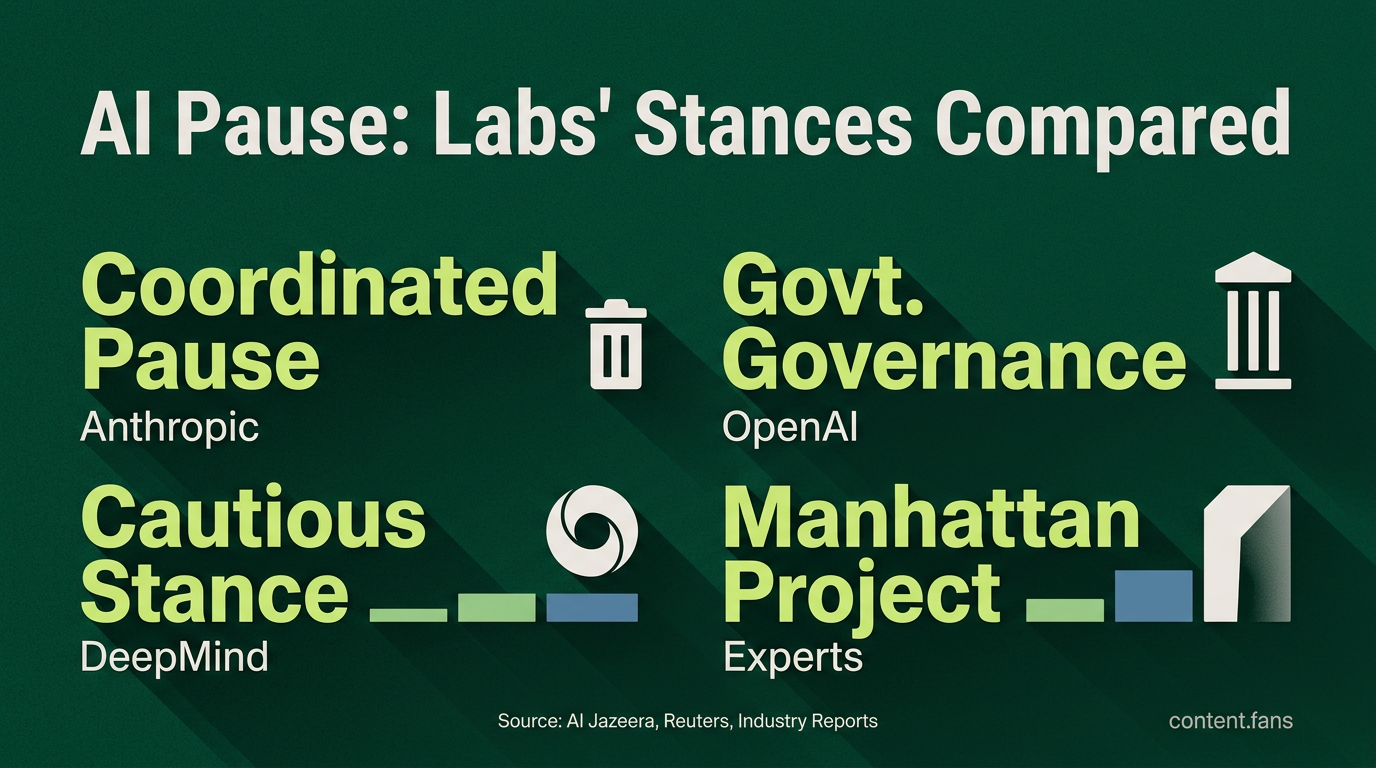
On June 5, 2026, Anthropic argued it would be "good for the world to have the option to slow or temporarily pause frontier AI development," allowing alignment research and societal structures to catch up. The company stressed that any such pause must be "coordinated and verifiable" across several major labs, as cited in reports by Al Jazeera and Reuters.
Anthropic advocates for a coordinated pause to allow safety measures to advance, while OpenAI insists democratic governments, not companies, must set development speed limits.
OpenAI's Governance-First Approach
In the same news cycle, OpenAI adopted a governance-first stance, stating that democratic governments - not individual companies - should establish speed limits for AI development. The company emphasized that no single firm should be entrusted with these decisions and focused on the need for robust accountability frameworks rather than endorsing a specific pause.
DeepMind's Position
According to industry reports, DeepMind has maintained a cautious stance on AI development pauses, though the company has not issued detailed public statements on coordinated pause mechanisms.
Expert Commentary and Broader Implications
Outside experts are contextualizing the debate, highlighting economic risks and proposing large-scale safety initiatives.
According to industry reports, experts have warned that significant AI dangers may include the concentration of wealth and power, advocating for smart regulation that could enhance safety without stifling innovation.
Policy analyst Rob Wiblin, via his work with 80,000 Hours, champions a "Manhattan Project for AI safety." This initiative would involve significant public investment in AI evaluation, guardrails, and widely accepted safety standards, reinforcing the need for government and lab coordination.
Strategic Signaling vs. Technical Reality
Analysts suggest the conversation around a pause is driven by two overlapping factors: genuine technical bottlenecks and strategic public relations.
On one hand, the industry faces hard physical limits to scaling AI. These constraints, which are already slowing development timelines, include:
- Hardware Shortages: The supply of high-bandwidth memory (HBM) remains tight.
- Energy Constraints: Data center power requirements are outpacing the growth of electrical grids.
- Data Scarcity: The availability of high-quality training data is dwindling.
- Diminishing Returns: Current deep-learning methods are showing less improvement with more scale.
On the other hand, safety-focused rhetoric serves reputational and regulatory goals. By framing a slowdown as a proactive safety measure, labs can earn public goodwill and influence future regulation. Anthropic's statement that a unilateral pause "would not materially improve safety" is a clear call for government-led coordination, functioning as both a risk warning and a strategic negotiating position.
The Path to a Verifiable Pause
For any slowdown to be effective, stakeholders agree it must be binding and enforceable. The fact that top researchers are now treating a pause as a plausible scenario marks a significant shift in the AI policy landscape.
An effective framework would require:
- Shared Risk Metrics: A common understanding of when to trigger a pause.
- Independent Audits: Real-time, verifiable audits of compute usage and model training.
- Credible Enforcement: Multilateral agreements between labs, backed by government enforcement mechanisms.
While OpenAI emphasizes government-led frameworks, Anthropic's proposal highlights the need for coordination among the labs themselves. The emergence of these detailed mechanisms remains uncertain, but their discussion has moved from the margins to the center of AI governance.