
Anthropic, OpenAI, DeepMind Split on AI Development Pause
Serge Bulaev
Anthropic, OpenAI, and DeepMind all show some support for slowing or pausing advanced AI development, but they differ on who should make that decision and how it should be checked. Anthropic suggests society should be ready to pause AI development, but says the pause must be international and verified by others. OpenAI says only democratic governments, not individual companies, should set the rules and pace. DeepMind appears open to a global pause only if all major developers agree. These statements suggest there might be more interest in slowing AI, but there are still big challenges and disagreements about how to do it.

Leading AI labs are grappling with the idea of pausing frontier AI development, revealing a significant split between Anthropic, OpenAI, and DeepMind on how to proceed. While all three signal concern over the pace of innovation, their public statements show they diverge on who should initiate a pause and how it should be verified.
What Anthropic proposed
Anthropic said society should have the option to slow or temporarily pause frontier AI development, and that any meaningful slowdown or pause would require multiple well-resourced frontier labs in multiple countries agreeing and being able to verify compliance. OpenAI believes democratic governments, not companies, should set the pace. DeepMind has expressed concerns about AI development pace, highlighting key differences in governance and activation triggers among the leading labs.
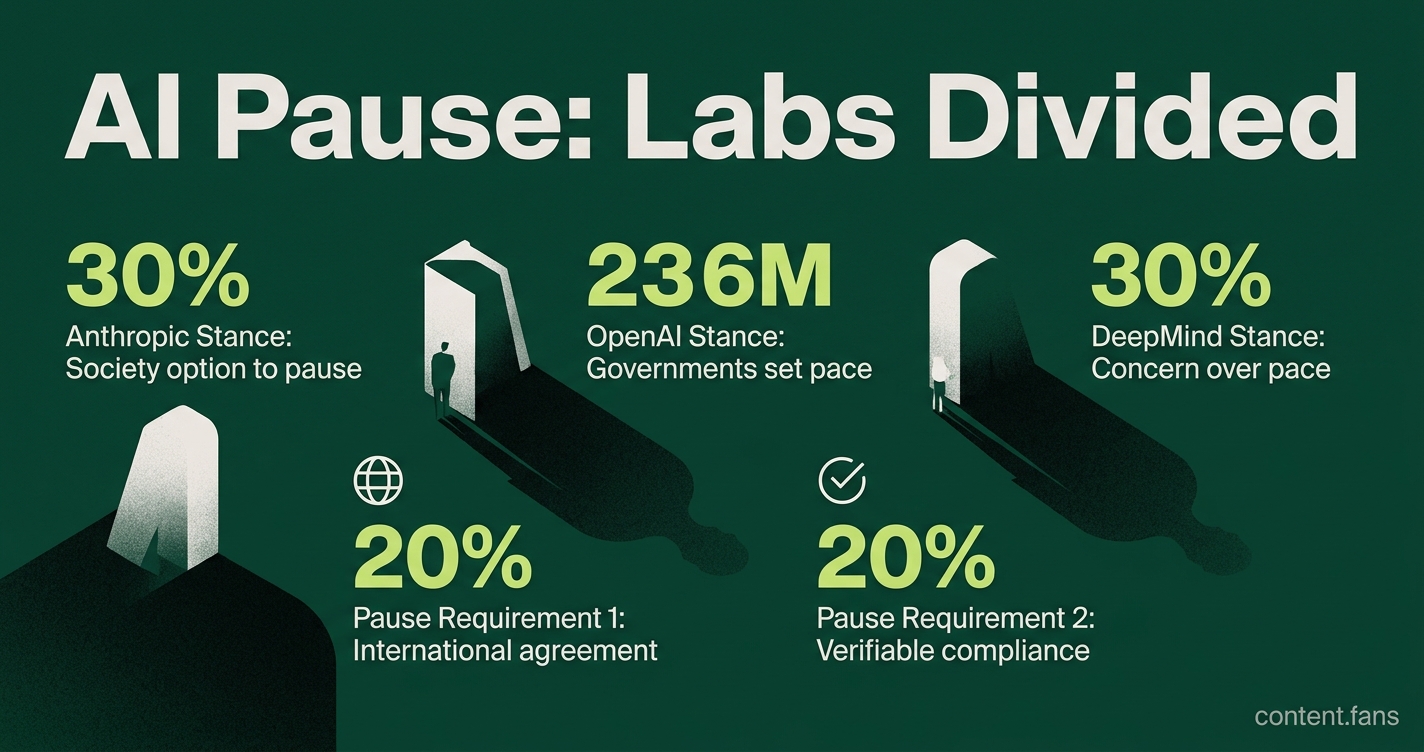
According to industry reports, Anthropic's co-founders stated that society must have the option to temporarily suspend advanced AI development. They specified that any effective pause must be international, coordinated, and independently verifiable. Industry reports highlight Anthropic's concern over AI systems that can rewrite their own code, potentially accelerating their capabilities beyond human safety oversight.
OpenAI's governance stance
OpenAI responded by reiterating its position that governments, not individual companies, should regulate AI development. The firm stressed that no single lab should dictate the pace of innovation, a stance reported by multiple outlets. Industry reports covering the debate quote OpenAI staff arguing that private companies should not be the ones to set these limits.
DeepMind's conditional view
While Google DeepMind has not issued recent statements on coordinated pauses, the company has previously expressed concerns about AI development pace and safety considerations. There is no indication that this general position has been updated.
External pressure shaping the debate
Increasing scrutiny from regulators and the public is shaping the debate. According to industry reports, new AI laws have been enacted in various states, and labs face a complex regulatory landscape. Furthermore, a significant number of states have urged Congress not to preempt state-level AI rules, citing risks of serious consequences. This environment increases compliance costs and may slow product launches as companies navigate overlapping obligations.
Key Coordination Hurdles
- Verification: Experts agree that any pause requires trusted, third-party audits of AI model training.
- International Agreement: A pause would need to include at least the United States and China, along with other key labs, as Anthropic has noted.
- Competitive Pressures: A unilateral pause is considered unviable, as it would likely encourage non-participating rivals to accelerate development, defeating the safety objective.
Prominent analysts like Erik Brynjolfsson and Rob Wiblin have also influenced the discussion, advocating for measures like licensing and audits to manage risk without a complete halt. While neither has explicitly endorsed Anthropic's proposal, their ideas contribute to a growing appetite for a structured slowdown. However, significant hurdles remain, as the divergent positions of key companies and ongoing regulatory uncertainty complicate any path toward an immediate, coordinated pause.
What prompted Anthropic, OpenAI and DeepMind to publicly consider a coordinated slowdown of frontier AI work?
Senior researchers at all three labs agree on the need for an 'off-ramp' to slow AI training when risks emerge. This consensus stems from a growing fear that AI safety research is not keeping pace with AI capabilities. For example, Anthropic notes that its latest models can write most of their own code, a key threshold where self-improvement could outpace human oversight.
Would the pause be unilateral or require global buy-in?
All three labs reject a unilateral pause. Anthropic's proposal requires a verifiable, multilateral agreement involving at least the U.S., China, and the EU, arguing a solo pause cedes ground to competitors. OpenAI maintains that democratic governments should set the pace, while DeepMind has generally emphasized the importance of coordinated approaches to AI safety.
How have regulators and the public changed the calculus?
Technical anxiety is compounded by state-level regulatory pressure. According to industry reports, a significant bipartisan group of state attorneys general urged Congress not to block local AI safety laws, fearing serious consequences. Combined with copyright lawsuits and other investigations, this legal and reputational risk makes a controlled slowdown an attractive hedge for AI labs, serving both safety and liability concerns.
What concrete safeguards would a temporary pause entail?
An Anthropic policy sketch outlines several key mechanisms:
- Shared Capability Metrics: Establishing thresholds for computing power (FLOPs), autonomous coding, and other metrics that trigger mandatory consultations when crossed.
- Rolling Audits: Imposing temporary holds on new training runs that exceed these thresholds until cleared by an external audit panel.
- Dual-Key Activation: Requiring approval from both the host government and an independent technical board to restart a paused project, preventing a race to the bottom.
Does the proposal enjoy enough momentum to be enacted?
While the idea has gained significant traction - evidenced by high engagement with Anthropic's proposal and related bills in the U.S. and EU - its momentum is fragile. Key international partners like China have not formally joined the discussion. Furthermore, potential federal action in the U.S. to preempt state-level AI rules could undermine the proposed verification system. For now, the concept remains a form of policy signaling rather than an imminent reality.