
Anthropic IPO filing signals end of free AI, higher prices
Serge Bulaev
Anthropic's confidential IPO filing may signal that free or very cheap AI is ending, as investors now want companies to recover more of their real costs. AI products might move to metered pricing, with higher prices reflecting how much computing they use. Analysts note there may be two types of prices: higher rates for top models and lower rates for simpler ones. Experts suggest companies should control AI spending by using budget limits, routing simple questions to cheaper models, and reusing answers when possible. Early users who manage their AI costs well may be less affected by rising prices as the market shifts.

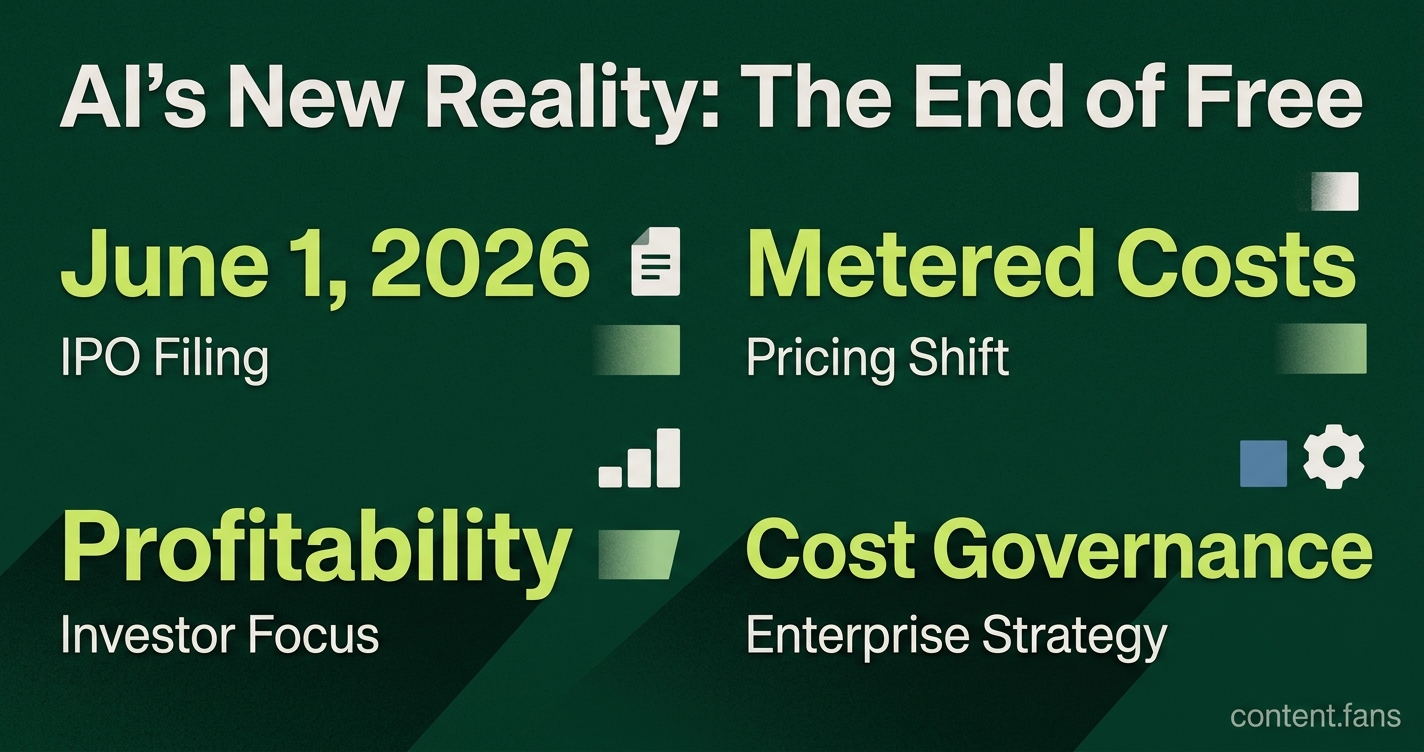
Anthropic's confidential IPO filing signals a major shift in the AI market, likely ending the era of heavily subsidized, low-cost services. As venture capital subsidies disappear, AI products are moving toward metered pricing that reflects their true computational costs. Reuters reported that Anthropic confidentially filed for a U.S. IPO on June 1, 2026, and that the company said timing depends on market conditions.
IPO pressure and the "$5 Uber era" - AI moving toward metered pricing
The move toward a public offering increases pressure on AI labs to demonstrate profitability. Unlike private venture capitalists, public market investors demand strong unit economics, forcing companies like Anthropic to end pricing subsidies and align charges with the actual, high cost of AI computation and model serving.
Anthropic's filing comes amid speculation that competitors are also considering public offerings. Public investors scrutinize unit economics far more than private backers, compelling AI labs to prioritize cost recovery. As The New York Times notes, Anthropic's growth hinges on favorable "market conditions," signaling a move away from unprofitable expansion. This financial discipline is reinforced by funding trends, with venture capital concentrating in fewer megadeals, leaving less room for sustained, below-cost pricing.
What metered economics mean for buyers
Enterprises should anticipate a dual-track pricing landscape. Frontier models will likely command premium rates due to the specialized hardware and energy required for training and inference. Simultaneously, smaller, more commoditized models will see prices fall toward their marginal cost. With growing generative AI spending, CFOs are increasingly focused on the cost of every token. Experts advise businesses to directly connect AI usage to business value, a strategy that includes implementing budget controls, as advised by IBM, and routing simple queries to cheaper models, as recommended by TrueFoundry.
Key strategies for managing this new economic reality include:
- IBM: establish an AI cost governance framework
- Gateway-level token budgets: block runaway spend
- Model routing: align cost with task complexity
- Prompt caching: avoid paying twice for the same answer
- Hybrid cloud or on-prem inference: match workload to the cheapest adequate hardware
First steps for enterprises
Ultimately, the transition to metered, cost-based AI pricing is inevitable as the market matures. Early adopters that implement rigorous spend controls and a tiered model strategy will be best positioned to mitigate price increases. By aligning AI costs with task complexity and business value, enterprises can maintain sustainable margins as providers are pushed toward profitability by public markets.
What exactly did Anthropic (and the rest of the Gen-AI "Big Three") just file for, and when could the stock actually start trading?
Anthropic confidentially filed for a U.S. IPO on June 1, 2026, according to Reuters.
- The company has not set a firm pricing date; the S-1 is under SEC review and the listing "depends on market conditions."
- Industry reports suggest various timing possibilities, though no firm dates have been confirmed.
- Other major AI companies are also reportedly considering public offerings, but their timing remains speculative.
Bottom line: Anthropic is furthest along, but investors should assume timing will depend on market conditions rather than any locked-in date.
Why does going public force AI labs to raise prices?
Once a company lists, unit economics become Wall Street's obsession. The generous VC subsidies that let users pay pennies for millions of tokens disappear because:
- Public-market investors demand visible paths to profit, not growth at any cost.
- Compute costs scale linearly with usage, so unlimited "free" access becomes a margin killer.
- The easiest lever left is price: shifting from flat or freemium plans to metered, token-based billing that approximates actual GPU time.
Industry reports suggest some enterprise customers are already generating substantial token costs - exactly the kind of imbalance IPO-bound labs must address.
Is this the end of "free" or "$5 Uber ride" AI?
Yes. The industry is replaying the ride-hailing script:
- Early era: massive subsidies → unsustainably low consumer prices.
- IPO era: prove every ride earns money → prices jump to true economic cost.
Expect the same for AI: cheap or free tiers will shrink, and the default will be usage-based tiers where users pay for actual consumption rather than unlimited queries.
What pricing models will replace the old freemium ones?
Several structures are emerging in industry planning:
- Pure metered (tokens, seconds of GPU) - already live at most frontier APIs.
- Hybrid subscription + overage - base fee for access, then pay-as-you-go beyond a quota.
- Enterprise commits - annual contracts with reserved capacity and locked-in rates to prevent sticker shock.
Industry reports indicate that a significant portion of generative AI spending now comes from usage-based billing, showing the shift is already underway.
How can businesses prepare for higher per-token costs right now?
Industry experts recommend several key strategies:
- Route smart - send simple prompts to smaller or distilled models, reserve frontier calls for complex reasoning (TrueFoundry guide).
- Cache aggressively - reuse answers for repeated or semantically similar queries to cut redundant spend.
- Budget at the gateway - enforce per-user or per-task token caps and circuit-breakers to stop runaway loops.
- Right-size infrastructure - match workloads to appropriate infrastructure based on performance and cost requirements.
Teams that put these controls in place before metered billing becomes universal will be better positioned to manage costs as the pricing landscape evolves.