
Anthropic integrates memory, orchestration into Claude Managed Agents runtime
Serge Bulaev
Anthropic has added memory, evaluation, and orchestration features to its Claude Managed Agents runtime, allowing developers to create agents with fewer separate parts.

Anthropic now integrates memory, orchestration, and evaluation natively into its Claude Managed Agents runtime. This update provides a bundled, hosted layer designed to let developers build and ship AI agents with fewer moving parts. However, by positioning itself as the single execution venue for core logic, the move raises new questions for engineering teams about vendor lock-in and regulatory compliance.
What's New in the Claude Managed Agents Runtime
The Claude Managed Agents runtime now bundles memory, evaluation, and multi-agent orchestration into a single hosted service. This integration provides a configurable agent framework on managed infrastructure, designed to simplify development by reducing dependencies on external tools for core logic, memory management, and agent coordination.
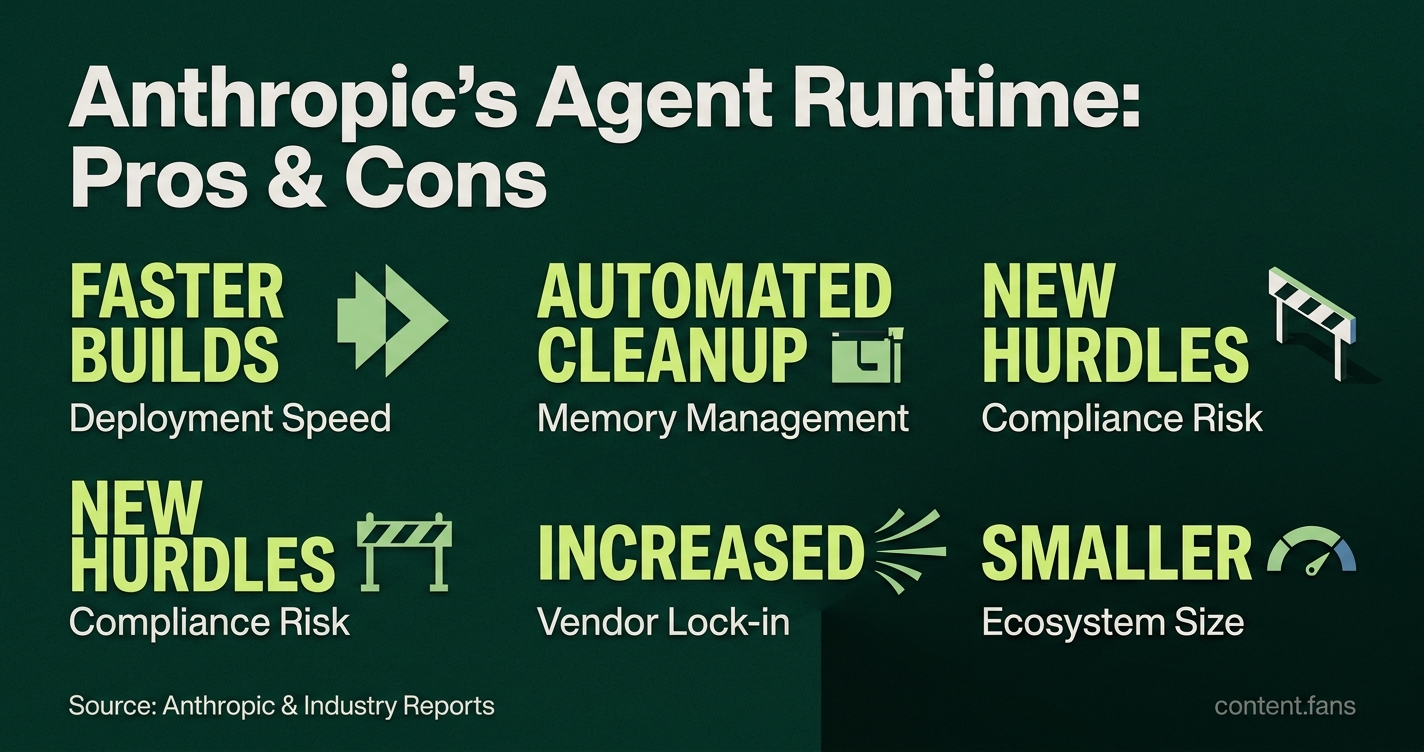
The runtime update introduces a "dreaming" capability, described as a background process for curating an agent's long-term memory. According to industry reports, this feature improves agents by reviewing past sessions to extract patterns, with an option for human approval on memory updates. This memory function now runs alongside multi-agent orchestration, where a lead agent delegates tasks to specialized sub-agents. This suggests Anthropic is absorbing roles previously filled by external frameworks like LangGraph for logic and Pinecone for retrieval.
The Trade-Off: Faster Deployment vs. New Compliance Hurdles
The managed stack aims to reduce deployment friction, with many customers reporting significantly faster builds than with self-assembled agent scaffolding. The "dreaming" cycle also cuts down on manual memory cleanup. However, this tight integration creates new compliance risks in regulated sectors. Because GDPR evidence "lives in the runtime trajectory of every AI agent execution," compliance teams now need visibility into prompt paths and tool calls inside Anthropic's cloud. Data residency must also cover the entire execution flow, as protection for data "at rest" is insufficient once an agent processes it.
A compliance checklist for integrated agent runtimes includes:
- Region where prompts, embeddings, logs, and backups are processed
- Audit-grade runtime traces for every agent action
- Business Associate Agreements for any protected health information
- Immutable log retention durations and deletion SLAs
How Tooling Vendors are Reacting
Early commentary from tooling vendors frames the hosted runtime as a competitive threat. While Anthropic's SDK is noted for being "MCP-first; tools portable across models," it has a "smaller ecosystem" than OpenAI. Competing frameworks like LangGraph are seen as stronger for "cyclic or branching workflows" because they offer checkpointing and time-travel debugging. LangGraph also provides "trace-level visibility into every node execution," a feature some auditors require. This may lead to a market split: teams prioritizing Claude-native features might accept tighter vendor coupling, whereas those needing model-agnostic orchestration and deeper audit controls may continue to use external frameworks. Pinecone, while focused on retrieval, risks being sidelined if customers adopt Anthropic's bundled memory.
Key Adoption Signals and Future Outlook
Enterprise adoption will likely hinge on feature maturity. The "dreaming" feature, which allows agents to self-improve, is still in research preview, prompting cautious enterprises to delay production workloads. Looking ahead, compliance demands will be critical; industry experts suggest that auditors will increasingly require extended agent action trails, creating an advantage for vendors that can provide immutable traces. The success of Anthropic's hosted layer will depend on whether its operational simplicity can outweigh enterprise concerns about data sovereignty, auditability, and ecosystem breadth.
What is the new "dreaming" capability in Claude Managed Agents?
Dreaming is a scheduled background process that reviews past agent sessions, extracts patterns, and curates memories so agents improve without human tuning. Early adopters report significant improvements in shipping speed compared with building agent infrastructure from scratch, while Anthropic stresses the feature is still in research preview and can be set to auto-apply or await human approval, a control many regulated buyers require.
How does the integrated runtime change where my data lives?
All memory stores, evaluation logs, and orchestration metadata now reside on Anthropic-managed infrastructure rather than inside your own cloud accounts. For EU, healthcare, or finance teams, this means you should verify region-pinning, subprocessors, and Business Associate Agreements before turning on dreaming or multi-agent flows, because residency evidence is expected to cover the full runtime trajectory, not just static file storage.
Will this replace LangGraph, Pinecone, or my current eval stack?
Anthropic openly positions the release as "orchestration is where lock-in occurs" and argues rivals will follow. LangGraph still leads for branching workflows, time-travel debugging, and crash recovery, while Pinecone remains a model-agnostic vector layer. In practice, Claude managed runtime + Pinecone is emerging as a low-ops alternative for teams that do not need LangGraph-level control, but audit-grade traceability or complex state machines still push many enterprises toward a hybrid stack.
What compliance risks should regulated industries watch?
Beyond classic GDPR or HIPAA storage rules, industry guidance suggests examiners increasingly want "runtime trajectory evidence" - a replayable log of every prompt, tool call, and memory write. If an agent can dynamically invoke external tools, you must prove no cross-border personal data slipped through during a 72-hour breach window. ITAR or PCI-DSS environments may still need self-hosted agents because foreign-person access or continuous control audits are not yet contractually offered by Anthropic.
How soon can my team adopt dreaming and multi-agent orchestration?
Managed Agents are production-accessible today, but dreaming remains in research preview and is turned off by default. Anthropic recommends starting with non-customer-facing workloads (internal research, code review, or reporting) while legal reviews data-use addenda and residency mappings. Industry reports suggest a formal GA announcement is anticipated along with SOC-2 Type II and ISO 27001 reports that many procurement teams are waiting for before green-lighting Claude-native orchestration at scale.