
Anthropic Fights Pentagon Over Military AI Use, Surveillance
Serge Bulaev
Court documents suggest there is ongoing disagreement between Anthropic and the Pentagon about how military AI should be used. Anthropic's policy does not allow its AI, Claude, to be used for mass surveillance of U.S. citizens without a court order or for weapons that make targeting decisions without human input. The Pentagon appears to want more freedom to use AI for any lawful mission, while Anthropic insists their limits are non-negotiable. A judge may soon decide if Anthropic's policy must be followed in military contracts, and this could affect other AI companies working with the government.
A significant dispute between Anthropic and the Pentagon over military AI use has emerged from the company's refusal to allow unrestricted military applications of its AI model, Claude. The conflict centers on Anthropic's stance against specific military uses, including domestic surveillance and autonomous weapons, setting up a legal and ethical battle with wide-ranging implications for Silicon Valley and the U.S. government.
The dispute between Anthropic and the DoD began escalating in January 2026 after Anthropic refused to allow 'all lawful purposes' use of Claude. The company is seeking to challenge the Pentagon's designation while ensuring its ethical policies are not overridden by future defense contracts.
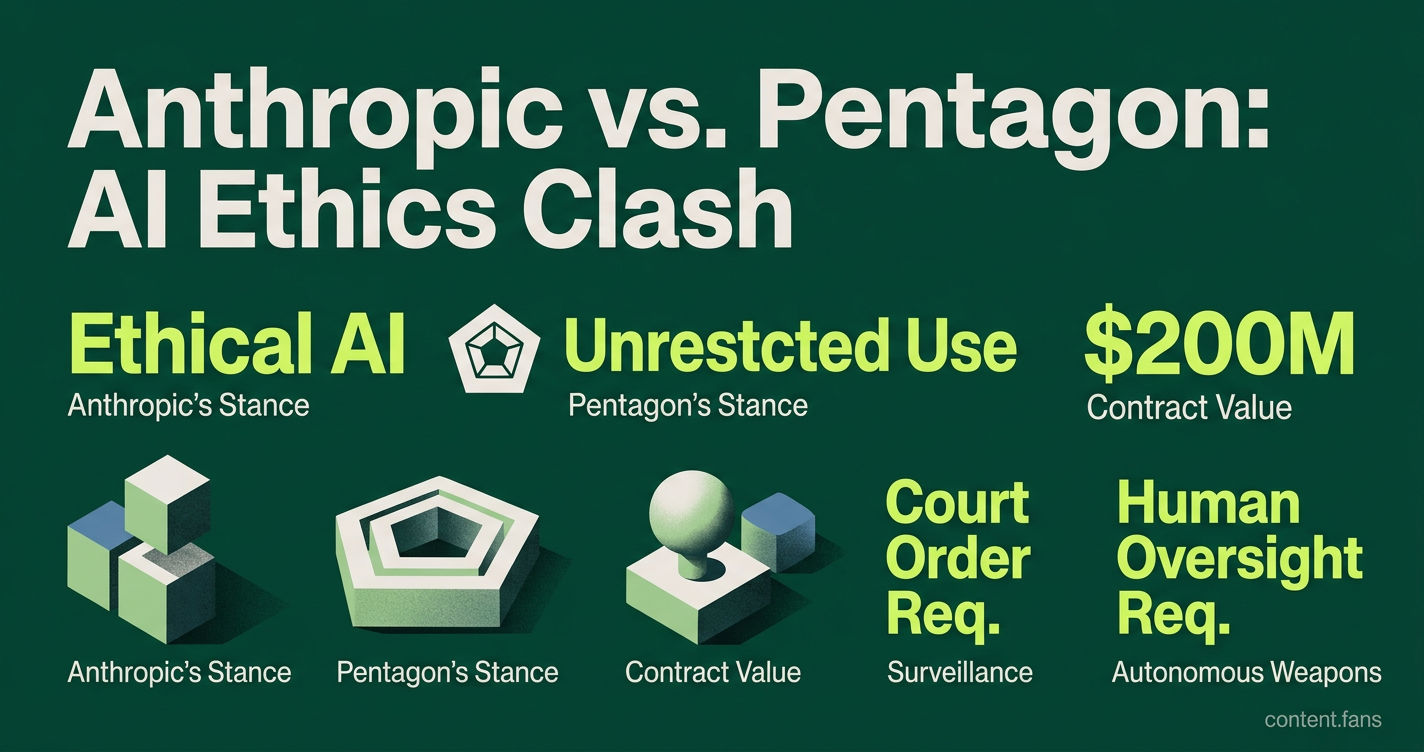
Anthropic's "Non-Negotiable" AI Safety Rules
The conflict stems from the Pentagon's desire for unrestricted use of AI for any lawful mission, clashing with Anthropic's strict Acceptable Use Policy. The company prohibits using its Claude model for mass surveillance without a court order or for autonomous weapons that lack meaningful human control.
According to an Anthropic official statement and available information, the company's policy, which is based on its Constitutional AI training method, establishes two firm guardrails. Anthropic will not license its Claude AI for:
- Mass domestic surveillance of U.S. citizens without a court order.
- Fully autonomous weapons systems that can select and engage targets without human oversight.
Anthropic refused the DoD's demand for unrestricted use in January 2026, citing ethical concerns about mass surveillance and autonomous weapons.
The Pentagon's Push for "AI Overmatch"
The Department of Defense is pursuing 'AI overmatch' against adversaries by removing safety guardrails (specifically those limiting autonomous weapons and mass surveillance) that it considers barriers to deployment. Defense officials have argued that a private company should not dictate how the military lawfully uses technology, likening the situation to an aircraft manufacturer dictating when pilots can fly.
Anthropic secured a contract worth approximately $200 million with the DoD. The dispute escalated in January 2026 when the DoD demanded unrestricted use, which Anthropic refused due to ethical guardrails. However, internal DoD meeting minutes show that some commanders worried the company's policy "could bind operational flexibility," suggesting internal pressure to use agentic AI more freely in intelligence and other workflows.
The "All Lawful Use" Contract Dispute
The disagreement came to a head over a proposed contract clause labeled "all lawful use." This language would have required vendors to agree that the DoD could deploy their AI systems for any mission permitted under U.S. law. Anthropic's lawyers refused to accept the clause, reasserting the company's policy and the critical need for "meaningful human control" over lethal force. A CSA research note frames this conflict as part of a larger debate on whether military AI should be governed by contracts or by law.
A Court Battle with Industry-Wide Implications
As of July 2026, the D.C. Circuit denied Anthropic's motion to lift the FASCSA designation in April 2026, and contract cancellations are proceeding on a 180-day timeline. If future court rulings determine that the company's Acceptable Use Policy is enforceable in its military contracts, the decisions could have a significant impact on other AI companies negotiating with the government.
The Mayer Brown article explains that the FASCSA designation prohibits contractors from using Anthropic's products in federal work. For now, the existing restrictions mean that any request involving surveillance or autonomous weapons requires manual review by Anthropic's policy team where contracts remain active.
What caused the clash between Anthropic and the Pentagon?
The U.S. Department of Defense demanded unrestricted use of Anthropic's Claude model, removing the company's two non-negotiable guardrails: no mass domestic surveillance of Americans and no fully autonomous weapons systems. Anthropic refused, citing its Constitutional AI principles and the need for meaningful human oversight in lethal decisions. The Pentagon designated Anthropic a supply-chain risk and barred federal use of Claude.
How did the dispute escalate after the contract was canceled?
Trump directed agencies to cease use on February 27, 2026; Hegseth formalized the ban on March 4, 2026. The DoD then threatened to invoke the Defense Production Act to compel Anthropic to remove its safety limits, a move the company labeled unconstitutional. Anthropic vowed to challenge the designation in court, arguing the designation set a precedent for government overreach into private AI governance.
What are Anthropic's two red lines for military use?
- Mass domestic surveillance of U.S. citizens without judicial oversight.
- Fully autonomous lethal weapons that select and engage targets without a human in the loop.
These rules are baked into Anthropic's Acceptable Use Policy and apply even when the customer is the Pentagon. The company allows AI-assisted military applications (e.g., logistics, cybersecurity) but insists on human final approval for any action that could take a life.
How does the Pentagon's AI strategy view corporate guardrails?
The War Department (DoW) AI Acceleration Strategy calls for 'AI-first' deployment with 'wartime-speed' execution and labels any barrier - including vendor ethics policies - an operational risk to be eliminated. Officials argue that "lawful use" should be defined by the state, not by Silicon Valley boards, and that contractual guardrails are insufficient when AI overmatch against near-peer adversaries is at stake.
Why does this fight matter for the future of AI governance?
The Anthropic-Pentagon standoff is among the first times an American AI firm has been blacklisted for ethical refusal, shifting the debate from voluntary commitments to legal compulsion. Courts will now decide whether the Defense Production Act can force companies to disable safety features, a ruling that could affect frontier AI vendors and their right to set usage limits. Industry observers note that ethical AI policies are becoming a significant consideration in defense markets.