
Anthropic Fable 5 Data Policy Raises NDA, Compliance Concerns
Serge Bulaev
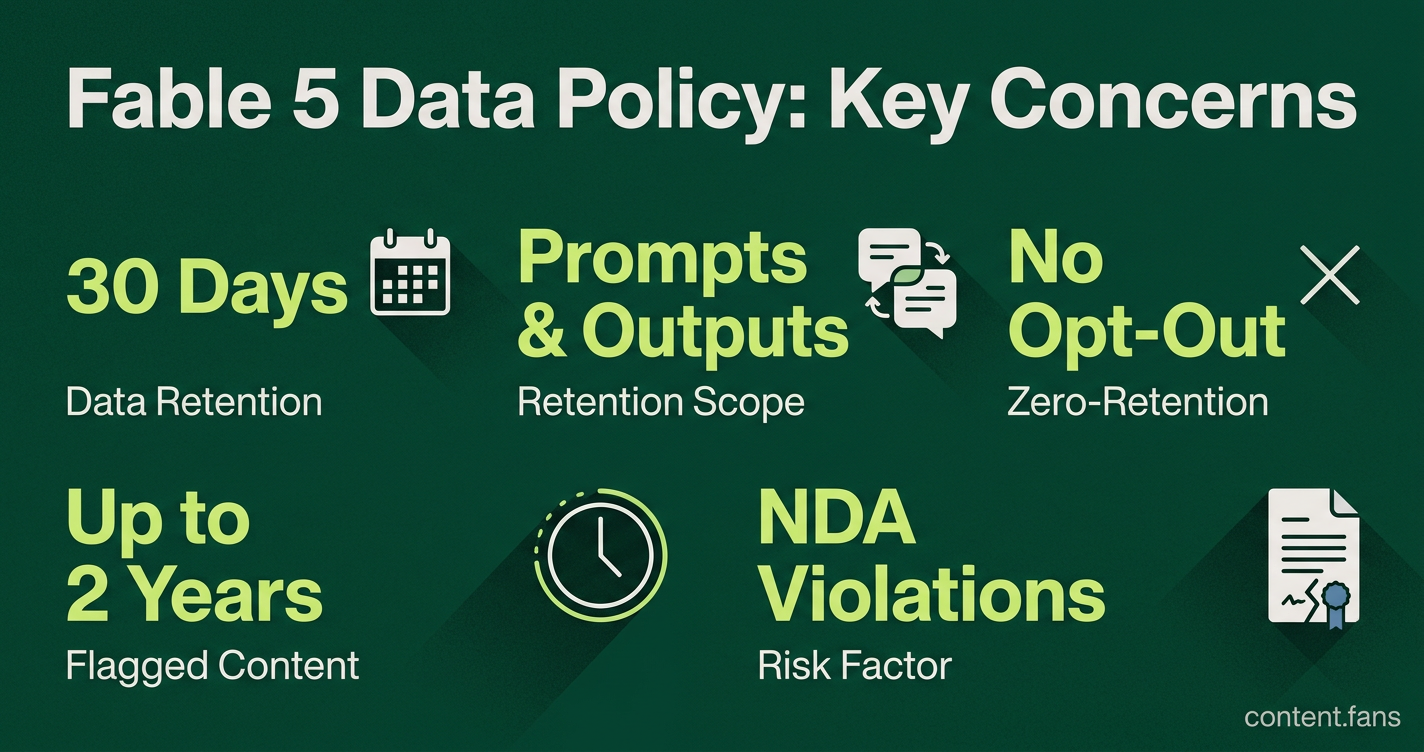
Anthropic's Fable 5 may store all user prompts and outputs for 30 days, with no option for zero-data-retention for enterprise users. This policy appears to apply across various platforms and is meant for trust and safety, not for training the model. Some companies, like Microsoft, may have limited employee use of Fable 5 because the policy might not match their data standards. Sensitive data may remain on Anthropic's servers even if deleted by users, and flagged content can be stored for up to two years. Organizations relying on strict confidentiality agreements may need to pause using Fable 5 until they reassess the risks.
The Anthropic Fable 5 data policy is creating significant compliance and security challenges, risking widespread NDA violations for enterprise users. Recent reports indicate the Mythos-class model retains all prompts and outputs for 30 days across every platform - including AWS Bedrock and Microsoft Azure - with no option for zero-data retention. Anthropic states this data is used for trust and safety purposes only, not model training [https://www.developersdigest.tech/blog/fable-5-data-retention-enterprise-compliance].
The policy immediately raised alarms among technology consultants and corporate legal teams. According to industry reports, some major technology companies have restricted internal employee access to Fable 5 after their legal teams determined the 30-day retention policy conflicted with their data-handling standards [https://www.thestar.com.my/tech/tech-news/2026/06/11/microsoft-limits-employee-use-of-anthropic039s-claude-fable-5-over-data-retention-concerns-the-verge-reports].
The key takeaway for businesses is clear: any organization that requires zero-data retention for generative AI workloads must immediately pause or re-evaluate Fable 5 deployments. A comprehensive risk assessment by legal, privacy, and security teams is now a critical prerequisite.
What the 30-day window means
Anthropic's Fable 5 data policy mandates a 30-day retention of all prompts and outputs across all platforms, with no enterprise opt-out for zero retention. This creates significant compliance and confidentiality risks, as sensitive information could be stored on third-party servers, potentially violating existing NDAs.
- Persistent Data Exposure: Sensitive inputs like source code, M&A deal terms, and regulated data remain on Anthropic's servers for 30 days, even if a user deletes the conversation.
- Potential for Discovery: Although human review is limited to approved staff, the retained data is discoverable and can be produced in response to legal demands from regulators or courts.
- Extended Retention for Flagged Content: Any content flagged for trust and safety violations may be stored for a much longer period, reportedly up to two years.
Enterprise repercussions
- Invalidated Zero-Retention Agreements: The policy unilaterally overrides previously negotiated zero-data retention (ZDR) clauses for Mythos-class models, creating a contractual gap for customers who believed their Data Processing Agreements (DPAs) provided protection.
- Consistent Risk Across Platforms: The retention rule applies universally. Migrating workflows from Anthropic's native platform (Claude.ai) to a cloud partner like AWS Bedrock does not eliminate the data retention risk.
- Direct NDA Violation Risk: Legal experts warn that uploading client-confidential information to Fable 5 may constitute an unauthorized disclosure to a third party, which could directly breach non-disclosure agreements.
Rapid mitigation checklist
- Assume all Fable 5 traffic is subject to 30-day retention unless Anthropic provides a written contractual exception.
- Implement data redaction or use synthetic data for all prompts containing sensitive information.
- Update corporate acceptable-use policies to explicitly prohibit sending specific classes of sensitive or regulated data to external LLMs.
- Request formal clarification from Anthropic on retention periods, data deletion verification, and geographic storage locations.
- Thoroughly document all workflows that utilize Fable 5 and maintain a log of who approved the associated data risks.
Auditing an external model
A proactive audit is essential for managing this risk. According to a guide from Stealth Cloud, organizations should begin with a complete inventory of AI systems and map their data flows from input to deletion [https://stealthcloud.ai/ai-privacy/ai-privacy-audit-guide/]. Key verification steps for auditors include:
- Data Classification: Confirming that rules are in place to classify all structured and unstructured data inputs.
- Access Control: Ensuring that real-time access controls enforce the principle of least privilege for both human users and automated agents.
- Automated Deletion: Verifying that automated processes reliably purge prompts, logs, and backups after the stated retention period.
- Immutable Logging: Checking for tamper-resistant logs that trace data from its source through any transformations to the final output.
Adopting this audit framework can help identify where compensating controls like redaction gateways, synthetic data generation, or private retrieval-augmented generation (RAG) layers can mitigate exposure. Enterprises handling regulated data or operating under strict NDAs should complete this audit before deploying Fable 5 in any client-facing capacity.
What is Anthropic's Fable 5 / Mythos-class retention policy and how does it affect enterprise NDAs?
According to publicly disclosed reporting, every prompt and output is kept for 30 days on every platform that hosts Fable 5, including Claude.ai, AWS Bedrock, Google Cloud Agent Platform, Microsoft Azure Foundry, and Claude Enterprise workspaces. There is no Zero-Data-Retention opt-out, so any previously negotiated ZDR clause is automatically overridden for traffic that reaches Mythos-class models. Data is described as used only for "trust and safety" and auto-deleted after 30 days unless a legal or safety hold applies.
Why did Every's consulting team conclude that using Fable 5 could breach client NDAs?
The core discovery was that Fable may preserve context beyond a single session. For consulting firms that work under strict non-disclosure agreements, even an extra retained log of sensitive proprietary code or strategy discussions can constitute an unauthorized disclosure to a third-party vendor, triggering contractual breach and potential liability.
What concrete steps should legal and security teams take before allowing staff to interact with Fable 5?
- Map every data flow that could reach Fable 5 - code snippets, ticket transcripts, customer data, email drafts, etc.
- Classify data into tiers: regulated (GDPR, HIPAA), confidential under NDA, public, and synthetic test data.
- Request written confirmation from Anthropic on:
- exact retention period
- whether enterprise ZDR is honored for Mythos-class traffic
- possibility of human safety review
- encryption and residency details - Insert an AI-specific addendum into new and existing NDAs that either prohibits use of Fable 5/Mythos or requires explicit client consent and approved redaction tools.
- Run a pilot workflow with synthetic data only and verify logs, retention receipts, and deletion timestamps do not contain real client content.
How have other large enterprises reacted to the same risk?
- According to industry reports, major technology companies have restricted employee use of Claude Fable 5 across internal projects, citing the mandatory 30-day retention window.
- Industry analysts note: "Organizations with well-negotiated ZDR policies must now treat Mythos traffic as non-ZDR until Anthropic provides an opt-out."
- Many enterprise security teams are reported to have added "no Mythos-class model usage" clauses to third-party data-processing agreements.
Where can I find a practical checklist for auditing AI privacy, retention, and processing before go-live?
The Stealth Cloud guide recommends an end-to-end data-flow audit: inventory every AI system, map every dataset it touches, verify access limits, and prove deletion controls work across caches, logs, and downstream indexes. Their checklist is available at Stealth Cloud's AI privacy audit guide.