
Anthropic Fable 5 adopts metered pricing, doubles Opus 4.8 rates
Serge Bulaev
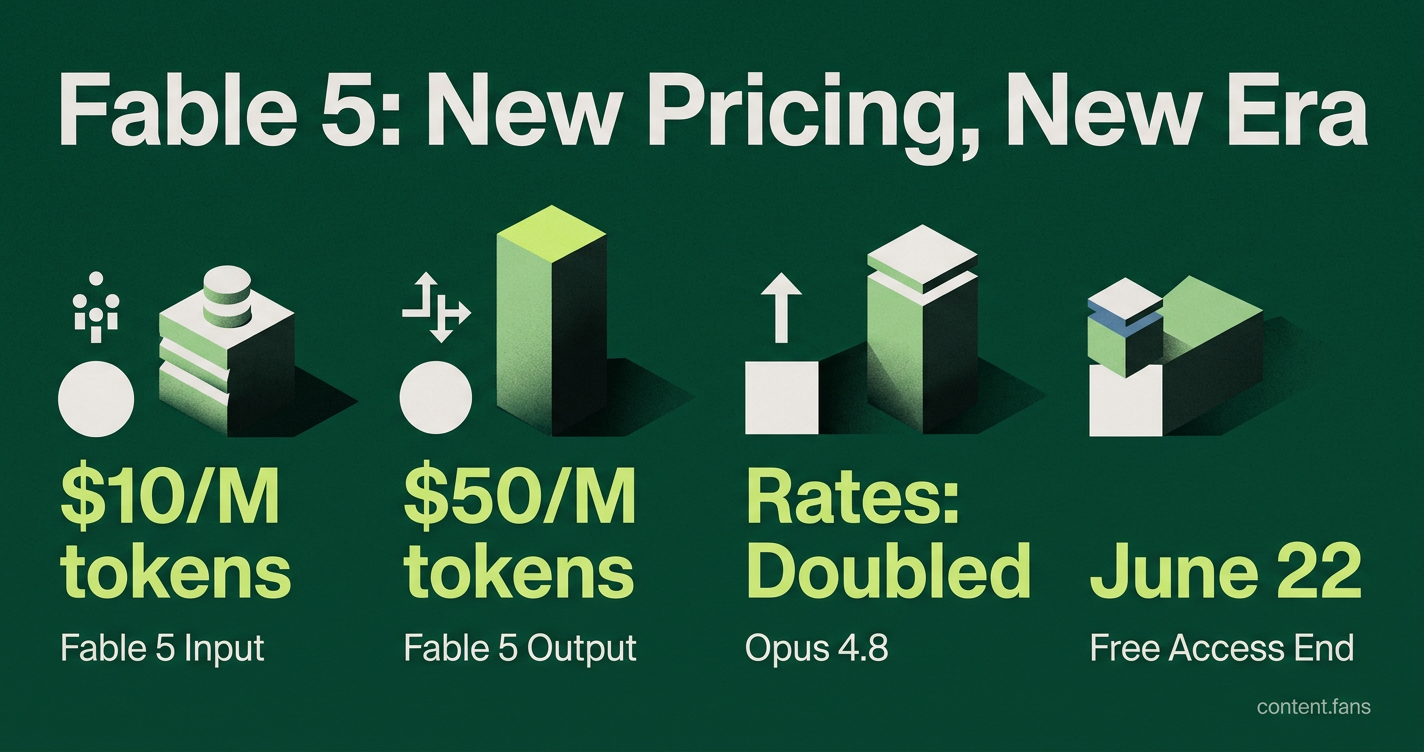
Anthropic has launched Claude Fable 5 with metered pricing, charging $10 per million input tokens and $50 per million output tokens, which may be about twice the price of the earlier Opus 4.8 model. For a short period, some users can try Fable 5 for free, but after that they will pay per use. Analysts suggest that this new pricing may encourage more trials at first, but later use might become more selective due to higher costs. Some reports show Fable 5 performs well on coding and analytics tasks, but requests involving certain sensitive topics are automatically sent to the less advanced Opus model. It appears that most users finish their Fable 5 sessions without switching to Opus, and the higher cost might be acceptable for teams with valuable tasks.

Anthropic has officially launched Claude Fable 5, its new AI model with Mythos-level capabilities, which adopts a metered pricing model that effectively doubles the rates of its predecessor, Opus 4.8. This strategic shift to usage-based billing sets a new precedent for monetizing frontier AI models. As of June 9, 2026, Fable 5 is priced at $10 per million input tokens and $50 per million output tokens.
To encourage adoption, Anthropic provided users on its Pro, Max, Team, and Enterprise plans with complimentary access to Fable 5 through June 22. After this promotional window, all usage will transition to a pay-as-you-go model using purchased credits, as confirmed in a LinkedIn post by pricing analyst Will Sessions. This strategy is designed to lower the barrier for initial testing while clearly establishing the model's premium, ongoing cost.
From bundled seats to meters
Anthropic's Fable 5 introduces a significant shift from bundled subscriptions to a metered, pay-per-use system. This utility-style model charges users based on the number of input and output tokens they consume, aligning costs directly with usage and moving away from flat-rate, all-access monthly fees.
Industry analysts highlight that Fable 5's public release pricing represents a significant reduction from its private preview cost. According to Unite.AI reports, early access to the model was substantially more expensive than current rates. This revised, albeit still premium, pricing may incentivize enterprises to retain high-value workloads within the Anthropic ecosystem.
The new model is expected to have two main effects:
- Increased trial volume: The free access period allows teams to experiment and prototype applications without requiring immediate budget allocation.
- Selective post-trial usage: Once metered billing begins, usage is expected to focus on high-ROI applications like agentic coding, complex data analysis, and in-depth research where Fable 5's performance justifies the cost.
Enterprise adoption dynamics
Fable 5's enterprise appeal is backed by strong performance metrics. A TrueFoundry's feature breakdown shows strong performance on the SWE-Bench Pro coding benchmark, while other tests demonstrate high accuracy on long-form analytics. These benchmarks provide tangible data for justifying the model's token cost. Concurrently, built-in safety guardrails automatically route sensitive queries about topics like cybersecurity to the less powerful Opus 4.8 model, as noted in a Hacker News article, ensuring consistent compliance.
Experts caution that teams accustomed to unlimited Opus access could face significant 'bill shock' if they use the expensive Fable 5 for routine tasks. A Shadow breakeven analysis estimates that a single day's intensive use could cost more than an entire monthly subscription to a lower tier. Consequently, organizations will likely implement stricter model routing policies and capped budgets to control spending.
Broader pricing trend
While competitors have not yet announced similar pricing, the market is evolving. For instance, TrueFoundry notes that using Fable 5 in U.S.-only datacenters incurs additional charges. This points toward a future of more granular AI pricing segmented by factors like geographic region, latency requirements, and compliance guarantees.
While official adoption data is not yet available, Anthropic's internal reports suggest that the vast majority of Fable 5 sessions are completed successfully without needing to fall back to the Opus model. Should this high efficiency rate hold true under the new pricing, teams may find the premium cost justifiable for critical, high-value tasks that demand superior performance.
What exactly is Claude Fable 5 and how does it compare to Opus 4.8?
Claude Fable 5 was reported as released on June 9, 2026 and described as having Mythos-level capabilities, positioned as a highly capable general-use model in their lineup. Compared to Opus 4.8, Fable 5 delivers frontier-level performance but at 2× the price - costing $10 per million input tokens and $50 per million output tokens, whereas Opus 4.8 costs $5/$25 per million tokens respectively.
How does the new metered pricing work?
The pricing model represents a fundamental shift from flat subscriptions to usage-based billing. Instead of unlimited access for a monthly fee, users now pay per token consumed. The model charges:
- $10 per million input tokens (your prompts)
- $50 per million output tokens (the AI's responses)
This utility-style pricing means heavy users will face significantly higher bills, while light users may pay less than before.
Is there any way to try Fable 5 for free?
Yes - Anthropic is offering a promotional free period for subscribers on certain plans. During this window, Fable 5 is included at no extra cost on these plans, allowing users to integrate it into workflows before the metered billing begins.
What's the real-world impact for enterprise teams?
Based on early adoption patterns, the free period is accelerating trial usage among enterprises, with teams testing Fable 5 in production workflows. However, after the promotional period, usage is expected to become highly selective as teams must prove ROI per token. The model appears most justified for high-value coding tasks, multi-day research projects, and complex analytical work where better performance offsets the premium pricing.
Will this pricing trend continue across the AI industry?
Current market analysis suggests yes - the industry is moving toward hybrid pricing models that combine subscriptions with usage-based elements. A significant portion of AI providers already use hybrid metrics, and experts predict more granular metering in the coming years including billing by task, outcome, or compute class. This positions Fable 5 as an early indicator of commoditized AI pricing treated like electricity or water - pay only for what you consume.