
Anthropic expands Claude Code with agentic platform, 1M token context
Serge Bulaev
Anthropic has expanded Claude Code from a simple terminal helper into a more advanced agentic platform with features like multi-step coding, large context windows, and dynamic subagents. Reports suggest Claude Code stands out for complex refactoring and handling large codebases, though its usage-based pricing may be costly for some. Market share data is limited, but capacity increases and new plan options may point to higher demand. Studies show AI coding tools might boost productivity for many, but some experienced developers take longer on complex tasks if verification is included. Organizations may still need skilled engineers to guide, review, and integrate the AI's output.

Anthropic expands Claude Code from a developer tool into a full agentic platform, sparking conversations among engineering leads about the future of software development. With multi-agent workflows, the tool is poised to redefine daily coding practices for teams experimenting with advanced AI.
From Autocomplete to Agentic Platform
Once a simple terminal helper, Claude Code has evolved following Anthropic's recent developments, which introduced a comprehensive agentic framework. Demonstrations of the platform have showcased lead agents delegating repository-wide refactors and security scans to parallel sub-agents. Official documentation details new features like Auto mode, background safety checks, and an agent monitoring view.
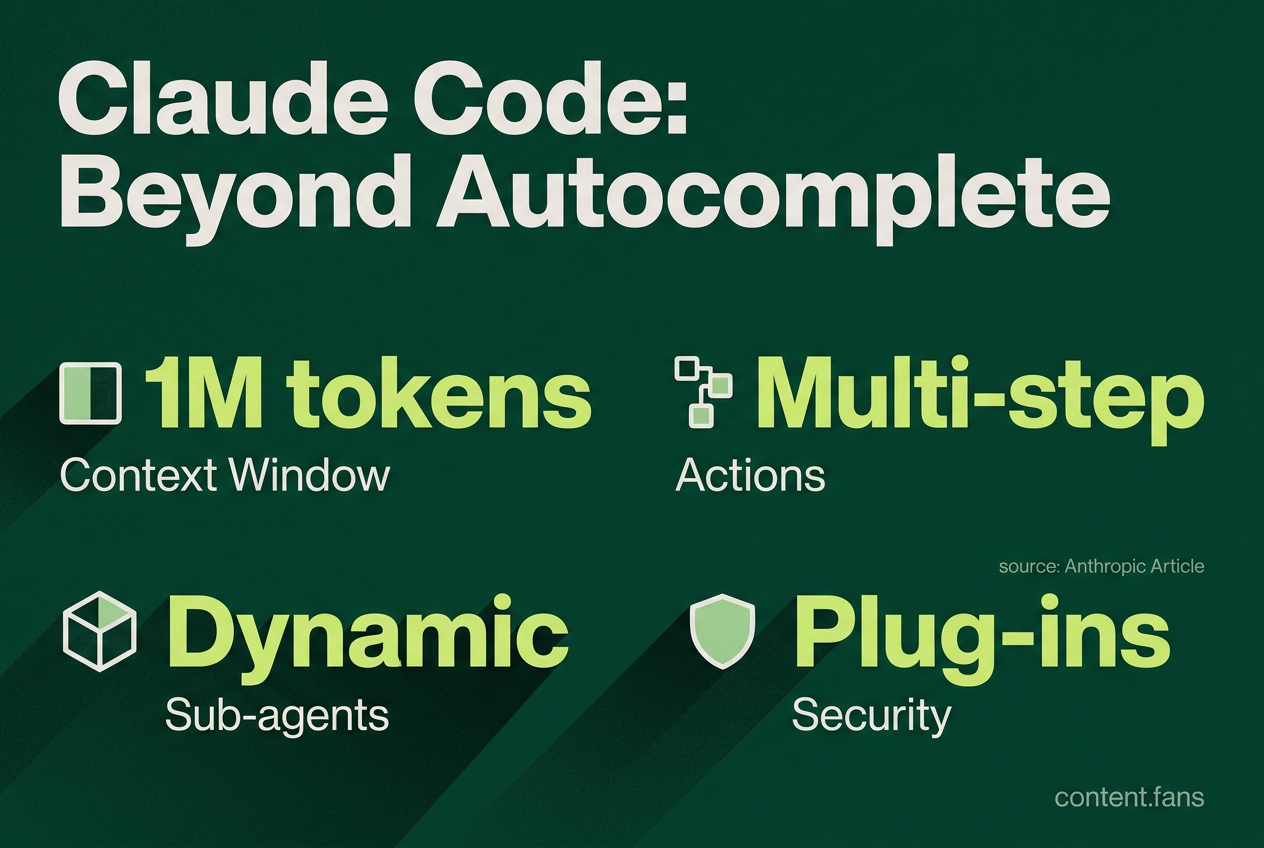
The platform now features multi-step coding actions, an expanded context window for large-scale reasoning, and the ability to dynamically spawn sub-agents for parallel tasks. With optional security plug-ins, Claude Code operates more like an autonomous development partner than a simple code suggestion tool.
Key capabilities highlighted in official sources include:
- Multi-step Actions: Executes read, write, and CLI commands within the developer's local environment.
- Expanded Context: Enables reasoning and analysis across entire code repositories simultaneously.
- Dynamic Sub-agents: Spawns multiple agents to run tests, CLI tools, and other tasks in parallel.
- Security Plug-ins: Offers optional guidance tools to screen generated code for potential vulnerabilities.
These features move the product well beyond a suggestion engine, positioning it as a near-autonomous development environment.
Competitive Landscape: Where Claude Code Stands Out
In the competitive AI coding landscape, Claude Code is often compared to Cursor, GitHub Copilot, and others. Multiple reviews find that Anthropic's agent excels at complex refactoring and large-scale codebase analysis. In contrast, Cursor is often preferred for daily inline edits, while Copilot maintains its dominance as the most widely integrated autocomplete tool in enterprise IDEs.
Context window size is a key differentiator. Claude Code's expanded context limit provides a significant advantage for architectural reasoning over the smaller contexts of competitors. However, its usage-based pricing model is a notable tradeoff, as costs can surpass the fixed subscriptions of other tools for high-volume users.
Adoption Signals and Capacity Changes
While concrete market share data is not yet public, strong adoption signals exist. Anthropic offers a mature, multi-tiered plan structure (Pro, Team Premium, Enterprise pay-as-you-go, and API). Furthermore, the company recently doubled usage caps on paid plans, a move that strongly suggests rising demand and user activity.
Analysts infer momentum from these capacity increases and the decision to host a dedicated developer conference, though audited user counts remain unavailable.
Industry Impact and Shifting Skill Demands
Recent industry studies on AI coding assistance present a nuanced view of productivity. Industry reports suggest many developers report feeling more productive with AI tools. However, a METR experiment found that including verification time led experienced developers to take 19% longer on complex tasks, highlighting the importance of the review phase.
Hiring trends reflect a shift in required skills. Surveys from Checkmarx and The Pragmatic Engineer show increasing demand for senior engineers capable of exercising critical judgment in code review, system design, and security oversight. As AI handles more routine implementation, human verification becomes the primary bottleneck. This aligns with Claude Code's agentic design, where organizations may still need skilled engineers to guide, review, and integrate the AI's output.
What new capabilities did Anthropic add to Claude Code?
Anthropic turned Claude Code from an IDE helper into a fully agentic platform. You can now spin up multi-agent workflows in which a lead agent farms out sub-tasks to background worker agents that run in parallel. The system has repository-wide context awareness, can read and edit multiple files at once, and even run shell commands or interact with external services such as Google Ads, Salesforce, Slack and Notion in a single session. A new Auto mode on Pro tiers lets the tool run unattended while a security-guidance plug-in screens every change for vulnerabilities.
How does the expanded context window change coding workflows?
With expanded context capabilities, Claude Code can keep an entire production repository plus documentation, logs and prior pull-request comments in memory at once. Early adopters report that legacy-code comprehension tasks that once took 3 - 4 hours now finish in 30 - 45 minutes, and cross-service refactors across micro-services no longer require manual file hopping. The extra context is especially valuable for architectural decisions and multi-language code bases where headers, docs and generated schemas must stay coherent.
Where does Claude Code outperform Cursor, Copilot and others?
Industry analysis shows a clear split:
- Complex refactoring and large-scale design - Claude Code leads because its agentic design plans changes across dozens of files.
- Everyday inline editing and speed of use - Cursor's VS-Code-fork IDE still keeps the crown.
- Enterprise autocomplete and low-friction onboarding - GitHub Copilot remains the default choice for teams that need broad IDE integration at a flat subscription price.
Are there hard numbers on developer adoption yet?
Anthropic has not released audited user counts. What we do know is indirect but encouraging: internal docs and tiering (Pro, Team Premium, Enterprise pay-as-you-go, Anthropic API) show the product is commercially mature, and rate limits were doubled for paid plans recently, implying demand is strong. Conference attendance and growing third-party skill directories also signal rapid momentum, even if exact download numbers remain private.
How might Claude Code alter hiring and team structure?
Productivity studies from JetBrains, METR and Checkmarx converge on three trends:
- Routine implementation is increasingly handled by AI, so entry-level roles that focus mainly on typing boiler-plate are at risk.
- Demand is rising for senior engineers who can review AI output, ensure security, and integrate generated code into existing systems.
- Team composition is shifting from "code producers" toward "system operators" who prompt, test, debug and deploy AI-driven changes.