
Anthropic confidentially files for IPO, raising AI token pricing stakes
Serge Bulaev
Anthropic has confidentially filed for an IPO, and other major AI companies may soon follow. Analysts suggest that investor demands and fewer venture subsidies are causing AI pricing to move from flat rates to pricing based on actual use. This shift means companies may need to control usage more carefully and find ways to cut costs. It also appears that the market could see more specialization and possible mergers as companies respond to changing economics. Experts recommend that all companies now closely monitor how much AI they use and what it costs.

The era of subsidized, cheap generative AI access is rapidly closing as major model labs face stricter investor scrutiny. With reports that Anthropic confidentially filed for an IPO, the industry is rewriting its approach to AI token pricing, shifting from flat-rate subscriptions to metered, cost-based billing that reflects real compute costs.
This change is driven by two converging forces: venture subsidy fatigue and the looming public listings of the largest AI labs. Together, these dynamics are forcing the industry to prove it can operate profitably without growth-at-all-costs discounts.
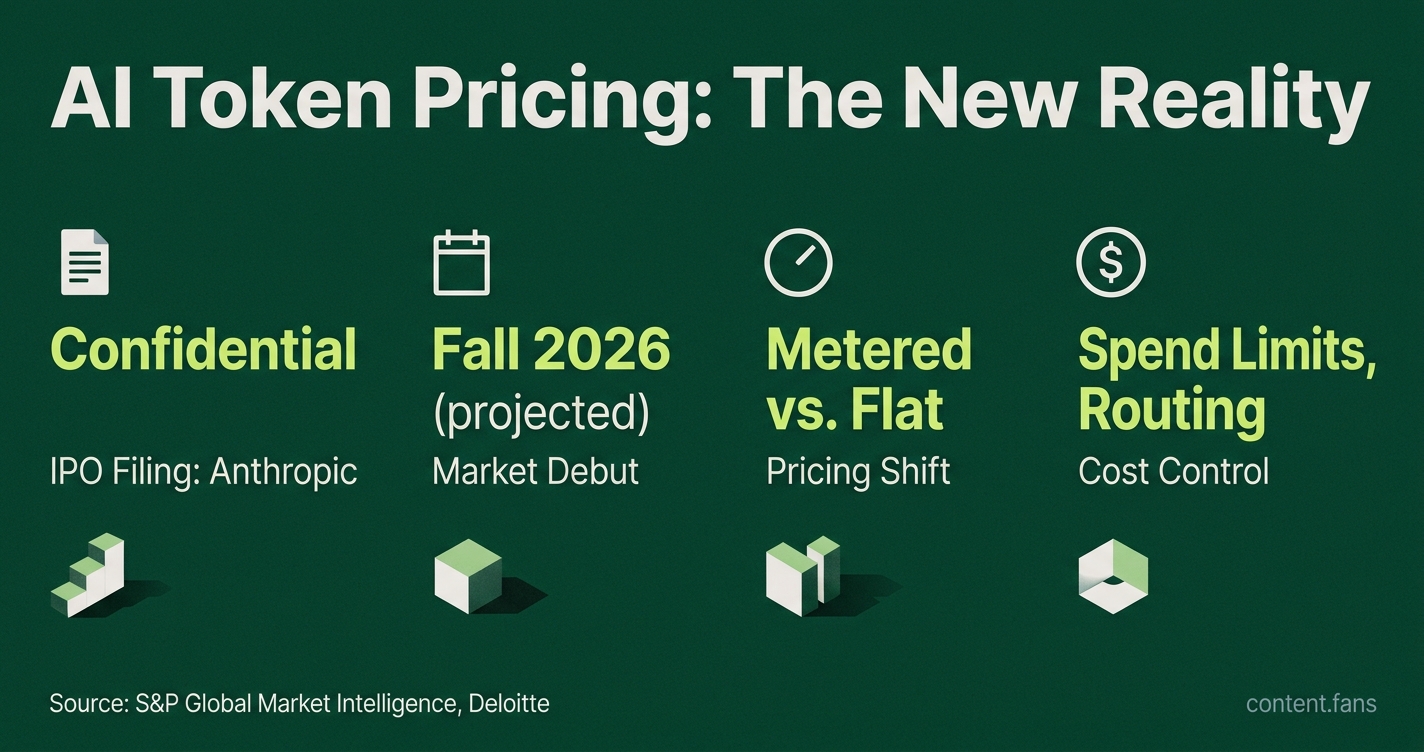
IPO Pressure Raises Unit Economics Stakes
Anthropic has confidentially filed for a public listing, with reports citing its SEC paperwork (link) and suggesting a market debut as early as fall 2026 (link). Other major players like xAI and OpenAI are also reportedly preparing for public offerings. Because public markets reward scalable revenue with healthy margins, each IPO filing amplifies the pressure to demonstrate that AI tokens can be sold profitably.
Looming public offerings from major AI labs, including Anthropic, are forcing a fundamental shift in business models. To satisfy investors, companies must prove profitability, moving away from subsidized flat rates toward metered billing that reflects the high computational cost of running large language models.
Metered Pricing Replaces Flat Subscriptions
Analysis from S&P Global Market Intelligence shows venture capital becoming more selective, compelling startups to price their services closer to actual inference costs. While large labs have significantly reduced headline API rates over recent months, this likely signals cost efficiencies rather than permanent subsidies. Deloitte's guidance on AI tokens confirms this trend, warning that "usage, hybrid, and outcome-based pricing" are overtaking traditional seat-based SaaS models.
How Companies Are Containing the New Token Bill
Enterprises accustomed to flat-rate pricing are now adopting new strategies to manage consumption-based billing. Industry advisors recommend a repeatable pattern for controlling costs:
- Set hard spend limits at the project, user, and API key levels, reinforced by real-time alerts.
- Route routine or deterministic tasks to smaller, more cost-effective open-source models.
- Optimize prompts and shorten conversation history to reduce token waste.
- Cache frequently used system messages and answers to avoid re-billing.
- Implement internal chargebacks to tie usage directly to departmental ROI.
According to industry reports, disciplined model routing alone can lead to substantial savings on inference-heavy workloads, though these figures vary significantly by use case.
Strategic Implications Beyond Price
This new pricing model is expected to drive industry specialization. S&P researchers predict that startups in high-stakes fields like law or healthcare can justify higher per-token prices due to accuracy and compliance needs. In contrast, mid-tier model providers will face commoditization, forcing them to differentiate on factors like latency and reliability rather than raw power.
Consolidation is another probable outcome. With CNBC reporting weaker funding for general-purpose AI applications, tighter margins could spur mergers as startups struggle to secure their next round. The situation mirrors the ride-hailing industry's retrenchment after consumer subsidies ended.
Ultimately, all stakeholders - investors, vendors, and customers - are now focused on a single variable: token consumption and its associated cost. As the era of venture-backed discounts fades, continuous usage measurement is no longer optional but essential.
Will metered billing replace flat API keys?
Yes. Venture subsidies that once let Anthropic and OpenAI keep per-token prices artificially low are drying up. With IPO-level scrutiny on unit economics**, public labs must bill closer to real compute cost. Expect seat-based SaaS to give way to usage dashboards that show every 1,000 tokens - and what they cost - before the next query runs.
When will Anthropic list?
They have already filed confidentially with the SEC in mid-2025, but no date, price range or share count has been set. Industry sources suggest a roadshow could occur if market conditions remain favorable.
How fast are API prices falling, and why does that still raise my total bill?
Frontier-grade APIs have dropped significantly in recent months as labs chase scale, yet enterprise tabs are rising because the same firms are pulling volume discounts and freemium layers. Once subsidies end, sticker prices will drift back up even as per-token rates stay low.
Is the Uber-style $5 era really ending?
Yes. Cheap rides existed while SoftBank subsidised every trip; cheap tokens existed while VCs subsidised every prompt. When public-market discipline hits, both models revert to cost-plus pricing - so budget for significantly higher run-rate spend if you currently treat Claude or GPT as a flat monthly line item.
What concrete steps cut token burn today?
- Route the majority of routine prompts to smaller/cheaper or open-source models
- Cache personas and static context
- Set hard monthly caps with circuit-breakers
- Charge usage back to the team that generated the call
Pilot customers using these strategies have reported substantial reductions in per-month AI spend within two quarters.