
Anthropic commits $200 billion to Google Cloud and chips
Serge Bulaev
A news report suggests Anthropic may spend $200 billion over five years on Google Cloud and custom chips, but neither company has confirmed this number. The claim remains unverified, as there is no official documentation and both companies have declined to comment. If true, this would make Anthropic one of Google Cloud's largest customers. Experts warn that such deals can increase reliance on a few big cloud providers, which might make it harder for customers to switch or negotiate prices. The $200 billion figure should still be seen as a claim, not a confirmed fact.

AI startup Anthropic reportedly commits to spending a significant amount on Google Cloud and custom chips over five years, according to news from The Information and Reuters. This unconfirmed deal would make Anthropic one of the largest cloud customers in history.
However, the staggering spending figure remains unverified. Neither Anthropic nor Google has officially confirmed the agreement's value. When questioned, Anthropic declined to comment, and Google directed inquiries back to the AI startup, leaving the claim without official documentation despite wide circulation.
This rumored deal highlights the intense competition among cloud providers for massive generative AI workloads, which demand enormous compute resources. The spending scale is immense; industry reports suggest the total AI infrastructure build-out could require substantial capital spending over the coming years.
What the reported deal involves
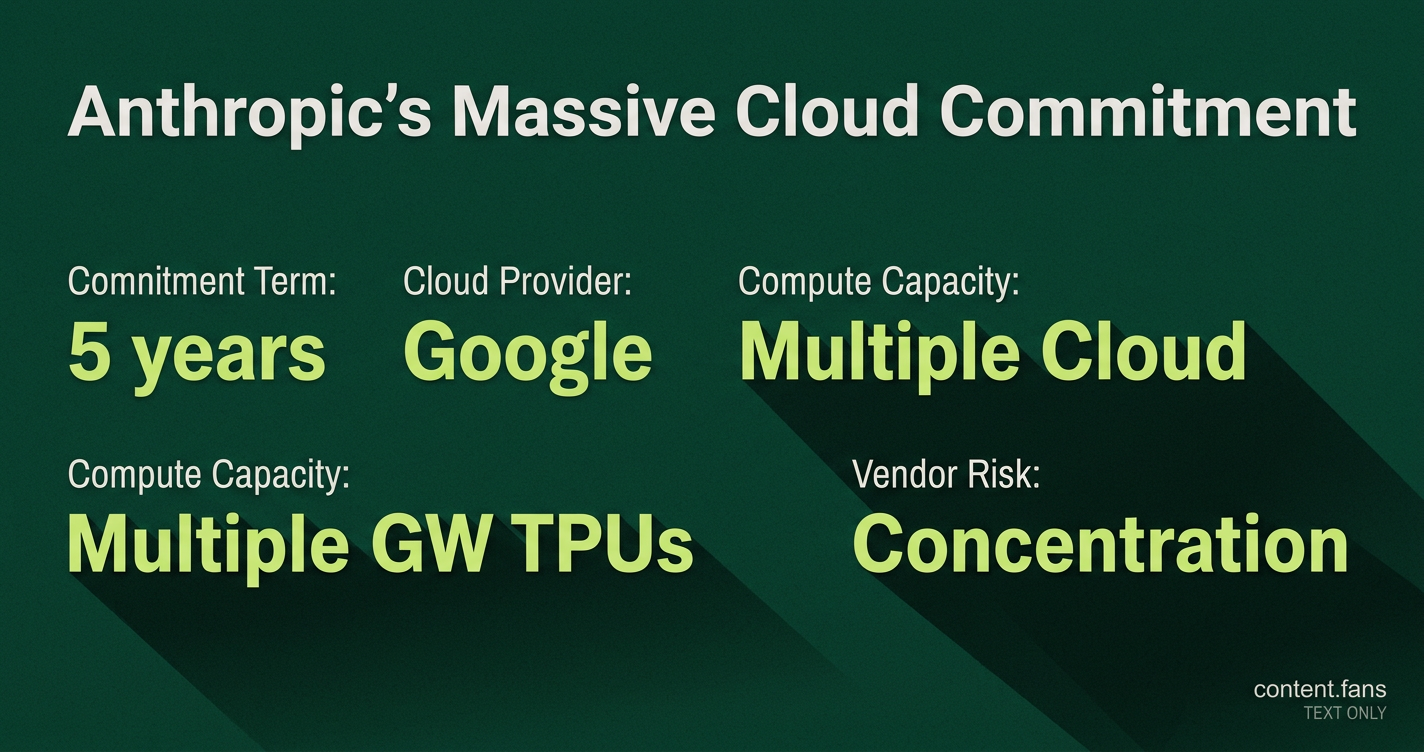
The unconfirmed agreement reportedly involves a five-year, substantial commitment from Anthropic for Google Cloud services and custom chips. This includes access to multiple gigawatts of TPU capacity starting in 2027 and is linked to a potential significant investment in Anthropic by Alphabet, Google's parent company.
- Five-year commitment reportedly worth a substantial amount
- Multiple gigawatts of TPU capacity supplied by Google and Broadcom, expected online starting in 2027
- Alphabet investment of a significant amount in Anthropic mentioned in the same Reuters story
If the reports are accurate, the deal's magnitude is significant. The cloud spending alone would account for a substantial portion of Google Cloud's current disclosed revenue backlog. A commitment of this size would solidify Anthropic's position as one of the most substantial customers in Google's history.
Vendor concentration risks
A deal of this size underscores the growing industry-wide reliance on a few hyperscale cloud providers, a trend known as vendor concentration. This concentration extends beyond cloud services to chip supply, power infrastructure, and networking. Experts warn that such deep dependencies can dramatically increase switching costs and give incumbent vendors significant leverage in price negotiations.
For technology leaders, the practical risks of single-vendor concentration include:
- Budget exposure to a single cloud region or architecture
- Limited leverage when negotiating future pricing or capacity guarantees
- Urgent need for workload portability strategies across clouds and accelerator types
A broader spending wave
This surging capital intensity is not unique to Anthropic. According to Goldman Sachs' original report, global data center supply had equated to about $12M per MW, and a typical 250 MW AI data center costs roughly $12B inclusive of equipment. Industry reports suggest many enterprises plan to increase AI budgets, signaling a broad market shift from pilot projects to production systems that require massive, durable capacity.
Outlook for Google Cloud
Securing the Anthropic deal would significantly boost Google Cloud's revenue backlog, but the overall competitive landscape remains dynamic. While Google holds a significant share of the global infrastructure market, it continues to trail market leader AWS and competitor Microsoft Azure. Converting large AI deals into permanent market share gains will depend on flawless execution, effective margin management, and Google's ability to outpace rivals in securing similar large-scale AI workloads.
Ultimately, no public filings confirm the final terms or minimum spending requirements of Anthropic's plan. Until official documentation is released, the reported spending figure must be understood as a significant but unconfirmed report, not a binding contractual obligation.
What exactly is the substantial commitment reported by The Information?
The reported spending figure is a reporting claim, not a signed contract that has been publicly filed or announced. The Information first reported that Anthropic committed to spend a substantial amount with Google Cloud over five years, covering cloud services and chips. Reuters, citing The Information, repeated the claim on 5 May 2026, but added that Reuters could not immediately verify the figure. Both Anthropic declined to comment and Google redirected questions back to Anthropic, so no official confirmation exists as of today.
How does this rumored deal compare to the broader AI infrastructure trend?
Industry reports suggest that the total AI build-out may require substantial cumulative CapEx over the coming years, while other reports indicate that major hyperscalers alone plan significant AI data-center capex increases year-over-year. Against that backdrop, Anthropic's alleged substantial spend over five years would represent a significant portion of the entire AI capital forecast, illustrating how a single AI lab can move the needle within an already massive global bill.
What concentration risks arise from a potential substantial single-vendor relationship?
A commitment of this scale would deepen vendor lock-in across four layers:
- Cloud: Google Cloud would host a majority share of Anthropic's training and inference workloads.
- Chips: Broadcom and Google's TPU roadmap would become the default silicon path, limiting future GPU portability.
- Power & sites: Multi-gigawatt capacity locked into Google's chosen geographies, raising exposure to regional grid constraints.
- Ecosystem APIs: Tight integration with Vertex AI, BigQuery, and other Google services raises switching costs.
Industry reports warn that next-generation AI data centers carry substantial costs, so any exit or renegotiation could carry significant stranded or sunk costs.
How would the deal affect Google Cloud's competitive position?
Based on industry reports:
- Google Cloud has reported strong revenue growth and carries a substantial backlog.
- If the reported figure is accurate, it would add significantly to that backlog, giving Google Cloud multi-year revenue visibility against AWS and Azure.
- Independent market snapshots suggest Google holds a significant global share, so while Google is gaining, AWS still leads and Azure remains the closest challenger.
In short, the size of the rumored Anthropic commitment would cement Google Cloud as the AI-first hyperscaler, but it is unlikely to flip global market leadership overnight.
What practical steps can procurement and technical teams take to hedge against vendor concentration?
-
Contractual portability clauses
Require model-weight export rights and container orchestration neutrality (e.g., Kubernetes multi-cloud manifests) so training artifacts can run on AWS, Azure, or on-prem GPUs. -
Infrastructure abstraction layers
Adopt Ray, Slurm, or open-source Kubeflow so job definitions stay portable even if TPU or GPU backends change. -
Power and colocation diversification
Reserve colocation space in two additional low-carbon grids to avoid geolocation lock-in if Google's chosen regions face power curtailment. -
Spend-based exit triggers
Insert price-escalation or service-level exit clauses tied to pre-defined budget thresholds, giving leverage to renegotiate or migrate if costs diverge from market rates. -
Parallel proof-of-concept tracks
Run a small shadow workload on an alternate cloud to maintain infra-as-code templates and staff readiness, turning future migration from a multi-month project into a multi-week cut-over.