
Anthropic ban sparks new playbook for managing AI talent risk
Serge Bulaev
Anthropic's June 2026 rule that banned all foreign nationals from its top AI models surprised companies that depend on workers from around the world. Reports suggest the rule came from the U.S. government and included staff with Canadian or British passports. This event has revived worries that more strict rules might be coming, so companies may need a plan to handle risks around hiring and keeping AI talent. The article suggests that companies should check where they might be exposed to these rules, invest in training local staff, and make sure they follow the law. It also recommends preparing clear messages for employees in case sudden changes happen and taking part in policy discussions to protect talent mobility.

Recent reports indicate that Anthropic said the U.S. government directed it to suspend access to Fable 5 and Mythos 5 for any foreign national, inside or outside the United States, including foreign national Anthropic employees, and Anthropic responded by suspending access to those models. This development caught many HR teams by surprise and has raised fears of broader policy restrictions, prompting companies to develop strategies to mitigate disruptions to their AI labs.
This article provides a comprehensive guide based on industry reports and emerging best practices. It offers HR, legal, and executive teams a defensive talent strategy to minimize compliance, retention, and reputational risks from sudden policy changes.
Map and Stress-Test Your Current Exposure
Following the reported Anthropic directive, a critical first step for any company is to audit its own vulnerabilities to similar nationality-based restrictions. According to industry reports, the U.S. government ordered Anthropic to "immediately" deny access to all foreign nationals, both within and outside the United States. This single order halted work for many employees. Assess your own technology stack - including model access, code repositories, and production systems - and run tabletop exercises to prepare for company-specific, sector-wide, or export-control style bans.
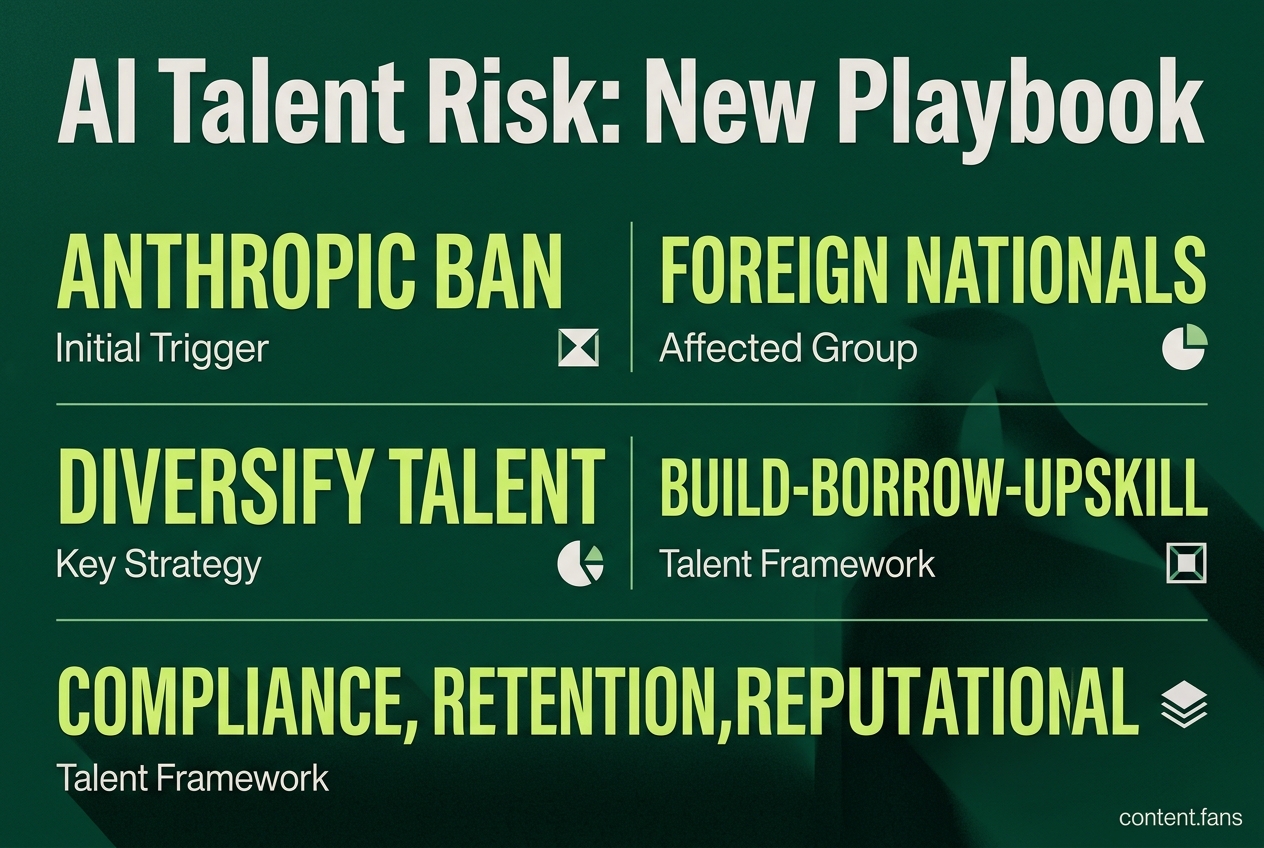
Companies must proactively manage AI talent risk by auditing their exposure to nationality-based restrictions, diversifying talent pipelines, investing in domestic upskilling, and ensuring strict legal compliance. A comprehensive strategy also includes preparing communication plans and engaging in policy discussions to safeguard global talent mobility.
Develop a Resilient AI Talent Playbook
A robust strategy for managing AI talent risk hinges on diversifying talent sources. Industry reports suggest a "build-borrow-upskill" framework is gaining traction. This involves expanding sourcing beyond traditional elite universities and creating internal learning pathways. A key step is conducting a skills audit to separate core roles requiring long-term ownership from those suitable for contract work. To maintain a healthy pipeline and avoid over-reliance on specific demographics, implement structured interviews, standardized rubrics, and bias audits. Additionally, industry guidance suggests internships with HBCUs and community bootcamps as effective talent sources.
Invest in Domestic Upskilling Programs
To counter potential shortfalls from slower foreign hiring, invest in domestic talent development. LinkedIn's workforce data shows that apprenticeships and rotational programs can transition employees from adjacent fields into AI roles within a few cycles. Effective tactics include creating role-specific learning paths, hosting internal hackathons with clear product goals, and offering tuition reimbursement based on skill acquisition. Industry studies indicate that frequent, bite-sized learning, such as monthly AI literacy sessions, is more effective for adoption than infrequent, intensive workshops.
Proactively Tighten Legal and Compliance Checks
The Anthropic case highlights that nationality, not just location, can trigger access controls. HR and legal teams must maintain a continuously updated roster of employee citizenship and visa statuses, linking them to system access permissions. Develop scenario templates to determine which staff would be affected by an export-control order and how quickly their workflows could be reassigned. With reports of Pentagon concerns over "adversarial risk," scrutiny may extend to other firms. It is also crucial to conduct parallel immigration reviews, ensuring critical foreign staff have visas compatible with national security-sensitive roles and planning for residency sponsorship or relocation if needed.
Engage in Policy Advocacy to Shape Future Rules
Instead of merely reacting to new regulations, companies should actively participate in AI governance discussions. According to industry reports, various programs provide platforms for industry input, such as policy advocacy coalitions and fellowship programs that connect to international AI dialogues. Engagement provides early insight into potential rules and a platform to advocate for talent mobility safeguards. Note that some programs have in-person residency requirements in Washington, D.C., necessitating advance visa planning.
Prepare a Robust Communication Toolkit
In a crisis, clear communication is key. Prepare internal messaging in advance to manage sudden access changes. These communications should reassure affected employees and detail support options like project reassignments or relocation assistance. For external stakeholders, draft statements that stress legal compliance while reaffirming a commitment to a diverse global workforce. Rehearsing these communications during scenario drills will enable leadership to respond effectively and calmly when facing a real crisis.
The Anthropic incident reveals a new dimension of policy risk for the AI industry. Companies that proactively build a defense-in-depth strategy - combining diversified talent pipelines, robust upskilling programs, rigorous compliance, and strategic policy advocacy - will be best positioned to navigate future regulatory challenges.
What exactly did Anthropic's restrictions on foreign nationals include, and how fast did the industry react?
According to industry reports, the U.S. government ordered Anthropic to disable access to its two most advanced models for every foreign national, including employees on U.S. work visas. The directive applies regardless of where the person is physically located, and within 48 hours OpenAI told staff the situation was "rapidly evolving" while UBS warned investors that nationality-based rules could make non-U.S. labs more attractive to top technical talent.
How can we diversify hiring pipelines so the team is less exposed to single-country risk?
Industry reports show that best-in-class companies run a build / borrow / up-skill review every quarter:
- Build - Map roles that must stay in-house (model governance, safety, core infra) and source from HBCUs, women's colleges, Canadian co-op programs and EU technical universities instead of relying on one geography.
- Borrow - Use short-term adjunct experts for niche techniques, keeping IP on-prem and reducing long-term visa dependence.
- Up-skill - Rotate existing software and statistics staff through internal bootcamps tied to a concrete business KPI; companies that embed learning in sprint retros see significantly faster internal mobility.
Structured interviews, bias-audited AI screening tools and funnel metrics by demographic segment are now table stakes.
Which legal checks should HR and Legal teams run before more rules drop?
Create a three-column risk register:
- Visa/authorization - Confirm every foreign national already on staff has valid H-1B, O-1, or dual-intent status and that any travel outside the U.S. will not trigger re-entry bars.
- Export control classification - Verify that frontier models are not listed on the Commerce Control List; if they are, map exactly which employee categories are "deemed exports".
- Policy horizon scanning - Schedule regular screening of public Federal Register notices, plus subscribe to alerts from CAIDP and policy advocacy coalitions; many groups flagged the Anthropic directive early.
What do we tell employees and external partners right now?
Use a tiered communication script:
- Tier 1 (affected employees) - Individual calls with HR + Legal to confirm individual impact and next steps.
- Tier 2 (wider tech teams) - Slack message within 2 hours: "We are reviewing new federal guidance that may limit access for non-U.S. persons; no immediate action required."
- Tier 3 (board & investors) - A concise slide deck showing contingency headcount by country, current visa runway in days, and projected project delay cost if a significant portion of staff lose access.
Industry reports show that transparent, same-day updates significantly reduce attrition risk when policy shocks hit.
How can we influence future policy instead of only reacting?
Join multi-stakeholder advocacy coalitions:
- Policy advocacy coalitions with many NGO partners are holding convenings focused on AI treaties that balance security and talent mobility.
- Industry groups run joint Capitol Hill briefings; sending a senior engineer to testify can help shift legislative language toward industry-friendly wording, according to industry reports.
Smaller firms can co-sign open letters coordinated by policy programs. Being on the record early helps shape narrow, sector-specific rules rather than sweeping nationality bans.