
Anthropic ban on foreign nationals sparks AI talent risk playbook
Serge Bulaev
Reports suggest that Anthropic has been ordered by the U.S. to block its advanced AI models from all foreign nationals, even those already working in the U.S. on visas. This move appears to make managing AI talent risks an urgent issue for many companies, who now need clear plans to keep projects on track and protect their teams. The suggested playbook includes steps like diversifying hiring, upskilling local staff, monitoring legal compliance, and preparing for sudden policy changes. Experts warn that if more restrictions spread, it could make daily collaboration much harder, so firms may need to quickly adapt their processes and advocate for clearer policies.

The reported Anthropic ban on foreign nationals sparks a critical need for a robust AI talent risk playbook, elevating the issue from a hypothetical threat to an urgent, board-level concern. Following reports of sweeping access limits, organizations now require an actionable roadmap to protect global teams and maintain product timelines amid growing regulatory uncertainty.
Why Anthropic's case is a wake up call
This playbook offers a strategic framework for companies to manage talent-related disruptions caused by sudden AI policy changes. It focuses on maintaining project velocity, ensuring legal compliance, and supporting international employees whose access to critical technology, like advanced AI models, may be abruptly restricted by government directives.
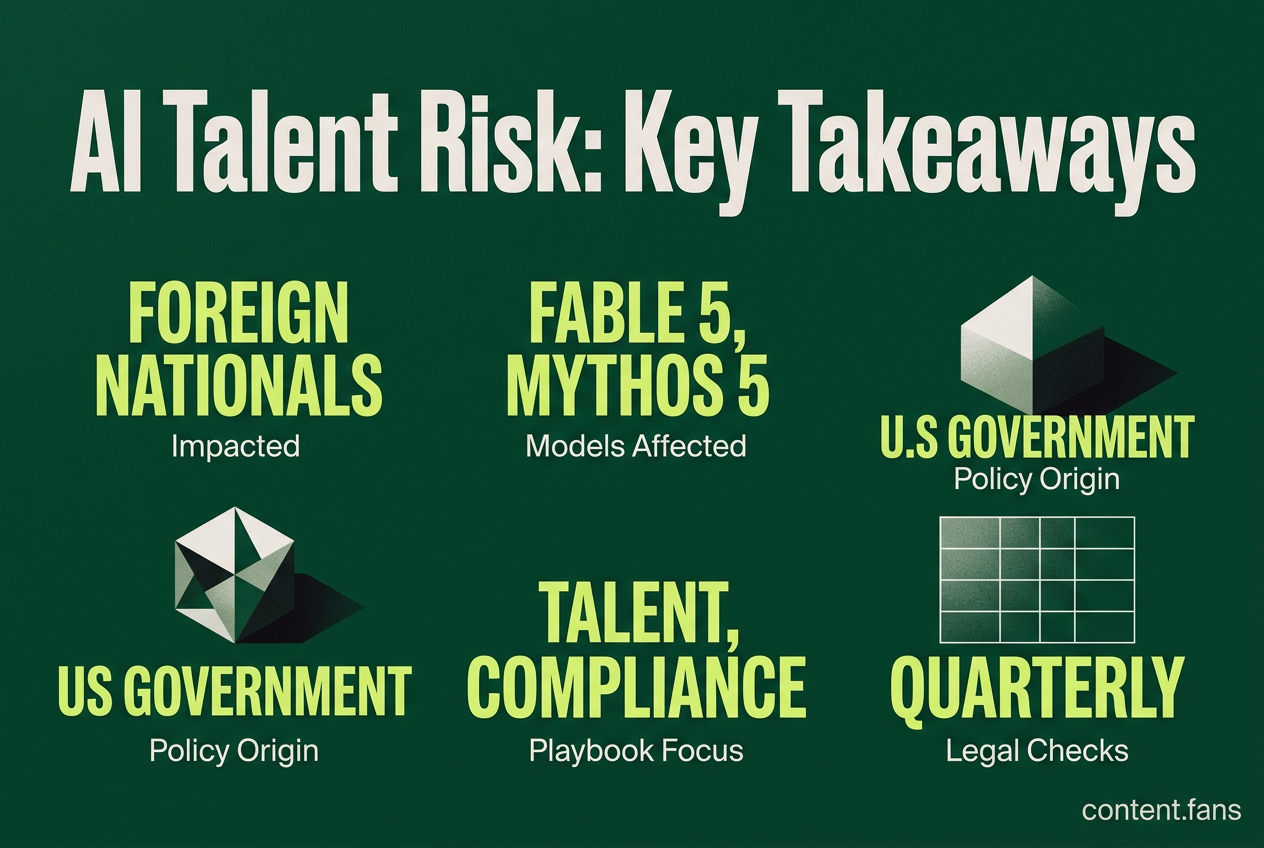
According to industry reports, the U.S. government reportedly ordered Anthropic to deny all foreign nationals access to its Fable 5 and Mythos 5 models, a restriction that included H-1B visa holders working within the company. This directive, first detailed by the New York Times, applied export-control principles to human access, sparking fears among employers that similar rules could create significant day-to-day collaboration hurdles across the AI sector.
Core pillars of the playbook
- Diversify hiring pipelines by sourcing talent from universities, remote hubs, and contingent markets.
- Upskill domestic talent by implementing structured six-month bootcamps for engineers and product managers.
- Ensure continuous legal compliance with quarterly checks that map every AI role to current visa and export-control regulations.
- Monitor the policy landscape by creating an internal watchlist for proposed fees, visa quotas, and AI governance bills.
- Prepare for rapid response with pre-drafted communication scripts for employees who may face access restrictions on short notice.
Tools for HR and legal teams
HR and legal teams must adopt agile tools to navigate this new environment. Following BCG guidance for rapid hiring, HR can leverage pre-approved relocation budgets and maintain a bench of external talent. Meanwhile, legal departments should create a detailed jurisdiction matrix to track potential costs, like proposed H-1B visa integrity fees, alongside compliance deadlines for emerging AI regulations.
A centralized dashboard is crucial for tracking key indicators: employee visa status, model access level, and compliance risk. When a policy shift occurs, this dashboard enables managers to instantly identify at-risk roles and reassign tasks, preventing productivity losses.
Executing the Playbook: Scenarios and Advocacy
Effective execution requires multi-horizon scenario planning. For short-term disruptions, the response plan includes activating retention packages, reassigning code reviews to unrestricted personnel, and communicating potential delays to customers. For long-term restrictions, strategies may involve segmenting research labs by geography, as discussed in industry coverage of similar cases.
Proactive policy advocacy is the final component. Government relations teams should lobby for clearer 'deemed export' rules and advocate for fast-track visas for researchers, similar to proposed streamlined visa systems for AI talent. Collaborating with industry trade groups amplifies the call for predictable, skills-based immigration pathways.
By implementing this disciplined playbook, companies can mitigate talent disruption, ensure compliance, and sustain innovation momentum in a rapidly shifting regulatory landscape.
What exactly did Anthropic announce and how wide is the impact?
According to industry reports, Anthropic received a U.S. government order to abruptly disable access to its newest models Fable 5 and Mythos 5 for all foreign nationals - including employees inside the United States on H-1B or other visas. The directive defines "foreign national" broadly, covering users and workers regardless of physical location. Early industry reaction, captured by The Information, warns that similar controls could spread to other frontier-model companies.
Which practical risks should HR and Legal teams prioritize first?
The most immediate threats are:
- Operational disruption: teams lose model access mid-project, slowing product releases.
- Retention shock: foreign staff fear marginalization and start exit planning.
- Reputational exposure: early signal that a firm is "no longer welcoming" can significantly reduce future applications in tight talent pools.
Priority actions include conducting a citizenship-aware role audit, drafting contingency SLAs for model access, and creating fast-track internal visa-renewal budgets.
How can organizations diversify hiring pipelines without lowering the technical bar?
- Skills-adjacent recruiting: convert strong software engineers and data scientists into AI roles via 8- to 12-week micro-credential programs; industry data show this can fill a significant portion of junior AI vacancies.
- Hybrid talent model: keep a build, borrow, upskill mix (core staff, contractors, retrained teams) so no single channel becomes a policy bottleneck.
- Global remote hubs: open engineering satellites in Canada, UK, or Singapore where U.S. export-control reach is lighter, cutting role-based access blocks to near zero for non-classified work.
- University partnerships: fund accelerated master's pipelines with domestic universities to build a citizen-heavy junior bench in 12-18 months.
What compliance checklists should General Counsel adopt before the next policy shift?
- Export-control role matrix: map every job title to EAR and ITAR coverage to predict who may be barred from frontier-model access.
- Jurisdiction licensing calendar: track emerging AI regulations and updated visa processing systems for AI occupations.
- Immigration cost buffer: reserve additional budget per H-1B hire in case proposed visa integrity fees are implemented.
- Policy monitoring cadence: assign a cross-functional task force (HR, Legal, Security) that meets monthly and reviews any new Commerce Department or Pentagon guidance within 48 hours of release.
How do we communicate policy changes without triggering a talent exodus?
Use a 3-message sequence:
1. Clarity: share exactly which roles and models are affected, avoiding vague terms like "some systems".
2. Support: announce immediate steps (legal aid, visa renewal fast-track, remote-work relocation stipends).
3. Future path: outline the domestic upskilling budget, new hub openings, and timeline for citizenship-friendly infrastructure.
Draft scripts for managers and FAQs for employees can be kept in a living document that is updated in real time as new directives emerge, reducing rumor-driven departures.