
Anthropic ban forces AI labs to rethink global talent strategy
Serge Bulaev
After the U.S. told Anthropic to block access to its top AI models for all foreign nationals, managing talent risk has become urgent for AI labs. The order may signal a shift from controlling hardware exports to limiting who can use advanced software. Experts suggest companies should check their visa situations, consider remote work options, and clearly explain policy changes in the short term. In the medium and long term, they may need to increase training, partner with universities, diversify locations, and keep up with changing rules. Long-term resilience appears to depend on flexible company structures and careful documentation to handle future restrictions.

The recent Anthropic ban is forcing AI labs to fundamentally rethink their global talent strategy, making the management of talent risk an urgent priority. Anthropic confirmed in June 2026 that a U.S. export control directive required suspension of access to Fable 5 and Mythos 5 for foreign nationals, leading to broader access suspension, as reported by Al Jazeera. This order signals a potential policy shift from controlling hardware exports to restricting the use of advanced software.
This playbook provides a strategic roadmap with short, medium, and long-term actions for HR, legal, and engineering leaders to sustain R&D momentum amid new cross-border hiring constraints.
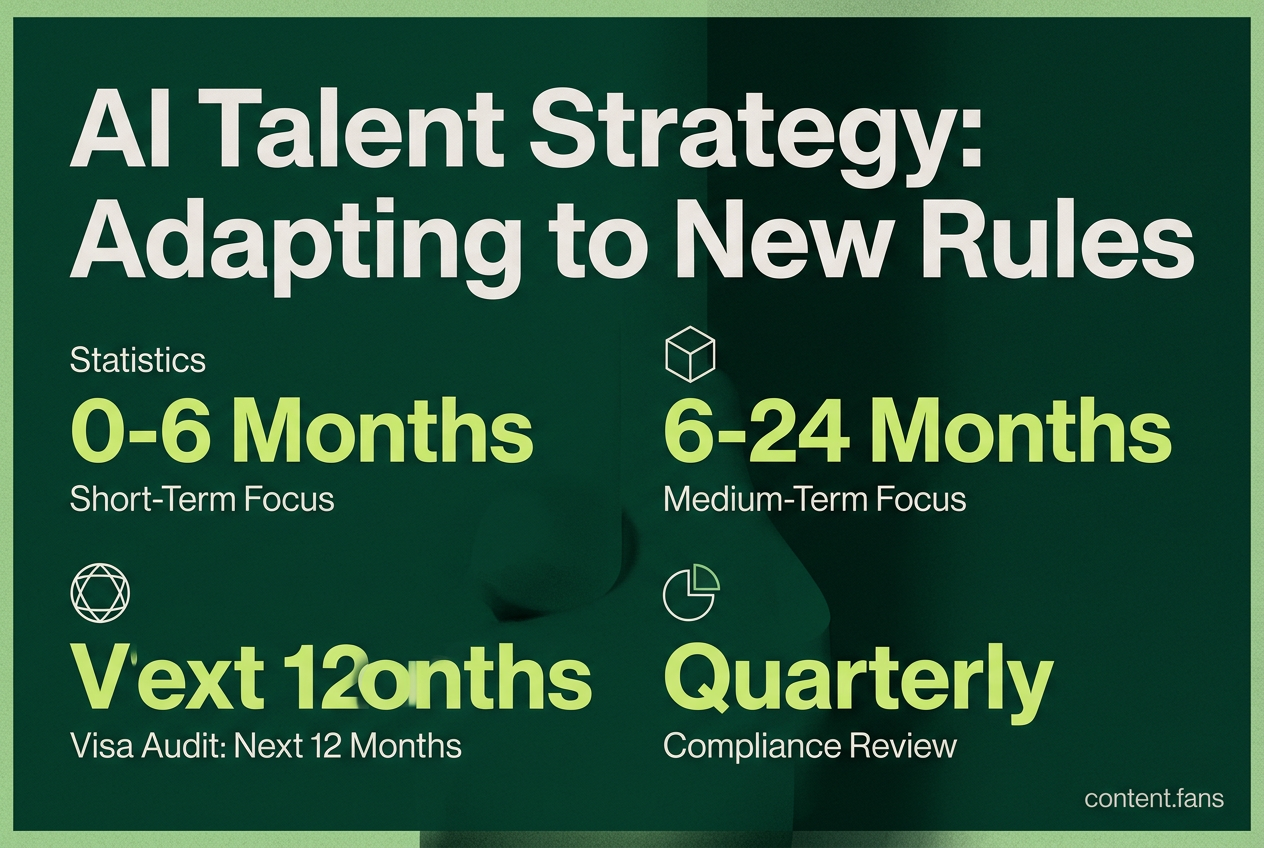
Short-Term Strategy: Immediate Actions (0-6 Months)
To build resilience, AI labs must first gain visibility into their talent pipeline. To maintain momentum, AI labs must immediately assess their workforce's immigration status by auditing visas, identifying roles that can be performed remotely, and segmenting system access. This proactive approach prevents total work stoppage for foreign nationals while ensuring compliance with new, evolving regulations. According to industry reports, leading firms are increasingly embedding immigration planning into enterprise-wide risk strategies and diversifying geographic talent concentration. Practical first steps include:
- Conduct a comprehensive visa expiration audit for the next 12 months.
- Identify roles that can transition to remote or Employer of Record (EoR) contracts to bypass relocation stalls.
- Implement segmented system access to ensure foreign nationals are not universally blocked from essential, non-restricted tools.
- Develop a clear communication template to explain policy changes transparently without over-promising specific outcomes.
Medium-Term Strategy: Building Resilience (6-24 Months)
To mitigate the high compliance costs associated with talent gaps, firms should focus on internal development and strategic diversification. Tech executives are increasingly prioritizing training and job rotation to reduce churn. Suggested actions include:
- Launch on-shore training cohorts to develop a domestic pipeline for critical machine learning engineering skills.
- Formalize university partnerships to guarantee a consistent talent inflow, such as securing internship slots annually.
- Establish a quarterly compliance review with external immigration counsel to proactively update risk maps.
- Build a 'best-shore' delivery model that follows the sun, leveraging global talent to reduce single-country dependency.
A UBS note warns that sustained nationality-based restrictions could make non-U.S. labs more attractive to top researchers, reinforcing the need for geographic diversification.
Long-Term Strategy: Ensuring Future-Proof Operations (24+ Months)
As export-control precedents may expand, long-term strategy requires integrating policy engagement with engineering operations. Resilient firms can:
- Establish a small R&D hub in a jurisdiction with clearer software-export rules to serve as an internal benchmark site.
- Actively track industrial policy incentives that can offset relocation or compliance expenses.
- Maintain a rolling five-year forecast of visa quotas, local graduate output, and potential model-access directives.
Research from MIT Sloan indicates that companies with flexible organizational designs, such as regional hubs instead of a single headquarters, adapt more quickly to shifting mobility rules. This confirms that long-term resilience depends on proactive structural changes rather than reactive hiring freezes.
Ultimately, disciplined documentation is critical across all time horizons. Experts advise tech employers to continuously monitor regulatory changes, train hiring managers, and keep meticulous records to minimize enforcement risk. The recommendations in this playbook align with that principle, aiming to maintain experimental velocity even if future restrictions mirror the Anthropic case.
What exactly happened in the reported Anthropic ban and why does it matter for other AI labs?
Anthropic confirmed in June 2026 that a U.S. export control directive required suspension of access to Fable 5 and Mythos 5 for foreign nationals, leading to broader access suspension.
The order treats model weights as export-controlled software, so a license is now required to share them with non-U.S. persons.
For day-to-day R&D this means:
- Foreign researchers can be blocked from debugging or benchmarking the very models they helped train
- Product roll-outs may stall if teams are split into "access" vs "no-access" silos
- Compliance costs jump: licenses, nationality audits, and segregated infra
How can labs protect R&D velocity in the short term (0-6 months)?
- Route foreign staff to safe work: remote contractors on Employer-of-Record arrangements in Montreal, London, or Bangalore can still fine-tune smaller checkpoints while U.S. staff run the restricted weights
- Expedite visas only for mission-critical hires: map current visa-expiration runway and file cap-gap extensions immediately; premium-processing H-1B approval times vary significantly
- Red-team your access matrix: label every repo, cluster, and notebook with export-control tags so foreign contributors know what they can (and cannot) open before sprint planning
What medium-term moves (6-18 months) reduce dependence on any single labor market?
- Stand up domestic up-skilling pipelines: partner with U.S. universities to run accelerated AI research fellowships; pilot programs have shown promise in developing production-ready engineers
- Automate low-risk workloads: move data-labeling, unit-test generation, and small-model distillation to best-shore hubs in various global locations
- Build compliance documentation into every JIRA ticket: evidence of recruitment efforts, prevailing-wage checks, and model-access logs; this keeps you audit-ready if rules broaden beyond Anthropic
Which long-term strategies (18 months+) insulate a lab from future nationality bans?
- Geographically diversify core R&D: according to industry reports, a significant portion of tech employers are feeling geopolitical impact; leading firms are establishing mirror labs in the EU or UAE so a single policy change cannot freeze all work
- Treat immigration as enterprise risk, not an HR afterthought: leading companies embed geopolitical monitoring and scenario-planning into board-level OKRs
- Engage policymakers early: Anthropic-style bans spread fastest when industry has no unified voice on balanced controls that preserve both security and innovation
Where can I download ready-to-use templates mentioned in the playbook?
- Risk-audit checklist: maps every foreign-national employee against model-access levels, visa expiry, and green-card stage
- Immigration timeline calculator: auto-emails stakeholders at key intervals before visa sunset dates
Both templates, plus a sample remote-hiring SOP, are available in the full Talent Resilience Playbook linked here:
Immigration, Talent, and Business Resilience in 2026 - WERC