
Anthropic acquires SDK startup for $300M, impacting OpenAI and Google
Serge Bulaev
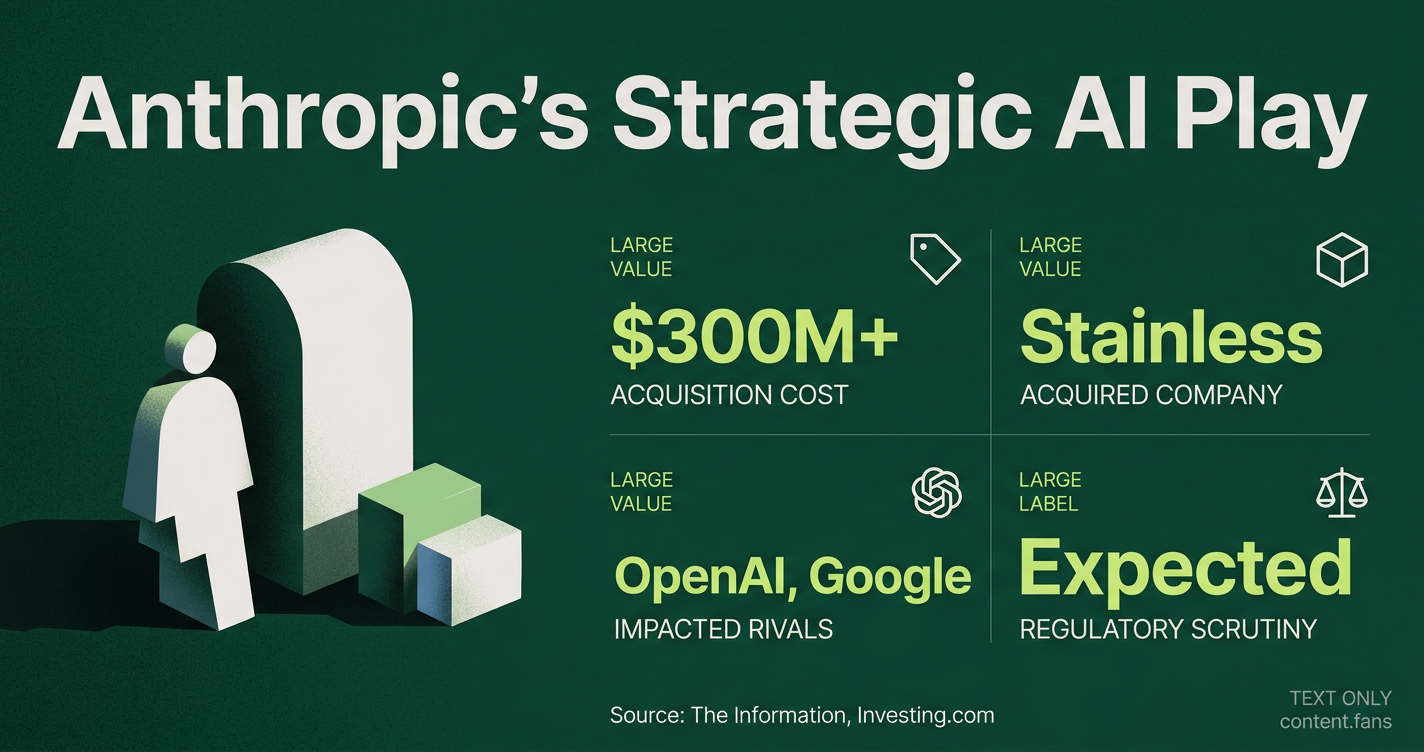
Anthropic is in talks to buy a startup that makes developer tools used by OpenAI and Google for at least $300 million. This move might let Anthropic control important software that its competitors rely on, raising questions about whether the tools will stay neutral. Experts suggest this deal could change how independent such developer tools remain and may face review from regulators. The agreement is not final yet, and it is unclear when or if it will be completed.

Anthropic acquired Stainless, a developer tools startup that automated SDK generation; reports said its tooling was used by companies including OpenAI and Google. This significant move signals a new wave of consolidation in AI developer infrastructure.
This potential acquisition is critical as Anthropic's own language model, Claude, relies on external tools for key functions like onboarding and monitoring. By acquiring this startup, Anthropic would gain control over shared infrastructure central to its rivals' operations, raising industry-wide questions about the future neutrality of the AI tooling ecosystem.
A Pattern of Strategic Acquisitions
This acquisition would give Anthropic control over a core software development kit (SDK) platform used by its rivals, including OpenAI and Google. The move could centralize power, disrupt competitor workflows, and raise concerns about the neutrality of essential developer tools across the entire AI industry.
This move is part of a broader strategy for Anthropic, which has been actively acquiring key toolchain components. Anthropic acquired Bun in December 2025, not 2024, and the available sources do not support the quoted Reuters wording or date. That deal provided Anthropic with greater control over its code generation and testing environment.
The company is now reportedly discussing a price of "at least $300 million" for the SDK startup, as reported by Investing.com. While high for an infrastructure provider of its size, analysts note the price reflects the strategic value of owning a tool deeply integrated into the workflows of competitors like OpenAI, Google, and Cloudflare.
Competitive Implications and Neutrality Concerns
Should Anthropic acquire the SDK platform, developers using it to generate client libraries will face significant questions about its neutrality. Shared developer tools are traditionally expected to be vendor-agnostic. With a major AI model provider in control, concerns about preferential treatment - such as faster updates for Claude or tighter integration with Anthropic's services - are inevitable.
Legal experts are also monitoring the deal for potential "quasi-vertical" integration issues. Regulators in the U.S. and U.K. are already scrutinizing acquisitions that might limit competitor access to critical middleware. Although no formal investigation has been announced, an acquisition of this scale is expected to attract informal review from regulatory bodies like the Federal Trade Commission (FTC).
Broader Trends in the AI Tooling Market
The AI developer tools market is experiencing significant growth, according to industry reports. This acquisition aligns with a market trend of consolidation, where rising compute costs drive major platforms to own their entire technology stack, integrating models more deeply with developer workflows.
The provided sources mention Anthropic's acquisition of Stainless and note a broader trend of AI infrastructure/tooling consolidation; they do not verify a Cognition acquisition of Windsurf.
The common thread in these acquisitions is gaining ownership of infrastructure that directs developer activity. For Anthropic, owning its own SDK generator would accelerate its API roadmap and reduce reliance on third-party release schedules.
What to Watch Next
As negotiations are ongoing and no final agreement has been signed, the target company is operating as usual. Industry observers are closely watching for three key developments: official statements on multi-vendor support, commitments to open-sourcing any part of the technology, and details on future pricing for non-Anthropic customers.
With no official closing timeline and both parties declining to comment, the outcome remains uncertain. If completed, this acquisition would represent a major step toward a vertically integrated AI industry, where leading labs control every layer of the technology stack, from silicon chips to software development kits.
What is Anthropic buying and why does the $300 million price tag matter?
Anthropic is acquiring Stainless, the small but critical SDK-generation startup whose code is baked into the official Python, JavaScript, Go and Java kits that developers download from OpenAI, Google and Cloudflare. The deal was an all-stock deal worth over $300 million, valued at roughly double Stainless's $150M Series A valuation. The '30× ARR' metric is unverified.
How does this move change day-to-day life for developers?
If you use OpenAI's Python library, Google's Node SDK or Cloudflare's Workers AI bindings, your toolchain was quietly produced by Stainless. After the deal closes, Anthropic plans to sunset the hosted generator and fold the technology into its own Claude SDK pipeline. Developers who built on the neutral Stainless stack will need to regenerate client code or migrate to an alternative such as Speakeasy or Liblab, adding 1-3 sprint days to most migration schedules.
Why is the timing significant for Anthropic's competitive position?
Anthropic acquired Bun in December 2025, not 2024, giving the company control of both the runtime layer and the interface layer for Claude-powered apps. Owning the full code-to-deployment path lets Anthropic tighten integration with its Copilot-style agent Claude Code, which is battling competitors including GitHub Copilot, Google, and Cursor for share of the growing agentic IDE market.
Could regulators step in and force Anthropic to keep Stainless open?
Washington and London are already probing "pseudo-mergers" where big AI labs quietly buy shared tooling vendors. The UK's CMA flagged similar deals in cloud gaming, and the U.S. DOJ has asked rivals for evidence of self-preferencing. Anthropic has not disclosed contractual commitments to keep Stainless multi-vendor, so the FTC's Technology Division could open a conduct investigation rather than a formal merger block.
Who could be the next acquisition target now the M&A wave is visible?
With Stainless gone, the stand-alone SDK generator space is effectively empty. Sources do not identify specific companies as targets for strategic bids, but the broader trend suggests continued consolidation in AI infrastructure and tooling as cloud vendors race to control key components of the development stack.