
Anduril Raises $5B at $61B Valuation, Doubles Worth
Serge Bulaev
Anduril has raised $5 billion in new funding at a $61 billion valuation, doubling its worth from the previous year. This new money may show that big investors see a chance for companies that can deliver autonomous defense systems quickly. The company recently won large contracts with the U.S. Army and Air Force, which could bring in billions over several years. Anduril's sales and investments are growing, but reaching its target revenue may depend on how well it can deliver products and manage large government contracts.

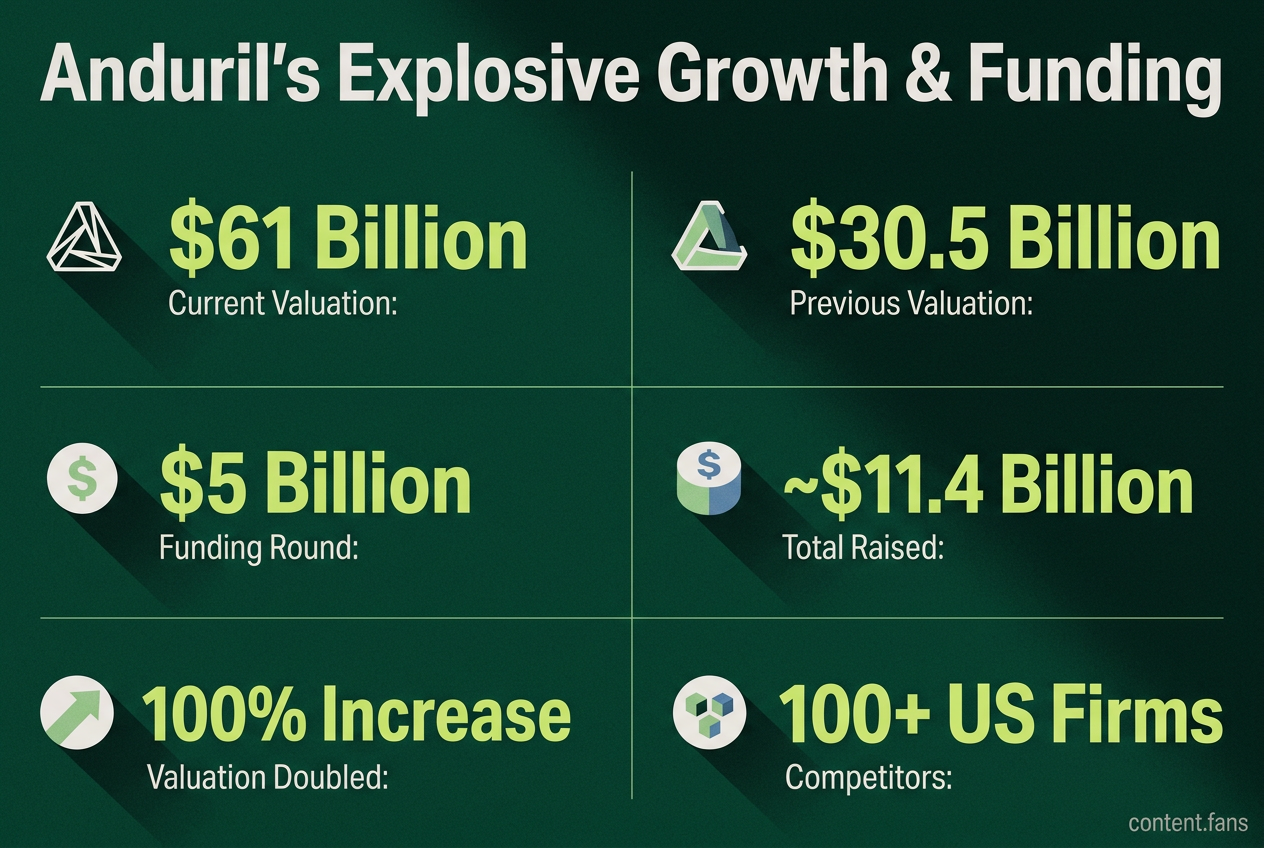
Defense technology firm Anduril has raised a landmark $5 billion Series H funding round, reaching a $61 billion valuation that doubles from its $30.5B valuation in June 2025. Co-led by Thrive Capital and Andreessen Horowitz, this infusion brings Anduril's total raised to ~$11.4B per Crunchbase, reflecting investor confidence in its ability to rapidly secure long-term Pentagon contracts for autonomous systems.
Rapid contract wins underpin the valuation
Anduril's soaring valuation is backed by a series of major government contract wins. According to industry reports, the company has secured significant U.S. Army enterprise agreements, consolidating many previous purchases of its Lattice command-and-control platform. Initial task orders under these agreements reportedly provide tactical C2 layers for counter-drone operations.
The company also won a significant contract with the U.S. Air Force, securing a spot on the Andromeda program for providing space domain awareness tools, among other awardees noted by GovCon Wire. Other key wins include substantial SBIR Phase III contracts and multi-year Marine Air Defense Integrated System deals.
Anduril secured $5 billion in a Series H funding round, bringing its total valuation to $61 billion - double its previous worth. The round, co-led by Thrive Capital and Andreessen Horowitz, significantly increases the company's total capital raised to date for scaling autonomous defense systems.
Where the money is going
With revenues reportedly growing substantially and ambitious growth targets, Anduril is channeling the new capital into expanding production and software development. The Series H funding will directly support:
- Manufacturing Scale: Scaling operations at its massive Ohio-based plant for drones and interceptors.
- Product Development: Expanding test ranges for its reusable Roadrunner-M drones.
- Software Enhancement: Accelerating updates to the Lattice software platform, which integrates sensor data to create a common operating picture for air domain awareness.
Competitive context
In a crowded field of over 100 U.S. competitors, Anduril is carving out a significant niche. While startups like Shield AI and Skydio focus on air autonomy and legacy primes like Lockheed Martin and RTX dominate traditional aviation, Anduril's strategic advantage is its speed and software-first approach. This is evidenced by its success in securing sole-source and limited-bid contracts. Anduril won a $642 million counter-drone contract from the Marine Corps in a competitive process with 10 total proposals received.
Capital flows into defense tech
Anduril's funding round is part of a broader surge in venture capital for the defense technology sector. According to industry reports, total investment in defense tech has increased dramatically in recent years. This trend is driven by the proven effectiveness of dual-use AI and autonomous systems in recent global conflicts, coupled with a strategic push from the Pentagon, such as its Replicator initiative, to rapidly field new technologies.
Outlook items to watch
Looking ahead, Anduril's long-term contracts provide significant revenue visibility according to industry analysts. However, the company's primary challenge will be to scale production and deliver on its promises to justify its high valuation. Key performance indicators for investors will include the volume of task orders awarded under its major contracts, progress on the Andromeda space program, and the successful integration of its technology in programs like Soldier-Borne Mission Command.