
American Express Unveils AI Payments with ACE Developer Kit
Serge Bulaev
American Express has introduced the ACE Developer Kit, which aims to let AI agents make payments using intent contracts and single-use tokens. This system may give American Express more control and could help prevent mistakes or fraud in AI-led purchases. Three parts of the kit - Account Enablement, Intent Intelligence, and Payment Credentials - are already available, while others are still being developed. Regulators and competitors appear to be watching closely, as this new way of handling AI payments might shape future industry standards. The company suggests that more features and updates are expected in 2026, but the program is still early in its rollout.

American Express is pioneering AI-driven commerce with its new Agentic Commerce Experiences (ACE) Developer Kit. According to industry reports, this framework allows autonomous AI agents to make secure, controlled payments, potentially setting a new standard for AI transactions and fraud prevention.
How Intent Contracts and Single-Use Tokens Enable Secure AI Payments
The system uses intent contracts to define a user's purchasing rules, such as price limits and time windows. An AI agent then requests a single-use token tied to these constraints. This tokenized credential allows the agent to complete the transaction only if it adheres to the pre-approved intent.
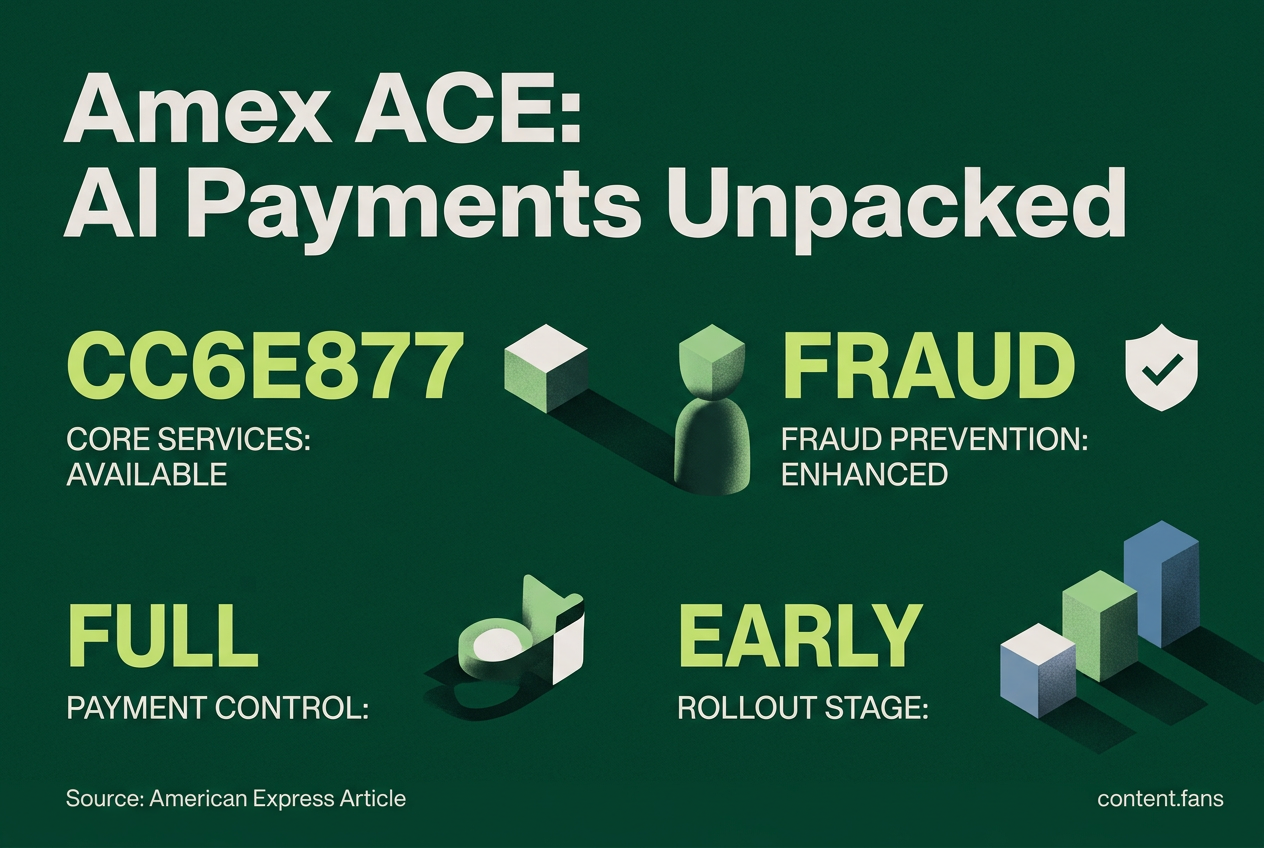
Intent contracts translate a shopper's goal - including limits and time windows - into a structured message. When an AI agent finds a product matching these rules, it requests a single-use payment token tied to the same constraints. The system can deny transactions in real-time if the agent deviates from the contract, such as by exceeding a price cap. Luke Gebb, Amex's EVP of Global Innovation, told VentureBeat the closed-loop design provides "full transaction control in the payment layer." This arrangement, as noted in a VentureBeat report, may offer card members superior error protection and accountability compared to traditional e-commerce.
ACE Developer Kit: What's Available and What's in Development
American Express is releasing the ACE services in multiple modules. According to industry reports, several core services are available while others remain in development as part of the company's ongoing priorities to embed payment capabilities into external AI ecosystems and ship proprietary AI experiences.
Industry Impact and Competitive Landscape
The ACE model is drawing attention from regulators and competitors. Recent reports highlight growing interest in similar AI tools for real-time fraud prevention. While the black-box nature of some AI models presents audit challenges, the demand for verifiable intent signals is growing. American Express's approach could establish a key reference architecture for aligning autonomous agents with human intent, an outcome that competitors and standard setters are already evaluating.
What's Next for Amex's AI Payment System?
While the ACE Developer Kit is production-ready for internal partners, a broader rollout is still on the horizon. Company executives have indicated that the program is still in early stages, with more AI products expected throughout the year. Observers are now watching for key milestones including the public release of the Agent Registration specification and the first demos of Cart Context reconciliation.
What is the ACE Developer Kit and when did it launch?
The Agentic Commerce Experiences (ACE) Developer Kit is a framework that lets software agents move money on an American Express-issued Card while staying inside strict guardrails.
- Recently announced according to industry reports
- Multiple micro-services are being rolled out in phases, with some core services available to partners while others are still being finalized
- ACE operates on Amex's closed-loop network with end-to-end visibility, but real-time reversal capability is not documented in provided sources
How does an intent contract keep an AI agent from overspending?
Before the agent can even request a credential, the cardholder's wish list is hashed into an intent contract that contains:
- Approved spend ceiling (for example, "red running shoes ≤ $200")
- Merchant category lock ("sporting-goods stores only")
- Time-to-live (often minutes, not hours)
Amex issues a unique Intent ID plus Proof-of-Intent Token that travels with every message. If the agent tries to check out with $250 trail boots, the network layer rejects the authorisation and the token self-voids.
What role does the single-use token play?
Think of it as a one-time gift card minted for that exact purchase.
- Lives only a few minutes and dies after first approval, so a replay attack yields nothing.
- Carries the intent constraints in its metadata, making real-time denial possible if the merchant, amount, or currency drifts.
- Because the real PAN (primary account number) is never exposed, a leak in the merchant's log cannot be laundered elsewhere.
Is any of this production-ready for merchants or fintech builders today?
Partially.
- SDK specs for account linking, intent creation, and token issuance are available on the Amex portal according to industry reports.
- Agent Registration and other components are still in development phases.
- Company executives have indicated they are in early stages of agentic commerce development, signaling wider rollout plans but no mass-market date yet.
Why do payment experts think Amex's model could shape industry standards?
- Dual-layer control - semantic intent plus cryptographic token - is being discussed inside industry working groups.
- Visa (Intelligent Commerce Connect) and Mastercard (Agent Pay Suite) announced rival toolkits weeks after ACE, so Amex's design choices now compete to become the reference architecture.
- Recent smart-contract failures have caused significant losses in DeFi; regulators increasingly ask for "ethical reversibility," a capability that Amex is building with intent tokens.