
Amazon Expands Trainium Chip Production, Challenges Nvidia's AI Dominance
Serge Bulaev
Amazon, Google, and Meta are now competing over the underlying parts of AI, like special chips, data control, and devices, rather than just the AI models. Amazon is increasing the use of its Trainium chips as an alternative to Nvidia, but overall adoption beyond key partners like Anthropic may still be limited. OpenAI and Anthropic together seem to make up most of the revenue among AI startups, showing a clear lead over others. Other companies like Apple, Meta, and Google are trying new ways to run AI directly on devices, but details are limited. The future of AI competition may depend on who controls the chips, data, and where AI runs, not just the models themselves.

The battle for AI dominance is shifting from models to infrastructure, where control over custom AI chips, data, and on-device computing is paramount. As tech giants like Amazon, Google, and Meta vie for control, Amazon's Trainium chip production is expanding to challenge Nvidia's market leadership, highlighting a new competitive front.
To understand the current market, it's essential to track who controls the core components that power AI agents: the specialized accelerators in data centers, the governed data repositories, and the on-device hardware like smartphones and headsets that run smaller, efficient models.
Custom silicon becomes a bargaining chip
Amid the scarcity of Nvidia GPUs, Amazon is accelerating the production of its home-grown Trainium chip line. By offering a cost-effective alternative tightly integrated with AWS, Amazon aims to capture a significant share of the AI training market, particularly for workloads from partners like Anthropic.
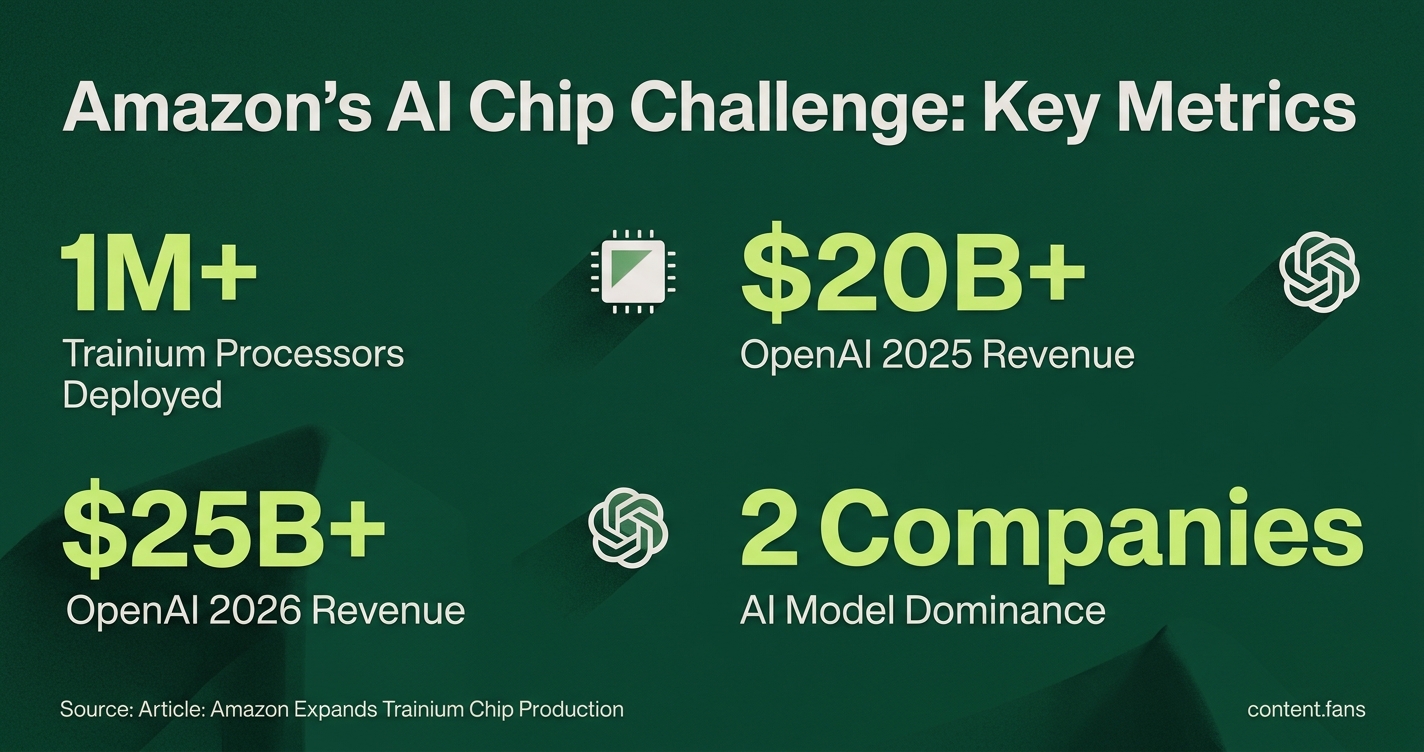
With Nvidia GPUs in short supply, Amazon is capitalizing on the demand with its proprietary Trainium chips. AWS says it has deployed more than 1 million Trainium processors overall for partners and internal use, including training Anthropic's Claude model, according to AWS Trainium customers. However, analysts note that broad adoption beyond key partners remains limited, indicating that while developer interest is growing, it is not yet widespread.
Industry reports suggest growing shipment expectations for Amazon's silicon as a viable and cost-effective alternative to Nvidia, especially for workloads deeply integrated with AWS.
Data governance turns into product strategy
This infrastructure-level control can create platform lock-in. For instance, as enterprises adopt Microsoft's Fabric semantic models and OneLake storage, AI-driven experiences improve. This delivers faster natural-language analytics and automated DAX generation but also increases dependency on Microsoft's ecosystem and its specific governance controls.
Revenue gravity favors two model vendors
The economics of AI startups reflect this battle for infrastructure control. Industry reports indicate that OpenAI and Anthropic dominate the market, with both companies showing significant revenue growth among leading AI startups. OpenAI was reported at over $20B annualized revenue in 2025 and over $25B annualized revenue by late February 2026. Although figures vary, all analyses point to a two-company race for market leadership.
- OpenAI: Dominates with a large consumer base through ChatGPT and holds higher absolute revenue in most recent projections.
- Anthropic: Shows rapid growth in the enterprise sector, leverages Amazon's Trainium chips extensively, and maintains a close alignment with AWS.
Despite the existence of other well-funded AI labs, their combined revenue share is minimal compared to the two frontrunners. This disparity underscores how control over fundamental compute and data infrastructure directly translates into commercial dominance.
On-device experiments quietly expand
Beyond the data center, companies like Apple, Meta, and Google are exploring various on-device AI strategies. These include model compression for Apple's Neural Engine and lightweight inference on Google's Pixel Tensor chips. Though public details are limited, these initiatives are seen as a strategic hedge against high bandwidth costs and growing privacy concerns.
Ultimately, the combination of custom silicon development, strategic data governance, and concentrated revenue streams clearly indicates that the future of AI will be decided not by models alone, but by control over the underlying infrastructure.
Who is actually using Amazon's Trainium chips today?
Amazon reports more than 1 million Trainium processors deployed overall for training and serving Claude, according to (Yahoo Finance). All publicly disclosed large-scale users are AWS partners or internal workloads, with Anthropic as the flagship external customer. While AWS cites significant cost reductions and an easy developer experience, analysts note that very few other major customers have been announced, making broad market penetration still uncertain.
How does Trainium compare to Nvidia GPUs on price and developer adoption?
According to industry reports, Trainium offers substantial cost advantages for large-model training versus comparable Nvidia GPU fleets. AWS is also courting the developer community through Build on Trainium grants and a growing library of reference implementations. Yet CUDA mindshare remains strong, and the ecosystem breadth still trails Nvidia. In short, Trainium wins on cost and AWS-native convenience, while Nvidia retains the wider skill-base and tooling.
What is Microsoft doing with Power BI that could lock in AI agent access?
Microsoft is turning Power BI into the privileged data gateway for Copilot-powered AI agents. According to industry reports, key moves include:
- Enhanced Copilot experiences that require tenant-level enablement and appropriate licensing.
- New model approval processes for Copilot integration; only approved semantic models surface in agent queries, steering governance onto Microsoft-controlled schemas.
- Evolution of legacy Q&A features toward the Copilot stack.
The net effect: the more enterprise data you expose through Power BI and Fabric, the more AI value you unlock - but the harder it becomes to move to any other platform.
Do Anthropic and OpenAI really dominate AI startup revenue?
OpenAI was reported at over $20B annualized revenue in 2025 and over $25B annualized revenue by late February 2026. While exact figures for other companies differ by source, the pattern is consistent: the leading AI labs have pulled far ahead of the next tier, creating a clear competitive race for AI startup revenue.
When will Trainium reach mass-market availability beyond AWS and Anthropic?
AWS is expanding Trainium production, with industry reports suggesting significant growth in shipments. However, public customer roll-outs beyond Anthropic have been sparse, suggesting mass-market availability will likely trail production by several quarters. Enterprises eyeing Trainium should expect broader third-party support to develop over time.