
Amazon builds $10B data center in Missouri, creating 400 jobs
Serge Bulaev
Amazon plans to build a $10 billion, 17-building data center in Montgomery County, Missouri, which may bring about 400 permanent jobs and thousands of construction jobs. Officials say the campus covers about 1,000 acres and could generate hundreds of millions of dollars in property-tax revenue over 25 years. Amazon has agreed to pay for all needed electric and water infrastructure, and the company might help fund local community projects. Analysts suggest that this move appears to fit a larger trend of tech companies expanding in the Midwest for lower costs and more space. There may still be questions about long-term energy needs, as Missouri is studying how to support large data centers like this one.
Amazon is investing $10 billion to build a massive data center campus in Missouri, a landmark project set to reshape the tech economy of Montgomery County. The company has confirmed plans for a 17-building complex on a 1,000-acre site. Governor Mike Kehoe stated the move would bring "new opportunities for Montgomery County and the surrounding region," according to a MissouriNet report. The campus will be located north of Interstate 70 and is eligible for performance-based tax incentives valued at over $244 million.
Job Creation and Economic Impact
The new Amazon data center is projected to create approximately 400 permanent operational jobs once fully online, along with thousands of construction and trade jobs during its multi-year development. According to Yahoo Finance, the project is also expected to generate hundreds of millions of dollars in new property-tax revenue for Montgomery County over the next 25 years.
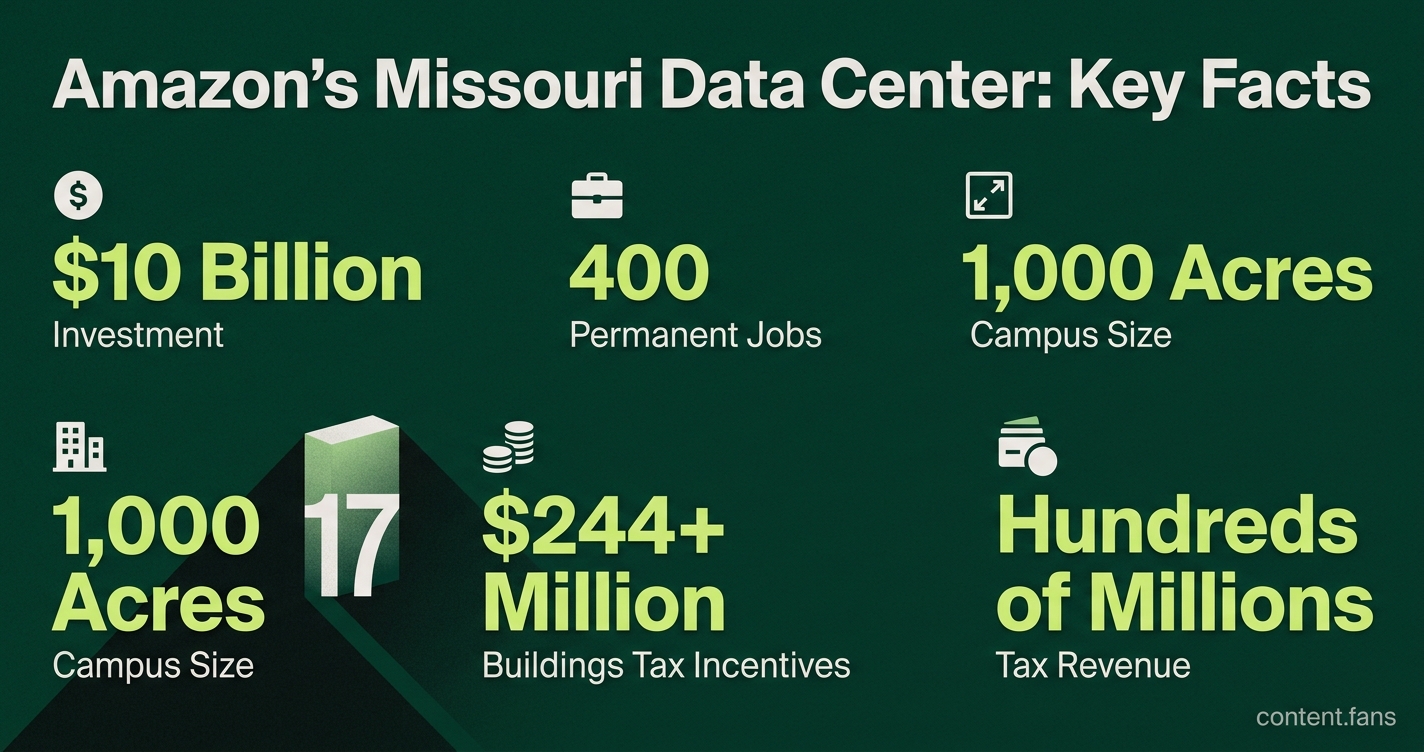
The new Amazon data center in Montgomery County is expected to have a significant economic impact by creating 400 permanent roles and thousands of temporary construction jobs. The $10 billion investment is also projected to generate hundreds of millions in property tax revenue for local community improvements.
Amazon's Commitment to Infrastructure and Utilities
As part of the agreement, Amazon will fund a significant portion of the necessary utility extensions. This includes electric service upgrades, with no special rate discounts applied. The company will also build and then transfer new water infrastructure to the local district. Amazon aims to implement water efficiency measures as part of its global commitment to being water positive by 2030.
Key community payments outlined in county documents include substantial contributions for emergency services upgrades and broader community contributions, such as fairgrounds gathering space and local programs.
Why Missouri? The Midwest's Rise as a Data Center Hub
Amazon's decision reflects a broader industry trend of hyperscale cloud providers expanding into the American Midwest. Seeking lower costs, ample space, and reliable power grids, tech giants are moving away from saturated coastal markets. Analysts note that states like Missouri are capturing a growing share of U.S. data center development, driven by the intense power demands of AI and the availability of land and flexible permitting.
Tax Revenue and Long-Term Energy Planning
Montgomery County officials anticipate hundreds of millions in additional property-tax revenue over 25 years, which could support schools and emergency services without raising local taxes. Leaders have also stressed that Amazon is responsible for grid-connection costs, protecting existing utility customers from rate increases related to the project.
Meanwhile, the state is proactively addressing long-term energy needs. The Missouri Department of Natural Resources is conducting a study to guide how the state will accommodate large-scale data center loads from Amazon and future hyperscale projects.
What will the Amazon data center bring to Missouri's economy?
Amazon has committed $10 billion to build a multi-building campus in Montgomery County, Missouri. State officials expect the investment to generate 400 permanent cloud and operations jobs and thousands of construction and trade positions during the multi-year build-out. Over the next 25 years, county leaders project hundreds of millions of dollars in new property-tax revenue, plus Amazon has pledged significant community contributions for emergency services, public spaces and local programs.
Where exactly is the campus being built?
The site sits on roughly 1,000 acres north of Interstate 70 between the towns of New Florence and High Hill, about an hour west of St. Louis. The rural location gives Amazon ready access to land, power and water while still serving Midwest customers with low-latency connectivity.
Why did Amazon pick Missouri over other states?
Power availability and cost were decisive. Missouri can deliver the large, contiguous blocks of electricity that hyperscalers need for AI workloads, while land and permitting timelines remain more favorable than in saturated coastal markets. The state's willingness to approve up to $1 billion in personal-property tax incentives through Chapter 100 bonds also lowered Amazon's 25-year total cost of ownership, making the deal competitive with offers from Ohio and Texas.
What infrastructure upgrades will Amazon fund?
Amazon has agreed to cover a substantial portion of utility-extension costs, including:
- New transmission lines and substations to ensure dedicated, redundant power
- Water infrastructure that the company will build and then transfer to the local water district, with Amazon implementing water efficiency measures
- Road improvements and emergency services upgrades, reducing burden from existing ratepayers or county budgets.
How does this fit the broader hyperscaler trend?
Missouri is now squarely on the inland hyperscaler map. Research group JLL finds that more than 64 percent of the 35 GW of new U.S. capacity under construction is moving to emerging markets such as the Midwest and Texas. Pew data show three-quarters of newly planned U.S. data centers will be built in the South and Midwest, driven by AI's appetite for high-density racks and reliable power. Amazon's $10 billion campus represents a major commitment in that shift.